

Akanksha closed her laptop at 1:47 a.m. and cried in the kitchen because she could not remember if she had eaten dinner. She is 29, leads a product team in Gurgaon, and has not taken a full weekend off in eleven months. Her story is not rare. What appears personal at the surface is increasingly systemic underneath. Employee burnout in India has crossed the threshold from concern to crisis. 59% of Indian employees now report burnout symptoms, three times the global average.
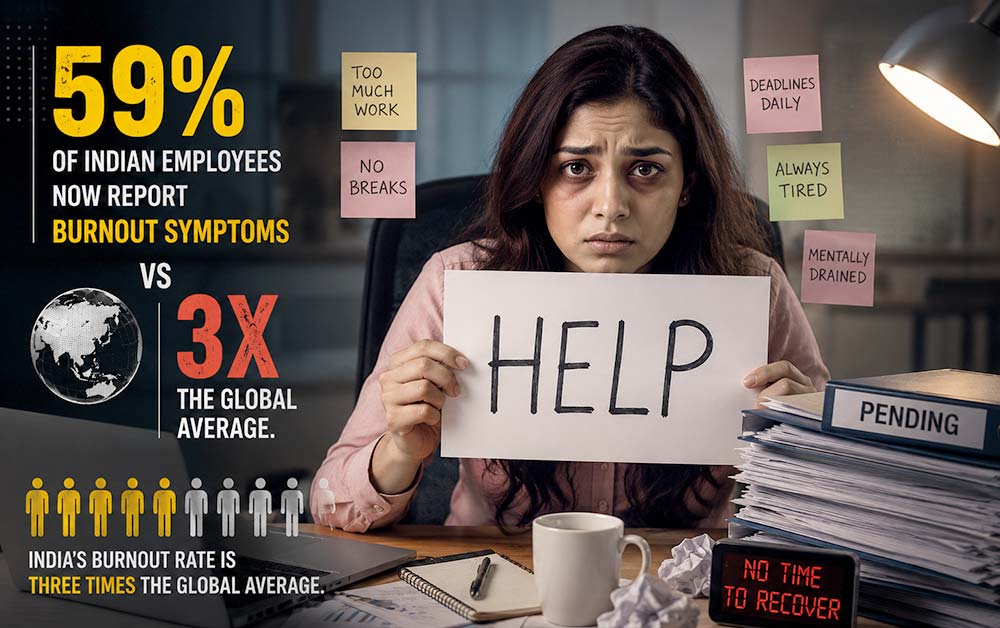
This is not a wellness problem. It is an architectural failure. In the absence of structural discipline, the pressure quietly shifts onto the workforce. Burnout becomes the visible symptom of a structural breakdown happening upstream.
My lens on employee burnout is rooted in operational clarity, not motivational theory. Across 32 years of building communication architecture and coaching busy professionals, one pattern repeats: burnout follows decision latency, not effort.
This article decodes burnout statistics India, identifies the causes of burnout at workplace, maps the signs of employee burnout, and outlines what preventing employee burnout requires from leadership. This is no longer only a workplace mental health conversation. It is a governance conversation about how modern work is being designed.
Also Read:
- Gen Z’s Bhajan Jamming Club: The New Face of Spirituality in India
- Web Offset Printing and the New Economics of Expansion
Burnout Statistics India — What the Data Reveals
The numbers describe a workforce running on cognitive overdraft. Like a phone left on charge with the screen still active, India’s professionals are plugged in but draining faster than they refill. Credible data sources converge on one verdict — India leads the world on burnout indicators, and the gap is widening.

The Headline Numbers Across Verified Reports
The data is not subtle. Four independent sources, four different methodologies, one converging signal — Indian employees are burning out faster than any major workforce in the world.
- McKinsey Health Institute, 2023: 59% of Indian employees1 report burnout symptoms, against a global average closer to 20%.
- FICCI-BCG, September 2024: 58% reporting burnout — ten percentage points above the global benchmark of 48%.
- Gallup State of the Global Workplace, 2024: Only 14% of Indian employees describe themselves as thriving, compared to 34% globally — the sharpest engagement gap on the report.
- Blind survey, March 2025: 83% of Indian IT professionals report burnout symptoms, with one in four clocking 70 hours or more every week.
Numbers in this range stop being statistics. They become weather patterns. When three out of five professionals in any country report the same operational stress signature, the pattern is no longer individual. It is climatic.
Sector-Level Concentration
Burnout in India concentrates in sectors where output is visible, but the emotional and cognitive load behind it remains invisible. IT carries the heaviest load, extended hours, always-on availability across global time zones, productivity targets calibrated for software rather than humans. A Bengaluru engineer rolling out of a 2 a.m. release call and into a 9 a.m. sprint review is operating on the same recovery margin as a marathon runner asked to start a second race before drinking water.
Finance and consulting trail closely behind, driven by client cycles that respect neither weekends nor calendars. Healthcare carries a different kind of weight, emotional exhaustion at work compounded by life-and-death decisions. Marketing teams burn out from creative load running parallel to performance pressure. Across all four, one common thread runs through the data, the workload is not the problem. The absence of recovery architecture is.
Numbers signal architectural failure, not workforce fragility. The question stops being whether burnout is real. It becomes what governance shift the data demands.
Causes of Burnout at Workplace: Why India Burns Out Faster
Burnout in India is not caused by hard work. It is caused by hard work without structure2. The problem is not a workforce running uphill. It is a workforce running uphill without clarity while the finish line keeps moving. Multiple forces inside Indian corporate work culture push employees from sustained effort into chronic workplace stress. Much of this pressure is reinforced by the toxic hustle culture India has increasingly normalised across startup and corporate ecosystems.
Toxic Hustle Culture and the 70-Hour Work Week
Hustle culture in India has been dressed up as ambition for so long that no one notices it is wearing the same tired shirt every day. The cost shows up in calendars that no human can sustain — and in a generation of professionals who confuse exhaustion with achievement.
- Cultural valorisation of overwork: Public calls for 70–90 hour weeks turned work-life imbalance India from a problem into a personality trait.
- Productivity targets without architecture: Goals get set faster than the systems built to support them. The gap is paid for in sleep and weekends.
- Founder culture as performance theatre: When the boss is online at midnight, the team learns the dress code is exhaustion.
Erosion of the Right to Disconnect at Workplace
The right to disconnect at workplace is not yet a policy conversation in most Indian companies. It is a private negotiation each employee has with their own phone, usually losing.
- Always-on availability: WhatsApp groups active past midnight. Weekend calls treated as urgent. Holidays answered on mute.
- Hybrid work without boundaries: The office moved home. The off-switch did not come with it.
- Escalation ambiguity: When everything escalates, nothing is prioritised. Cognitive bandwidth runs out before lunch.
The causes of burnout at workplace are operational, not personal. Naming them correctly is the first step toward structural correction.
Signs of Employee Burnout : What Leaders Must Recognise Early
Signs of employee burnout appear in operational drift long before they show emotional collapse. The earliest signals are missed because they are read as performance issues, not structural symptoms. A leader who fixes the symptom and ignores the source is rearranging deck chairs.
Cognitive, Behavioural, and Physical Markers
The first markers are cognitive. Decisions that used to take a day take a week. A senior manager forwards an email three times because she cannot remember if she answered it. Errors creep into work that was once flawless. Meetings drag because nobody wants to be the one to commit.
Behavioural drift follows. The team Slack goes quiet. The marketing lead who used to push back on briefs starts saying yes to everything and delivering late on most of it. Cynicism replaces curiosity. Phrases like “anyway, what does it matter” become routine.
Then the body starts filing its own complaints. Sleep breaks first. Headaches arrive without warning. Immunity weakens — the same person catches every flu doing the rounds in the office. Chronic workplace stress writes itself into the skin, the gut, the spine. The body documents what the workforce will not speak.
Why High Performers Often Ignore Early Burnout Symptoms
High performers hide burnout because the culture rewards endurance. Recognition depends on output, not honesty. By the time symptoms surface publicly, the structural cost is already compounded — and the company has usually lost the person privately, weeks before they hand in notice.
Leaders who read these signs early avoid the cost of replacement. Those who miss them pay through attrition, productivity collapse, and reputational drift.
Cost of Employee Burnout: The Business Case for Action
In many organisations, employee burnout at workplace now affects operational continuity as much as employee wellbeing. The financial, operational, and reputational impact of unaddressed burnout shows up in three measurable dimensions — and unlike most line items, it grows quietly until it becomes the only thing anyone is talking about.
Productivity and Attrition Cost
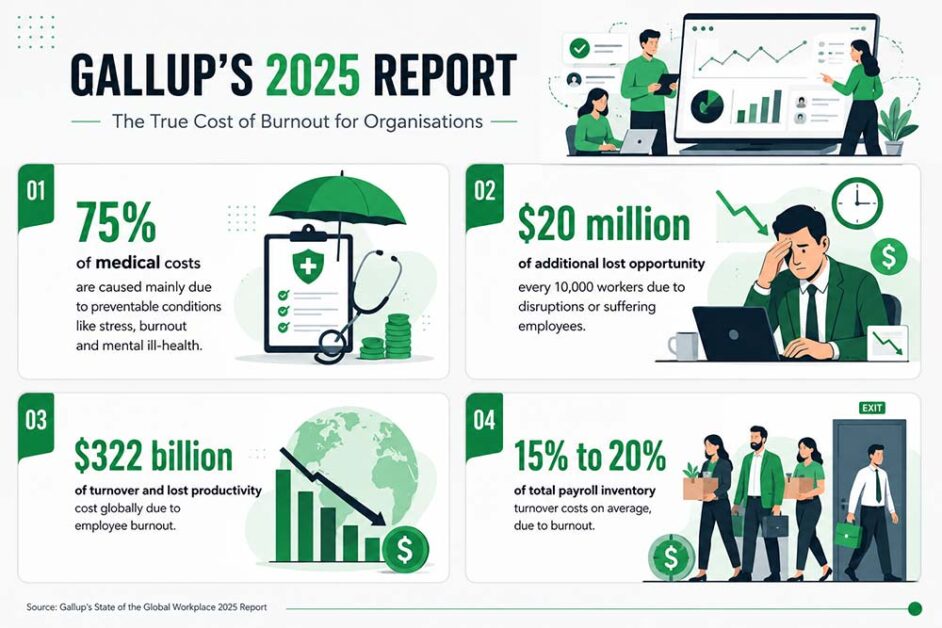
The cost of employee burnout is no longer theoretical. Gallup’s 2025 report estimates burnout drains the global economy of $322 billion annually through lost productivity and turnover. India contributes disproportionately to that figure. Half of Indian employees, according to the same data, are actively scanning the exit. Not browsing. Scanning — the resume is updated, the LinkedIn is polished, the conversations have begun.
A senior employee earning ₹25 lakh annually can cost an organisation ₹40–50 lakh to replace once hiring expense, onboarding time, lost productivity, transition delay, and client disruption are factored in. Burnout rarely exits alone. It often takes institutional knowledge and execution continuity with it.
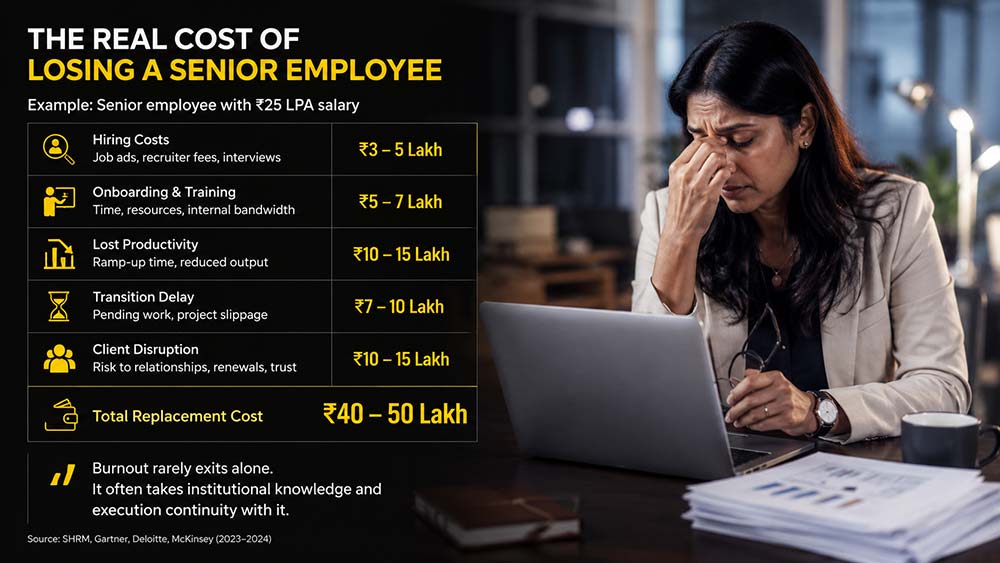
The replacement maths is brutal. Backfilling a mid-senior role costs 1.5 to 2 times the annual salary once recruitment fees, lost ramp-up time, and team disruption are accounted for. A company that loses six leaders in a quarter has paid for twelve. And the ones who stay carry the absorbed workload — which feeds the next wave of attrition. It is not a leak. It is a loop.
Decision Quality and Reputational Cost
A burnt-out workforce makes slower decisions, and slower decisions make weaker companies. Customer escalations sit unresolved. Product launches drift past deadlines. Quarterly reviews become exercises in explaining why nothing moved.
Then the reputational cost arrives , usually without warning. In late 2024, home-salon platform YesMadam triggered widespread criticism after a viral email appeared to show employees being dismissed for admitting workplace stress in an internal survey. As backlash intensified online, the company later clarified that the incident was a staged guerrilla marketing campaign and that no actual layoffs had taken place.
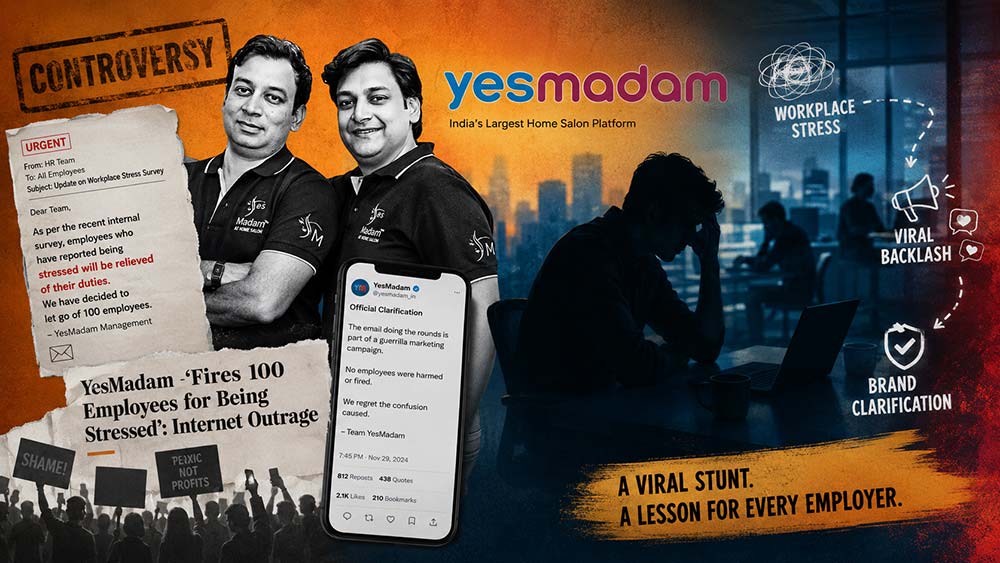
Viral exit letters posted to LinkedIn now travel faster than any HR statement can chase them. A single screenshot can do to an employer brand what a year of recruitment ads cannot undo. Digital reputation does not heal at the same pace it breaks.
The cost of employee burnout compounds quietly. By the time burnout begins appearing in productivity loss, attrition cost, and financial reporting, the structural damage has already spread through the operating model.
Leadership Behaviour and the Burnout Loop: Why the Top Sets the Tone
Employee burnout in India does not start at the bottom of the org chart. It cascades from the top. Leadership behaviour — visible, observed, mimicked — sets the operating tempo that every team below absorbs as the unwritten standard.
How Leadership Modelling Drives Workforce Burnout
Teams do not read company handbooks. They read their leaders. Every visible behaviour at the top becomes an instruction manual for the rest of the organisation, whether the leader intends it that way or not.
- Visible overwork as silent instruction: When the founder is online at 1 a.m., the team reads it as the bar, not the exception. The hustle metric is set without a single word spoken.
- Skipped vacations as cultural signal: Leaders who never take leave teach their teams that rest is for the uncommitted. The out-of-office message becomes a confession.
- Reactive decision-making as norm: A CEO who responds to every Slack ping rewards interruption over deep work. Across the whole organisation, focus becomes a luxury nobody can afford.
- Praise calibrated to hours, not outcomes: When the late-night reply earns more recognition than the well-finished project, exhaustion becomes the performance metric. The wrong behaviour gets the applause.
Can a Company Solve Burnout Without Changing Leadership Behaviour?
No. Burnout is downstream of leadership tempo. Wellness programs, mental health days, and yoga sessions cannot offset a CEO who models always-on availability. Cultural change starts with what leadership stops doing — not what HR starts offering.
Leadership cannot delegate the burnout problem to HR. The behaviour at the top is the architecture the entire organisation either follows or quietly rebels against.
Burnout Among Indian Employees Is Reshaping Workplace Culture
Burnout among Indian employees is no longer affecting only individual wellbeing. It is beginning to reshape Indian corporate work culture itself. As chronic workplace stress normalises across sectors, exhaustion is influencing communication patterns, leadership behaviour, collaboration quality, and employee trust.
How Burnout Changes Workplace Behaviour and Team Dynamics
The shifts are easy to miss because they look like professionalism at first glance. Disengagement wears a clean shirt. The senior analyst who used to ask hard questions in review meetings now nods through them. The team that once brainstormed for an hour finishes the call in fifteen minutes — not because they aligned faster, but because no one had the energy to disagree.
Collaboration energy thins. Cross-functional meetings feel emotionally withdrawn. Presence replaces participation. Employees remain in meetings, reply to messages, and stay visible across systems, but the creative and emotional energy behind the work begins to disappear. Communication becomes purely functional, while psychological safety declines so gradually that most teams notice the symptoms long before they recognise the cause.
Younger employees are reading the room differently. They watch managers who never log off and decide they want no part of that future. Middle management carries the worst of it — escalation pressure from above, exhaustion from below, and no permission to flinch in either direction.
In metro-driven corporate environments, constant availability is increasingly being interpreted as commitment rather than overload. That single misreading is doing more damage to Indian workplace culture than any single policy failure.
Why Burnout Weakens Organisational Decision-Making
Burnout reduces cognitive sharpness, increases escalation dependency, and weakens decision quality across teams. Over time, exhausted leadership structures respond slower, communicate poorly, and create operational drift that compounds stress throughout the organisation.
Workplace culture is shaped by repeated behaviour, not company values written on walls. When exhaustion becomes normalised, burnout slowly transforms from an employee issue into an operating condition.
Preventing Employee Burnout: What Companies Must Build
Preventing employee burnout3 requires architecture, not announcements. Wellness programs without structural change do not move the dial. They are paracetamol for a broken bone. Five governance shifts separate companies that contain burnout from those that escalate it.
The shifts below are operational, not aspirational. Each one is something a leadership team can build inside a quarter — if they choose to.
- Decision framing at each level: Clarify which decisions belong where. When everything escalates upward, senior bandwidth drains and junior judgement never gets built.
- Right to disconnect as policy: Formalise after-hours boundaries in writing. Make it operational, not aspirational. The CEO who emails at 11 p.m. sets the dress code, no matter what the policy document says.
- Communication architecture as infrastructure: Replace informal coordination with structured channels. Slack at midnight is not collaboration. It is noise pretending to be productivity.
- Workplace mental health as governance, not benefit: Embed mental health support inside the operating model, not the HR brochure. A counsellor on retainer is not a strategy. A workload audit is.
- Workload visibility at leadership level: Make team load measurable. What leadership cannot see, leadership cannot govern. Burnout thrives in the gap between assumed capacity and actual capacity.

Preventing employee burnout is not a wellness initiative. It is a governance discipline. The architecture either holds the workforce — or transfers the load onto it.
Also Read:
- 3D Photo Crystal: A Global Craft and Complete Buyer’s Guide for 2026
- Workplace Burnout in India: The Rise of a Burnout Economy
- How to Balance Travel and Remote Work in a Digital World
FAQ: Employee Burnout in India
The most common signs of employee burnout in India include emotional exhaustion at work, irritability, declining motivation, poor concentration, sleep disruption, and falling productivity. Chronic workplace stress from long hours and constant digital availability now affects most Indian professionals across sectors.
Employee burnout in India is rising because of toxic hustle culture, extended work hours, unrealistic productivity targets, job insecurity, and poor work-life boundaries. Hybrid work has further blurred personal and professional time, eroding the right to disconnect at workplace.
Companies can prevent employee burnout by improving workload distribution, setting realistic deadlines, prioritising workplace mental health, enabling flexible work policies, and building communication architecture that reduces after-hours pressure. Structural governance, not wellness programs, drives lasting change.
Conclusion
Employee burnout in India is structural, not personal. The data is settled. The cost is measurable. What remains is the leadership decision to treat burnout as an architectural problem, not a wellness one.
Companies that build communication architecture, decision discipline, and operational clarity contain burnout before it costs them their best people. Those that delay pay through attrition, productivity erosion, and reputational drift — usually in that order.
Indian companies will not solve burnout through wellness language alone. They will solve it by redesigning how work, communication, leadership, and recovery are structured across the organisation.
TrendVisionz publishes structural analysis on enterprise communication and decision architecture — built from three decades of operational experience.
Explore More from Anuj Mahajan: For deeper conversations on mindfulness, professional growth, and modern work culture, explore the podcast series on Spotify.
References and Further Reading:
- McKinsey Health Institute. (2023, November 2). Reframing employee health: Moving beyond burnout to holistic health. McKinsey & Company ↩︎
- Calitz, Karin. (2022). BURNOUT IN THE WORKPLACE. Obiter. 43. 10.17159/obiter.v43i2.14277. ↩︎
- Gaspar, T., Botelho-Guedes, F., Cerqueira, A. et al. Burnout as a multidimensional phenomenon: how can workplaces be healthy environments?. J Public Health (Berl.) 33, 2591–2604 (2025). https://doi.org/10.1007/s10389-024-02223-0 ↩︎
Stay Connected with Me:
Anuj Mahajan is a senior marketing and communication professional with over three decades of operating experience across complex business environments. A business and media operator at core, he uses structured storytelling to sharpen judgement, strengthen communication architecture, and reinforce leadership discipline that drives sustainable growth. An ICF-ACC Certified Coach and seasoned corporate trainer, he works closely with leaders and organisations to translate strategy into consistent execution and measurable business outcomes.
- Explore my work: Nuteq Entertainment | TrendVisionz | Author Profile
- Read our newsletters: Transforming Lives | BizTech Chronicle | Nuteq Newsline
- Guest writer: BizCatalyst360 | Praja Today
- Books: Go Mindfulness: Practices for Professionals Coached
- Join the community: LinkedIn Group – Digital Marketing & Content Creation World
- Connect with me: LinkedIn | Twitter | #StoryforBusiness
- Share your review: Leave your review on Google — your feedback helps us grow.
- Listen on Spotify: Leadership Podcast | Guided NLP (7 Episodes) | Daily Motivation – 21 Episodes
Believe. Practice. Perform. Let’s create impact together.
✍️ A Note from the Editor
Independent storytelling thrives with you. Contribute $15/month via PayPal or email us at anujmahajan@trendvisionz.com. [Guest write for us — Free or Paid.]


