

India is a nation of high effort but accidental direction. When 90% of career choices are made in the dark, we do not just lose dreams. We lose the compound interest of aligned talent. A United Nations–backed finding shows that only 10% of Indian students receive expert career counselling.
Many professionals reach their mid-career years working hard yet feeling unsure. The roles are demanding, the calendars are full, and the milestones look respectable. Still, beneath performance reviews and promotions, a deeper question lingers. In many cases, this comes from early career decisions made with limited clarity and even less guidance.
As an ICF-ACC certified coach working closely with Corporate India, I see this pattern repeatedly in leadership rooms and corporate training sessions. High-potential professionals speak less about failure and more about misalignment. Many chose early, guided by familiarity, social validation, or perceived safety rather than structured insight.
This article explains why many career choices lack clarity. It shows how this leads to job mismatch over time. Why do businesses end up paying the price?
The Anatomy of Blind Career Decisions in India
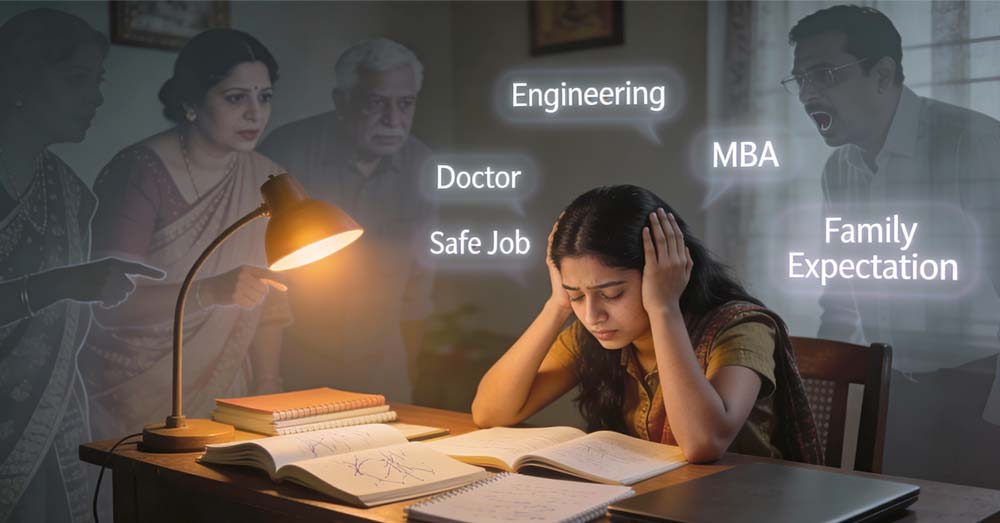
Blind career decisions in India are not a failure of ambition. They are the outcome of missing systems. When structured career counselling is absent, social defaults step in. Effort stays high. Direction becomes accidental. Most students do not choose poorly. They choose familiarly.
Image: india-blind-career-decisions-social-pressure
Caption: Career choices shaped by social pressure
Alt Text: Indian students choosing careers under family and societal pressure
For many individuals, choosing a career happens before any real career planning has taken place, turning long-term direction into a short-term social decision.
The Proximity Bias Behind Choosing a Career
Career decisions often begin close to home. Family opinions, relative success stories, and peer examples dominate the conversation. These influences feel trustworthy because they are familiar. Fit is rarely tested. Exposure remains limited.
This is not neglect. It is proximity at work. When options are few and time is scarce, familiarity becomes the decision filter.
“Most career decisions fail not because of poor intent, but because choice is made before self-understanding is allowed to develop.”
Image:proximity-bias-career-decisions-social-influence.jpg
Caption: Invisible forces shape visible career choices
Alt text: Social pressure influencing individual career decisions silently
Before any formal assessment enters the picture, an informal hierarchy is already set. Certain careers appear visible, respectable, and achievable. Others disappear without discussion.
- “Uncle advice” as a system: Guidance is anecdotal, not diagnostic. One success story becomes a universal rule.
- Confidence from familiarity: Repeated exposure creates comfort, not alignment.
- Early narrowing: Options disappear before self-awareness develops.
Multiple international assessments show that formal career counselling access in India remains extremely limited. Most students rely on family members, peers, or informal social advice rather than trained professionals when making early career decisions. The choice feels informed because many people endorse it. It is rarely examined for fit.
The Trend Trap and the Illusion of “Safe” Careers
Trends add legitimacy to weak decisions. Competitive exams, prestige colleges, and popular roles create a sense of safety. When many people pursue the same path, risk appears diluted. Crowds substitute for clarity.
Image: career-trend-trap-escalator-dead-end.jpg
Caption: Momentum hides the dead end
Alt image: Professionals moving upward on escalator ending at wall
As roles evolve faster due to automation and AI, sunk cost pressure becomes more dangerous. Skills become obsolete quickly, while misfit remains embedded. This confidence does not last.
- Exams create false certainty: Clearing a test feels like destiny, not selection.
- Late realisation: Misfit surfaces only after entering the job market.
- Sunk cost pressure: Time, money, and identity lock people in place.
Transitions become harder once investments accumulate. What could have been a small correction early becomes a major disruption later.
The first wrong choice rarely looks wrong in Year 1. It looks approved. Looks respectable. And it looks safe too. Only time exposes the cost.
What Mid-Career Doubt Reveals About Early Career Choices
Over years of career counselling conversations with working professionals, a clear pattern emerges. These are not people who failed. They performed well. They stayed employed. Yet something feels off. The questions they bring are rarely about skill. They are about fit.
I see this across sectors. Technology. Manufacturing. Media. Finance. Titles change. Pay scales vary. The emotional loop remains strikingly similar. What surfaces is not confusion, but delayed clarity.
The Pattern Behind Mid-Career Doubt
Mid-career doubt does not arrive as a breakdown. It arrives quietly. Professionals speak with control, logic, and achievement. Yet their words point to an internal disconnect that has been present for years, only unspoken.
The same lines repeat across conversations.
- “I did what was expected.”
- “The work is fine. The fulfilment is not.”
- This is where career transitions begin, not from failure but from fatigue.
What stands out is this. Most are not questioning competence. They are questioning ownership. The work was chosen early, reinforced socially, and never revisited with intention.
In one conversation, a senior professional in his early forties described what looked like a mid-life crisis. Stable role. Respectable title. Growing restlessness. He was not unhappy, but he felt disconnected from his work and increasingly irritable at home. Through structured career counselling, it became clear that his career had been chosen early through social expectation, not ownership. The transition that followed was not abrupt. It was planned, gradual, and grounded in rediscovering aptitude and motivation. What changed first was not his job, but his sense of agency.
This is the point at which many professionals realise that what they are experiencing is not burnout, but misalignment.
A Simple Line I Hear Often
There is one sentence that surfaces again and again, regardless of age or industry. It is spoken calmly, almost casually, yet it carries weight.
“I never chose this. I just entered it.”
That line connects directly back to the invisible early decision. The choice made through proximity, trend, or safety. Not through self-understanding. What feels like a mid-career problem is often an early-career omission.
Career misalignment is rarely recognised early. It is recognised when momentum slows, motivation fades, and correction becomes harder than continuation.
Job Mismatch Is the Business Cost Nobody Tracks
Job mismatch is rarely treated as a business risk. It is framed as an individual issue. In reality, it is an efficiency leak. When people work in roles that do not match their identity or aptitude, organisations absorb the cost quietly and repeatedly.
Image: job-mismatch-business-cost-career-misalignment.jpg
Caption: The hidden cost of wrong hires
Alt Text: Business impact of career misalignment and wrong hiring
These are common ways mismatch shows up inside organisations, often long before it is acknowledged or measured.
- Low engagement: Skilled employees disengage once effort stops translating into meaning. Delivery becomes mechanical. Discretionary effort disappears.
- High attrition: Early exits rise when identity and role do not align. Exit interviews cite growth or culture, but the root cause is fit.
- Slow growth: Promotions stall as confidence erodes quietly. People hesitate to step up in roles they never fully owned.
- Reskilling burden: Companies invest heavily to correct gaps that better career counselling could have prevented upstream.
- Underemployment: Degrees exist, experience accumulates, yet role fit remains weak. Capability is present but misapplied.
Industry estimates suggest that replacing a mid-level employee can cost organisations between 50 to 200 percent of annual salary when hiring, onboarding, training, and lost productivity are included. A large share of this churn is not caused by skill failure. It is caused by role misalignment that surfaces only after years of investment.
Business pays twice. First to hire. Then to correct.
From a business lens, this is not a talent shortage problem. It is a placement problem. When early career decisions are made without structure, organisations inherit the consequences later. The cost is hidden in attrition data, learning budgets, and stalled leadership pipelines.
Weak career decision making during the education to employment transition creates a cumulative loss of human capital that organisations spend years trying to recover.
The Five-Step Process That Defines Professional Career Counselling
Professional career counselling is not advice sharing. It is a structured decision process. Unlike informal guidance driven by opinion or precedent, it follows a defined sequence that reduces error and long-term misalignment. Career development frameworks, including those referenced by Magnuson, describe counselling as a staged progression, not a one-time conversation.
Image: five-step-career-counselling-process.jpg
Caption: Structured guidance replaces career guesswork
Alt Text: Five step professional career counselling decision process
The process typically unfolds in five connected steps.
- Problem awareness: The individual recognises dissatisfaction or uncertainty without yet knowing the cause.
- Self-understanding: Aptitude, values, motivation, and constraints are examined beyond surface preferences.
- Occupational exploration: Options are expanded systematically, not limited to what is visible or familiar.
- Decision making: Choices are evaluated for fit, feasibility, and long-term impact.
- Implementation and adjustment: Transition is planned, monitored, and refined over time.
The difference becomes visible after occupational exploration. In one case, a professional with strong analytical ability had only considered roles common within his immediate network. Structured counselling widened exposure, challenged assumptions, and reframed risk. The final decision was not dramatic. It was deliberate. Implementation focused on gradual transition, with adjustment continuing after the move.
From a business lens, this structured guidance process functions less as advice and more as early-stage risk reduction against future job mismatch, disengagement, and costly correction.
Process replaces guesswork with informed direction by introducing structure where opinion once dominated. It reduces preventable errors early, protects human capital investment, and creates alignment before correction becomes expensive.
Five Counselling Skills That Make Guidance Work
Career counselling succeeds or fails on human skill, not information volume. Tests, reports, and platforms can support the process, but they cannot replace judgment. What creates impact is how guidance is delivered, interpreted, and held, especially when stakes are high.
Image: career-counseling-skills-human-judgment.jpg
Caption: Human judgment defines counseling outcomes
Alt Text: Core skills required for effective professional career counseling
These skills are what separate structured guidance from casual opinion, and why professional career guidance cannot be reduced to checklists or tools.
- Active listening: Helps individuals feel heard rather than directed. When people are listened to fully, resistance drops and clarity improves.
- Questioning ability: Reveals what matters beyond marks, rankings, or external expectations. The right question surfaces motivation, not just preference.
- Interpretation: Turns test data into practical meaning. Scores alone do not guide decisions unless they are translated into context and relevance.
- Trustworthiness: Keeps guidance neutral and ethical. Without trust, advice turns persuasive, and outcomes become biased.
- Empathy: Makes pressure, fear, and confusion visible. It allows difficult realities to be acknowledged without judgement.
These skills work together. Listening without interpretation creates confusion. Data without empathy feels mechanical. Questions without trust feel intrusive. When combined, they create a space where informed decisions can emerge calmly.
Tools can help scale access to career guidance. They can speed assessment and widen reach. But skill determines quality. Without human judgment, counselling becomes information delivery. With it, guidance becomes a stabilising force that protects individuals and organisations from preventable misalignment.
The Long Tail of Misalignment From Career Regret to Mid-Life Crisis
Mid-life crisis is often misread as a sudden emotional event. In reality, it is delayed feedback. Years of working in roles that do not align with identity quietly accumulate before surfacing as restlessness, dissatisfaction, or loss of meaning.
This phase rarely looks dramatic. It appears gradually, shaped by time, responsibility, and unexamined choices.
- Restlessness, not breakdown: Most professionals do not collapse. They feel disengaged, impatient, or emotionally distant from work that once felt acceptable.
- Regret tied to identity and time: Career regret is less about pay and more about realising that years were spent building something that never felt fully owned.
- High cost of late transitions: By this stage, financial commitments, family responsibilities, and organisational dependence make change slower, riskier, and more disruptive.
Workforce transition studies show that many professionals consider major career shifts only after a decade or more in the workforce, when financial and personal stakes are already high. What could have been an early correction becomes a complex life decision.
Late clarity is still meaningful. It can restore direction and self-respect. But it is expensive clarity, shaped by higher risk, limited flexibility, and consequences that extend beyond the individual to families and employers.
Why Business Should Treat Career Guidance as Workforce Infrastructure
Businesses often treat career guidance as a social good or an individual concern. In reality, it is workforce infrastructure. The quality of early career decisions directly shapes hiring efficiency, retention, and leadership development. When guidance fails upstream, organisations inherit the cost downstream.
From a return-on-investment perspective, preventing one bad hire or early exit often offsets the cost of structured career guidance across multiple individuals.
“For organisations, this shifts career guidance from a reactive HR function to a learning and development capability. Embedding career pathing, professional coaching, or structured guidance into L&D programs creates alignment before disengagement appears, rather than analysing it later through exit interviews.”
When this infrastructure is missing, misalignment does not disappear. It is deferred. Organisations encounter it later, at the point of hiring, onboarding, and early attrition, where correction is slower and more expensive.
The Workforce Misalignment Businesses Inherit
Misalignment rarely begins inside the organisation. It arrives with the hire. Entry-level employees often join roles that match qualifications on paper but not aptitude, interest, or identity. The impact shows up early and compounds quietly.
- Role fit issues: New hires struggle to connect with the work beyond basic execution.
- Longer onboarding: More time is spent correcting fit gaps rather than building capability.
- Faster churn: Early exits increase as reality diverges from expectation.
This difference becomes clear when comparing how careers are chosen.
Career Decisions by Guesswork vs Structured Career Counselling
The contrast below shows how early career decisions shape long-term workforce outcomes for individuals and organisations.
| Aspect | Blind Career Decisions | Structured Career Counselling |
| Entry-level role fit | Low, trial-and-error driven | Higher alignment from start |
| Early attrition | High within 1–3 years | Lower due to clarity |
| Reskilling cost | Reactive and expensive | Preventive and targeted |
| Engagement | Declines over time | Sustained |
| Career transitions | Late and disruptive | Early and intentional |
| Human capital ROI | Erodes quietly | Compounds over time |
What begins as an individual career choice compounds quietly across teams and years, eventually surfacing as a systemic business loss that no balance sheet explicitly tracks.
The Human Capital Loss Nobody Budgets For
For HR and leadership teams, career guidance is not an employee benefit. It is a lever to stabilise hiring costs, protect learning investments, and improve long-term workforce ROI.
Image: early-career-guidance-vs-late-correction-roi.jpg
Caption: Early choices shape long-term returns
Alt Text: Early career guidance versus late correction business ROI
The cost of misalignment is rarely visible in one line item. It is spread across outcomes that feel disconnected but share a common cause.
- Lost productivity: Time is spent managing disengagement rather than performance.
- Lost leadership pipeline time: Potential leaders arrive late or burn out early.
- Lost confidence in the system: Employees disengage when effort and fit never align.
With millions entering India’s workforce each year, even small percentages of misalignment translate into large-scale productivity loss. The demographic dividend then shifts from an advantage to a structural risk.
Hiring is late-stage optimisation, applied after misalignment has already entered the system. Career guidance works upstream. It prevents avoidable mismatch, protects human capital investment, and reduces the need for costly correction later.
FAQ: Career Counselling
Who can benefit from career guidance?
Career guidance helps students choosing streams, professionals facing mid-career doubt, and organisations managing talent alignment. It is most effective when used early, before misalignment turns into disengagement, attrition, or costly career transitions.
When should someone seek career counselling?
Career counselling is most valuable at transition points. Before choosing a stream, during early career uncertainty, or when persistent dissatisfaction appears despite success. Early guidance prevents long-term misalignment that becomes harder to correct later.
What are the 3 C’s in counselling?
The three C’s in counselling are clarity, confidence, and commitment. Together, they help individuals understand themselves, make informed choices, and sustain action over time without external pressure or regret.
How do businesses calculate the cost of employee turnover?
Employee turnover cost is calculated by combining hiring expenses, onboarding and training costs, lost productivity during ramp-up, and management time. For mid-level roles, this often totals 50 to 200 percent of annual salary.
Conclusion
Career choices shape far more than individual livelihoods. They determine engagement, productivity, and the long-term health of organisations. When decisions are made without structure, effort remains high but direction becomes accidental. That is the hidden cost running through education systems and workplaces alike.
This is why career counseling must be viewed clearly. It is not a luxury, a remedial service, or a late-stage fix. It is risk reduction. Early, structured guidance prevents misalignment that later shows up as disengagement, attrition, stalled growth, and expensive correction. What looks like a personal struggle in mid-career is often the delayed outcome of an early decision made without clarity.
For businesses, the implication is direct. When fit is prioritised early, human capital compounds instead of eroding. When prestige dominates over alignment, correction costs quietly multiply. Sustainable performance improves when careers are built with intent, not inheritance.
If you are shaping talent pipelines, advising careers, or navigating your own uncertainty, start upstream. Invest in structured career guidance before misalignment turns into cost.
Stay Connected with Me:
Anuj Mahajan is a marketing and communication professional with over 30 years of experience. A senior business and media operator, he uses storytelling to bring clarity, strengthen communication, and reinforce leadership discipline to drive growth. He is an ICF-ACC Certified Coach and an experienced corporate trainer. Drawing from deep operating experience, he helps leaders and organizations translate strategy into consistent business outcomes.
- Explore my work: Nuteq Entertainment | TrendVisionz | Author Profile
- Read our newsletters: Transforming Lives | BizTech Chronicle | Nuteq Newsline
- Guest writer: BizCatalyst360 | Praja Today
- Books: Go Mindfulness: Practices for Professionals Coached
- Join the community: LinkedIn Group – Digital Marketing & Content Creation World
- Connect with me: LinkedIn | Twitter | #StoryforBusiness
- Share your review: Leave your review on Google — your feedback helps us grow.
- Listen on Spotify: Leadership Podcast | Guided NLP (7 Episodes) | Daily Motivation – 21 Episodes
Believe. Practice. Perform. Let’s create impact together.
✍️ A Note from the Editor
Independent storytelling thrives with you. Contribute $15/month via PayPal or email us at anujmahajan@trendvisionz.com. [Guest write for us — Free or Paid.]


