

A viral Reddit post recently caught my attention. A professional wrote, “I just have to survive three more years.” It sounded like patience. It was actually pressure. Workplace burnout in India is no longer a quiet HR concern. It has evolved into a structural workforce crisis. Professionals are not just overworked. They are navigating financial dependency, psychological inertia, and a corporate culture that equates endurance with commitment.

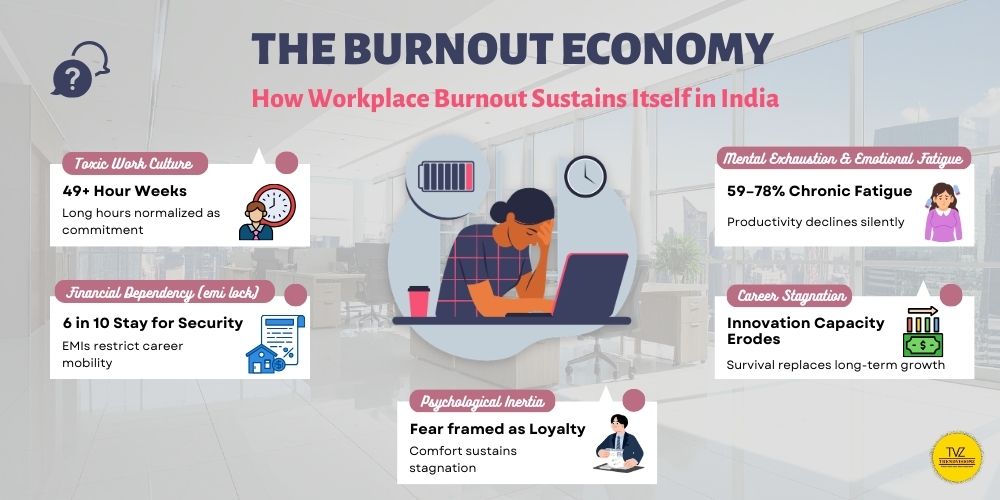
India ranks among the highest globally, with 6 in 10 employees showing signs of chronic workplace anxiety and emotional fatigue. This is not just about long hours. Toxic work culture, financial stress and job insecurity, and shrinking work-life balance are driving measurable productivity decline.
Working closely with corporates and growth-focused professionals experiencing employee burnout, I observe a recurring pattern. Career stagnation in India is often mistaken for stability, while employee burnout quietly compounds beneath performance metrics.
This article explores how workplace burnout in India is fueling a burnout economy, and why skills-based digital autonomy may offer a structural reset from survival to sustainable growth.
Also Read:
The Silent Burnout: When Survival Replaces Growth
In India, work-related fatigue 1is rising because long hours, stagnant pay, and toxic work culture normalize chronic job stress. Exhaustion is no longer episodic. It is structural. Recent data shows that 6 in 10 employees display visible signs of burnout, and 53% report productivity decline linked directly to workplace mental health. In sectors like IT, where 83% report employee burnout, the cost is not only emotional. It is economic.
Consider a mid-level professional in a metro city. He earns well, meets targets, and responds to emails at midnight. On paper, he is stable. In reality, mental exhaustion and emotional fatigue at work have reduced his creativity and long-term growth.
Workplace anxiety is masked as dedication. This is how corporate burnout culture erodes earning potential, innovation capacity, and long-term financial mobility. From his book Dying for a Paycheck, Jeffrey Pfeffer underscores the systemic cost of workplace insecurity.
The workplace has become the fifth leading cause of death… People stay in these jobs because they feel they have no choice. Economic insecurity is a powerful tool for compliance, even if that compliance results in total physical and mental collapse — Jeffrey Pfeffer, Professor of Organizational Behavior, Stanford University
This reframes burnout not as overwork alone, but as economic insecurity embedded within organizational systems. When insecurity becomes policy, exhaustion becomes predictable.

Why is workplace burnout increasing in India?
Workplace burnout in India is rising due to extreme work hours, toxic work culture, and blurred boundaries created by always-on digital connectivity. Professionals often work 49–51 hours weekly, with leadership expectations extending beyond office hours. Excessive work hours are often justified in the name of productivity. Yet institutional voices are raising concern about this normalization.
Demanding 70–90 hour work weeks raises serious ethical concerns. Instead of maximizing hours, organizations must prioritize employee well-being, work structures, and ethical business practices.” — Manoj Sharma, Chairperson–ASSOCHAM, National Council
Research shows Gen Z 2employees struggle to separate work from personal identity, increasing emotional fatigue and workplace anxiety. Economic instability, job insecurity, and fear of AI-driven displacement further intensify job stress, while limited mental health support allows productivity decline to compound across industries.¹
The Culture of Endurance
In many corporate environments, endurance is glorified. “Work till you drop” is praised as commitment, not warning. Unlike Western models that increasingly prioritize work-life balance, Indian professionals often equate overwork with ambition. We mistake coping for thriving. Emotional fatigue at work becomes a silent badge of honor, even as productivity decline signals deeper workplace burnout3.
What are the early signs of workplace burnout?
Early signs of workplace burnout include persistent mental exhaustion, emotional fatigue at work, reduced motivation, frequent workplace anxiety, irritability, and measurable productivity decline. Employees may struggle with focus, disengage from tasks, or feel detached despite continued job stress and long working hours.
Takeaway: Burnout is not laziness. It is accumulated pressure. When survival becomes identity, ambition shrinks into routine. India’s workforce does not lack drive. It lacks recovery systems and structural balance.
The Economic Chains Behind the Choice
Financial stress and job insecurity make leaving a toxic work culture far more complex than motivation alone suggests. EMIs, dependent parents, and social expectations lock many professionals into prolonged workplace burnout in India. According to LinkedIn Workforce insights, 6 in 10 Indians stay in roles they dislike for financial security, and 64% would accept a salary reduction for better work-life balance.

When employee burnout collides with financial obligations, survival becomes a rational choice. Elizabeth Warren’s work on fixed-cost pressure illustrates how debt reduces career flexibility, turning financial commitments into long-term career constraints.
Work-life balance becomes a distant ideal rather than a practical goal when financial stress and job insecurity dominate decision-making.
Financial Fear and the EMI Mindset
Paycheck paralysis explains why workplace burnout persists. Each EMI represents stability, even if the job fuels job stress and workplace anxiety. Financial stress and job insecurity reinforce career stagnation in India, making change feel risky. Over time, mental exhaustion and emotional fatigue at work become normalized because income continuity outweighs personal well-being. Productivity decline is tolerated because financial disruption feels more dangerous than professional stagnation.
The biggest killer of the Indian entrepreneurial spirit is the EMI. Once you are locked into a cycle of monthly payments, your ability to say ‘no’ to a bad boss or ‘yes’ to a risky opportunity drops to zero — Nithin Kamath, CEO, Zerodha
In many Indian households, resignation is not a career decision. It is a financial risk assessment shaped by fixed monthly liabilities. Stability begins to outweigh ambition. When income supports EMIs, family obligations, and social mobility, workplace burnout becomes economically rational rather than emotionally reactive.
This is how a burnout economy quietly sustains itself — through financial dependency disguised as stability.
How does financial stress increase workplace burnout in India?
Financial stress increases workplace burnout in India by creating dependency on stable income despite toxic work culture. EMIs, family obligations, and job insecurity discourage risk-taking, forcing employees to tolerate job stress and workplace anxiety. This prolonged exposure deepens mental exhaustion, reduces work-life balance, and accelerates productivity decline.
Takeaway: The workplace is not the only trap. Financial architecture is. Without financial literacy and diversified income thinking, toxic work culture becomes economically rational.
The Psychology of Staying: Comfort as a Coping Mechanism
Familiar misery often feels safer than uncertain change. In this context, emotional fatigue and in India create psychological inertia that quietly sustains corporate burnout culture.
Workforce exhaustion crisis persists not only because of long hours or toxic work culture, but because predictability feels safer than disruption. Stability, even when draining, feels rational.
How Fear Masquerades as Loyalty
Organizations often normalize overwork as loyalty. Job insecurity becomes an unspoken test of commitment, where staying silent signals dedication and questioning expectations signals weakness. Priya, a project manager at a Bangalore IT firm, has not taken a full week off in three years. Not because her workload demands it, but because visibility feels like survival.
My manager calls me dependable. My therapist calls it chronic workplace anxiety. I am not sure who is right anymore — Priya, Project Manager, Bangalore

In urban India, workplace burnout rarely appears dramatic. It shows up as chronic overwork followed by weekend distraction. Bhajan clubbing, spiritual retreats, or late-night social escapes become coping rituals. They offer temporary emotional relief but do not address workplace anxiety, financial stress, or career stagnation in India.
An always-on work culture reinforces this cycle. Continuous digital connectivity sustains workplace anxiety, while emotional fatigue at work slowly erodes identity and ambition. Over time, productivity decline feels normal. Corporate burnout culture sustains itself not through visible coercion, but through familiarity and financial dependency.
Burnout becomes systemic when organisations normalise survival instead of designing for sustainability. Exhaustion is rarely accidental. It is often structurally reinforced — Anuj Mahajan, Media Strategist and Leadership Coach
It shifts the focus from individual weakness to organizational design, highlighting how workplace burnout is embedded within systems. If psychological inertia sustains workplace burnout, the solution must be structural, not motivational.
Why Do Employees Stay in Toxic Work Culture?
Employees stay in toxic work culture due to financial stress, job insecurity, and fear of losing stability. EMIs, family obligations, and limited alternative income options discourage risk-taking. Workplace burnout feels safer than uncertainty, reinforcing emotional fatigue at work and long-term career stagnation.
Comfort is seductive but costly. Staying still protects stability in the short term, but gradually erodes identity, growth, autonomy, and resilience.
Breaking the Cycle: Digital Freedom and New Workfronts
Digital transformation has dismantled the traditional office-or-nothing binary. Remote work, freelancing, and AI-enabled micro-entrepreneurship are helping professionals decouple financial survival from legacy corporate burnout culture. For many experiencing workplace burnout in India, 7 habits is fast becoming a structural alternative for digital burnout.
From Survival to Autonomy
Digital freedom and remote work have transitioned from fringe experiments to measurable workforce shifts, offering a structural exit from the “EMI-locked” career stagnation currently prevalent across India’s professional landscape.
- Upwork India Growth: India remains one of the fastest-growing hubs for independent talent, with sustained year-on-year growth in high-skill freelance earnings.
- Hybrid Adoption: Over 60 percent of Indian tech firms have institutionalized hybrid models to reduce attrition and rising digital fatigue.
However, autonomy without design can recreate burnout. Poor AI integration often produces AI workflow friction, where tools increase coordination instead of reducing effort. Without disciplined workflow architecture, digital systems extend the always-on work culture into personal life.

Instead of reducing job stress, fragmented automation layers new dashboards, approvals, and monitoring loops onto professionals already navigating digital fatigue. Without intentional workflow redesign, technology can amplify workplace burnout rather than relieve it.
Can digital freedom reduce workplace burnout?
Yes, if governed by structure. Digital freedom can reduce workplace burnout by restoring work-life balance, enabling income diversification, and limiting exposure to toxic work culture. Without firm boundaries and workflow discipline, however, it can increase digital fatigue and reinforce always-on work culture patterns.
Takeaway: In a burnout economy, specialized skills, not corporate titles, define long-term worth and resilience.
The Way Forward: Redefining Success for the Next Generation
Sustainable growth requires redefining professional achievement itself. Productivity decline, mental exhaustion, and corporate burnout culture cannot remain normalized as the cost of stability in India’s changing economic environment.
Building the Mental Wealth Economy
The next economy must value resilience, financial literacy, and emotional sustainability as seriously as revenue. It must move beyond the EMI-locked mindset toward structural balance.

Career longevity is no longer about endurance. It is about integrating financial literacy to reduce paycheck paralysis and structured recovery to prevent emotional fatigue. When work-life balance becomes functional rather than aspirational, professionals shift from survival mode to sustained, high-impact contribution.
Takeaway: The price of staying cannot be peace of mind. The future workforce must prioritize balance, courage, and structural redesign with modern NLP anchors over the outdated glorification of professional exhaustion.
Practical Steps to Navigate Workplace Burnout in India
Workplace burnout in India cannot be solved by motivation alone. It requires structural recalibration. Small, disciplined shifts in financial planning, digital boundaries, and career strategy can reduce job stress and restore work-life balance without impulsive, high-risk decisions.
Structural Strategies for Professional Recovery
- Audit Your Energy Leaks: Identify triggers of mental exhaustion and emotional fatigue at work. Track specific tasks that spike workplace anxiety and reduce productivity.
- Rebuild Financial Cushion: Strengthen financial literacy by building a six-month emergency buffer and systematically reducing high-risk EMIs. Lower financial stress before attempting career transitions.
- Set Digital Boundaries: Limit after-hours response habits driven by always-on work culture. Reduce digital fatigue through scheduled deep work blocks and non-negotiable offline recovery time.
- Standardize AI Workflows: Avoid ‘tool-sprawl’ that adds coordination tax. Audit your tech stack to ensure AI is automating tasks, not just increasing the volume of digital notifications”
- Upgrade Skills, Not Titles: Prioritize skills-based growth over designation-based identity. High-demand expertise reduces career stagnation and increases professional autonomy.
- Design Income Optionality: Explore remote work, consulting, or freelance projects. Diversified income streams reduce dependency on a single toxic work culture.

Burnout recovery is not about quitting overnight. It is about redesigning your financial, digital, and career architecture so survival does not become your permanent professional identity.
FAQ: Workplace Burnout
Why do Indian professionals stay in jobs that cause burnout instead of quitting?
Financial dependency — not lack of awareness — sustains this burnout economy. EMIs, family obligations, and job insecurity make leaving a toxic work culture feel riskier than enduring chronic mental exhaustion and emotional fatigue at work.
Can digital freedom and remote work actually reduce workplace burnout?
Yes, but only with structure. Digital freedom reduces exposure to toxic work culture and restores work-life balance. Without disciplined boundaries and intentional workflow design, however, it risks amplifying digital fatigue and always-on work culture patterns.
How does the EMI-locked lifestyle contribute to India’s burnout economy?
EMI dependency creates financial inertia that traps professionals in draining roles. When monthly obligations outweigh career flexibility, professional exhaustion becomes economically rational, sustaining a burnout economy where survival replaces long-term professional growth.
Also Read:
- Financial Discipline in Your 20s: How To Avoid Slow Financial Suicide
- The Rise of Digital Detox Retreats – How They Boost Mental Health & Reduce Stress
Conclusion
Workplace burnout in India is not a personal weakness. It is a systemic crisis shaped by cultural conditioning and financial dependency. The normalization of an EMI-locked lifestyle has forced professionals to endure chronic mental exhaustion as the cost of stability. Over time, this silent endurance contributes to measurable productivity decline, fueling a fragile burnout economy that rewards presence over performance and survival over innovation.
Breaking this cycle requires more than resilience. It demands structural recalibration. By addressing financial stress, redesigning work boundaries, and leveraging digital freedom responsibly, professionals can transition from legacy exhaustion to sustainable autonomy.
If you recognize yourself in this burnout economy, pause. Relearn your worth, redesign your work, and begin building structural autonomy today.
Additional Resources:
- Wong K, Chan AHS, Ngan SC. The Effect of Long Working Hours and Overtime on Occupational Health: A Meta-Analysis of Evidence from 1998 to 2018. Int J Environ Res Public Health. 2019 Jun 13;16(12):2102. doi: 10.3390/ijerph16122102. PMID: 31200573; PMCID: PMC6617405. ↩︎
- Kumar, S. J., & Abraham, S. (2025). Why generation Z in India is burning out faster, and how they’re starting to escape it. International Journal of Research in Human Resource Management, 7(2), 660–662. ↩︎
- Shankar, P. S. (2023). Burnout syndrome. RGUHS Journal of Medical Sciences, 13(3), 105–111.5/ ↩︎


