
Guests arriving tomorrow. The house needs to be spotless. Or it is one of those mornings — back-to-back meetings, school run, breakfast still on the counter. For millions of urban households, maid services are not a luxury. They are the invisible infrastructure that holds the day together. And then the message arrives. Aaj nahi aaungi. Three words. No explanation. No backup. Just you, the mop, and a day that was already too full.
What begins as a desperate Google search often becomes a fifteen-minute solution. An app. A verified stranger in a uniform, booked through a maid booking app. Swept, mopped, done. What starts as a stopgap is quietly turning into a habit. Urban India, conditioned by quick commerce and same-day everything, is now extending that expectation to maid services.

Having watched Indian households navigate domestic relationships for over three decades, I see this shift as more than convenience. It is structural. And for millions of women working within the unorganised labour sector, it may matter more than we realise.
This article examines both sides — what app-based maid services are delivering to urban households, what they are offering domestic workers for the first time, and whether the kaam wali bai and the booking app can coexist in the same India.
Also Read:
- Obesity Treatment: From GLP-1 Therapy to Gene Therapy Breakthroughs
- Women Riders in India Changing the Biking Landscape
- Web Offset Printing and the New Economics of Expansion
Why Urban Households Are Rethinking Maid Services Today
Urban households are rethinking maid services due to reliability gaps, time pressure, and the rise of on-demand alternatives. The relationship between employer and domestic help has always been built on trust. For households, trust without structure has a breaking point, especially when they regularly hire a maid to keep daily routines stable.
The Reliability Gap That Built the Market
In most urban homes, the morning runs on an invisible clock. Breakfast, tiffin, school drop, office login — every task is sequenced around one assumption. That she will show up. Priya Khattar, Principal at a school in Shahdara, Delhi, has lived that breaking point more than once.
I manage four hundred children every day. But my mornings fall apart the moment my help doesn’t come. I have stood in my kitchen in my saree at 7:45 am, with no other option. — Priya Khattar, Principal, Shahdara, Delhi
She further adds in frustration, the vessels don’t wash themselves. The school does not wait. And the emotional weight of that moment — helplessness dressed as a domestic inconvenience — is something millions of working women in urban India carry silently every week. That silence is the founding frustration of an entire market. It is also, quietly, the business case that three of India’s fastest-growing startups are now building on.
How Quick Commerce Rewired Urban Expectations
Groceries arrive in ten minutes. Cabs in three. Medicine at midnight. Urban India has been quietly trained to expect reliability on demand. This behaviour is now extending to on demand household services, and that conditioning did not stop at the kitchen door. When domestic workers travelled back to their home states during the Bengal elections, households turned to apps out of desperation. What they found was structure. Fixed time. Verified worker. No negotiation. Many did not go back entirely.
The panic moment is universal. What changed is that urban India now has an alternative — and using it once is enough to shift expectations permanently.
What App-Based Maid Services Actually Deliver
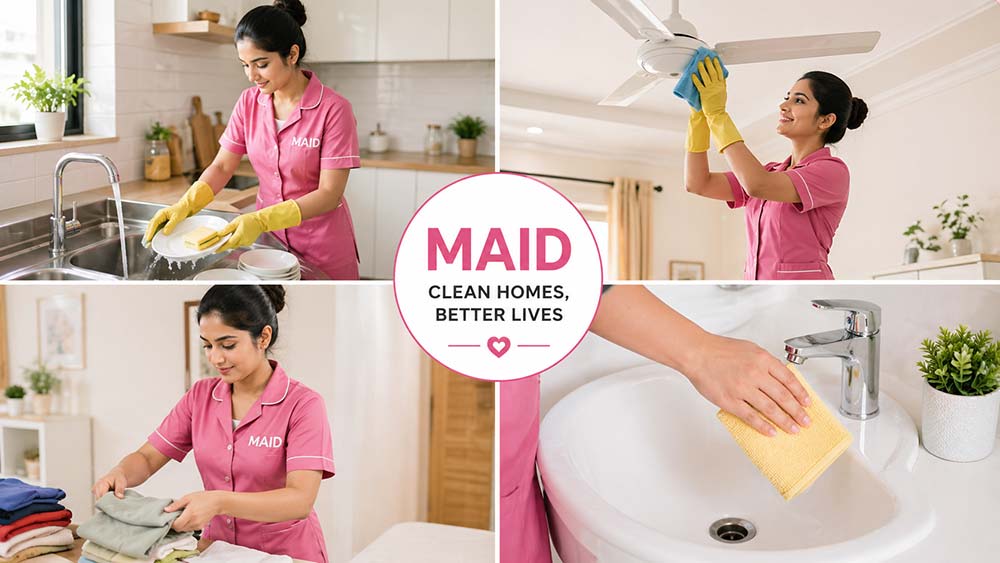
App-based maid services1 offer more than speed, redefining how house help services are delivered in urban India. The architecture underneath — verification, standardisation, accountability — represents the first formal infrastructure built specifically around domestic work in India.
The Platform Promise — Verification, Speed, Accountability
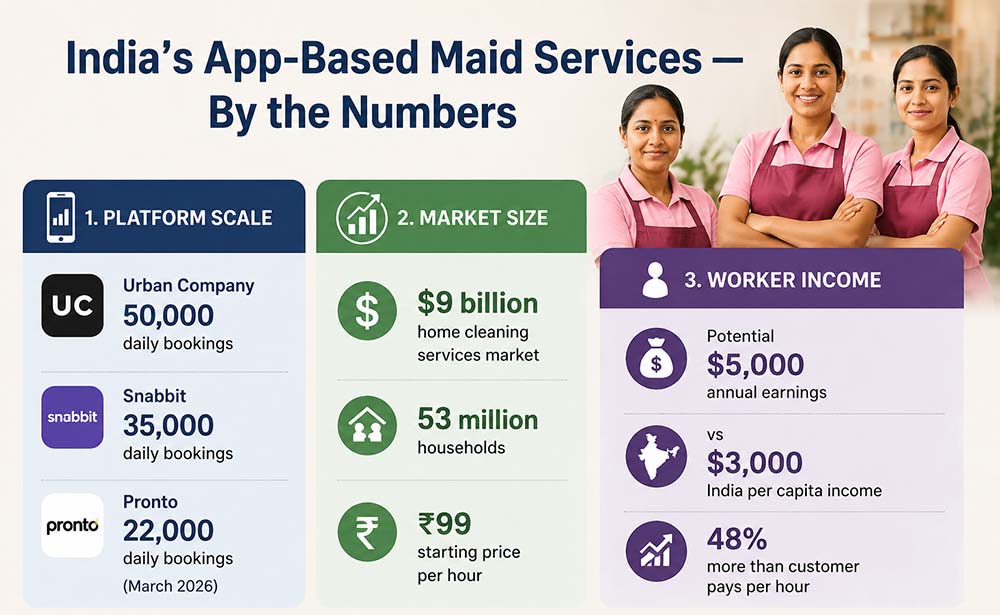
India’s home cleaning services market is estimated at $9 billion, spread across 53 million households. That demand existed long before any app tried to serve it. What Urban Company, BookMyBai, and Snabbit have done is build a delivery system around it for the first time.
The model is simple. Select a service — deep cleaning, dishwashing, laundry, kitchen prep — pick a time slot, pay a fixed rate. Snabbit starts at ₹99 and promises arrival in under ten minutes. Every worker is background-verified. Every job is rated. No negotiations. No morning uncertainty.
Infographic
Sonia Mendes, a resident of Andheri, Mumbai, discovered the service by chance.
I had guests coming and my regular bai had taken leave. I booked someone for two hours at ₹99 an hour. She cleaned the kitchen, mopped the house, and left. I spent less than two hundred rupees and my home was ready in time. Now I book for extra work every week — things I never got done otherwise.
For households like Sonia’s, the ₹99 hour is not a replacement for the kaam wali bai. It is an extension — a way to get more done without the guilt of asking for extra.
What This Delivers for the Household
App-based maid services connect urban households with background-verified domestic workers through a mobile platform. Users book a service, select a time slot, pay a fixed rate, and rate the worker post-completion — bringing predictability to the one part of urban life that consistently resisted it.
For the first time, domestic help in India comes with a paper trail. That single shift changes the power dynamic between household and worker in ways that are still unfolding.
What This Shift Means for the Kaam Wali Bai
App-based platforms introduce structure, visibility, and consistency to domestic workers who have historically operated as a domestic maid within India’s unorganised labour sector. But formalisation and protection are not the same thing — and that distinction matters enormously.
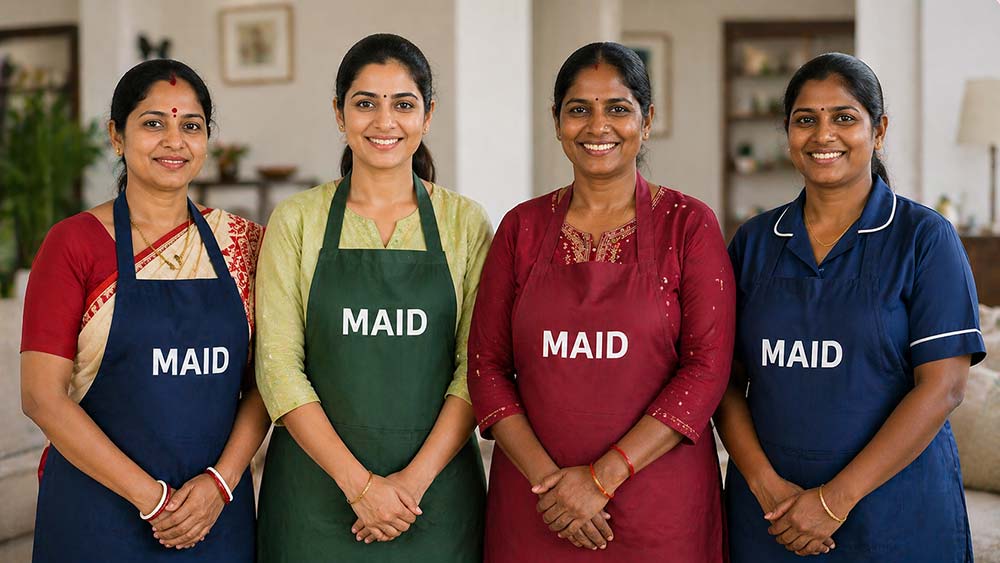
The First Digital Identity — What Registration Actually Gives Her
For most domestic workers in India, a career has no paper trail. Platform registration changes that fundamentally.
- Verified profile: A digital identity that travels with her across every household she serves.
- Rated work history: Proof of reliability that no informal arrangement ever provided.
- Wider client base: Income no longer dependent on one household’s goodwill or mood.
- Income potential: A platform worker putting in eight hours a day can earn nearly double India’s per capita income.
For women who built careers invisibly, inside other people’s homes, this infrastructure arrives decades late — but it arrives. Dipika Jaikishan, captures it well
Domestic work is one of the oldest, largest and most overlooked labour markets in our country. Tens of crores of women have done this work for decades with little control over their conditions and with no real safety net.
But what platforms offer with one hand, they quietly take back with the other.
Platform Dependency, Pricing Control and the Limits of Formalisation
What platforms give, they also control. The ceiling is real and worth naming honestly.
- Fixed rates: Experience earns no premium. Ten years commands the same hourly rate as ten days.
- Rating pressure: One difficult household can damage a worker’s visibility permanently.
- Platform fees: Take-home pay is lower than the headline rate suggests.
- No negotiation: Unlike traditional arrangements, there is no room to ask for an advance or adjust hours.
A verified profile is not a labour contract. The kaam wali bai entering the gig economy becomes part of platform based employment2 in India, where visibility increases but control shifts. The kaam wali bai entering the gig economy gains visibility — but the question of dignity and fair wage remains open.
Why the Traditional Kaam Wali Bai Still Holds Her Ground
The traditional domestic help relationship is not disappearing. In millions of Indian homes, the kaam wali bai remains irreplaceable — not because no alternative exists, but because what she brings cannot be standardised or rated on a five-star scale.
What Twenty Years of Trust Looks Like in a Home
Some knowledge cannot be transferred through an app. She knows the dal is never too watery in this house. The older child gets lunch before the younger one. She knows which shelf the extra bedsheets live on and which door needs an extra push. Rekha Sharma, a working mother from South Delhi, tried an app-based service for three weeks while her regular bai was away.
The work got done. But I spent twenty minutes every morning explaining things my bai has known for twelve years. There is a comfort in not having to explain yourself in your own home.
Rekha realised the bitter fact that efficiency and familiarity are not the same thing — and in a home, familiarity often matters more.
Is the Traditional Kaam Wali Bai Losing Her Ground in Today’s Market?
The traditional kaam wali bai is not losing ground — but she is operating under new pressure. Household expectations have risen, tolerance for unpredictability has dropped, and app-based alternatives have given employers a visible benchmark for the first time.
At the same time, experienced domestic workers are exercising more choice than before. Selective households. Preferred timings. Planned holidays. The power in this relationship is quietly rebalancing — and both sides are still adjusting to what that means.
Loyalty built over years cannot be replicated by an algorithm. But it can be taken for granted — and that dynamic is exactly what is changing in urban India.
Can App-Based and Traditional Maid Services Coexist in India?
Both models are likely to coexist, with households choosing between flexibility and systemised reliability depending on their needs. The real question is not which wins — it is what each model owes the woman at the centre of it.
The class divide and pricing reality are worth naming honestly before drawing any conclusions.
- ₹99 sounds accessible: But a full month of daily app-based house maid services costs significantly more than a traditional monthly arrangement.
- Middle-income reality: The kaam wali bai remains the dominant model in Tier 2 cities and households needing full-time daily presence.
- Pricing sustainability: Urban Company lost ₹381 per order in October–December 2025. When investor subsidies moderate, the ₹99 hour will not hold.
- Premium positioning: App-based home cleaning services are, for now, an urban upper-middle-class convenience. Not yet a mass solution.
- Daily work: Regular kaam wali bai handles the routine — vessels, sweeping, mopping, familiar rhythm.
- Emergency cover: App booked when the regular bai is absent or on leave.
- Deep cleaning: Platforms used for periodic intensive work the regular bai does not cover.
- Hybrid as default: This coexistence is not a compromise. It is the most honest portrait of where urban India already stands.
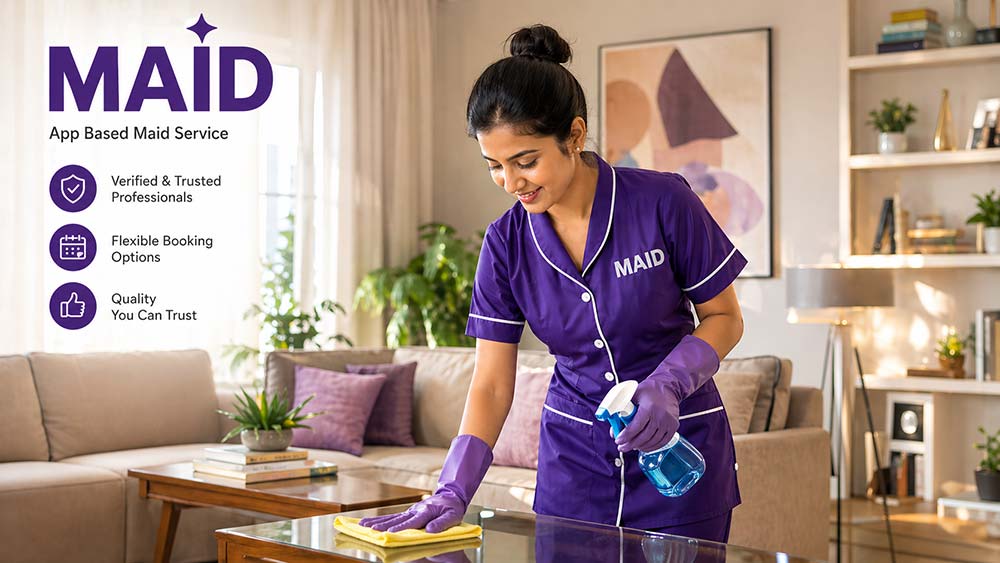
The future of domestic help in India will not be decided by an app or a tradition. It will be decided by whether either system finally treats the worker as a professional.
Also Read:
- Digital Payments Under Threat: UPI Scams and Digital Arrest
- The Great AI Giveaway: How Big Tech and India Are Shaping the Future
FAQ: Maid Services
Are app-based maid services better than a traditional kaam wali bai?
App-based maid services offer verified workers, fixed pricing, and on-demand availability. A traditional kaam wali bai brings long-term familiarity, flexibility, and relationship-based trust. Neither is universally better — the right choice depends entirely on your household’s priorities and daily needs.
How do maid booking apps work in India?
Maid booking apps connect urban households with background-verified domestic workers through a mobile platform. Users select a service, choose a time slot, pay a fixed rate, and rate the worker after completion — making the entire process structured, transparent, and accountable.
Do app-based maid services help domestic workers earn more?
App platforms give domestic workers verified digital identities, consistent bookings, and access to a wider client base across house maid services. However, fixed platform pricing and fees can limit earnings, making formalisation a genuine but imperfect step forward for India’s domestic workers.
Conclusion
Maid services in India are being restructured — not by disruption alone, but by a long-overdue demand for reliability, dignity, and accountability on both sides of the relationship. The app did not create this need. It simply made ignoring it harder.
The app gave urban households control. It gave domestic workers visibility. Neither is enough on its own — but together they are forcing a conversation that Indian homes have avoided for decades.
Progress that does not protect the most vulnerable is not progress worth celebrating. How urban India treats its domestic workers — on an app or off it — remains the real measure.
For more insights on the shifts reshaping everyday life in India, follow my work on TrendVisionZ.
✍️ Guest Write with Us
At TrendVisionz, the digital venture of Nuteq Entertainment Pvt Ltd, we welcome contributors who share our passion for storytelling, digital marketing, and innovation. Whether it’s an article, case study, or industry insight that educates, inspires, or entertains — we’d love to feature your perspective.
- Explore our work: Nuteq Entertainment | TrendVisionz | Author Profile
- Read our newsletters: Transforming Lives | BizTech Chronicle | Nuteq Newsline | Growth Catalyst
- Guest Contributions: BizCatalyst360 | Praja Today
- Books: Go Mindfulness: Practices for Professionals Coached
- Join the community: LinkedIn Group – Digital Marketing & Content Creation World
- Connect with me: LinkedIn | Twitter | #StoryforBusiness
- Share your review: Leave your review on Google — your feedback helps us grow.
Follow me on Twitter or LinkedIn. Check out our website.
How to Contribute:
Send your pitch or draft to Editor: anujmahajan@trendvisionz.com
Additional Resources:
- Neethika, Alluri & Chilakarao, M. & Keerthi, Koluvula & Harshitha, Paidi & Lalitha, Marisetti & Lavanya, Motupalli. (2026). Maidly: Revolutionizing Instant Maid Services for Efficient and Spotless Homes. 10.1007/978-3-032-08253-4_40. ↩︎
- Tandon, A., & Rathi, A. (2024). Sustaining urban labour markets: Situating migration and domestic work in India’s ‘gig’ economy. Environment and Planning A: Economy and Space, 56(4), 1245–1261. ↩︎


