

A plant owner in Sahibabad walks me through his shop floor. Two web offset printing from 2008. Order book full through Q2. The new-line OEM quote sits at 18 crore with a 14-month lead time. He has neither the capital nor the wait window. His problem is not unusual. It is the unspoken reality of mid-tier Indian print.
Yet this is not a story of stagnation. The Indian print industry employs 2.5 million people across 250,000-plus companies. The packaging demand is expanding 8–12% annually. Demand is real. The capital to build that capacity is harder to find. Most mid-tier plants quietly turn away work they could otherwise run.
As a digital growth strategist driving measurable pipeline growth across businesses, my lens on print plant expansion is rooted in capital allocation logic, not equipment specifications. Evaluated correctly, capacity expansion behaves like a balance sheet decision governed by leverage discipline, payback period, and lifecycle economics, not OEM sales architecture.
This in-depth analysis examines how web offset technology is evolving in 2026. Our team highlights the capacity squeeze mid-tier plants navigate. If you are planning to scale operations or expand print capacity, this blog is for you. It breaks down the economics, risks, and capital decisions shaping Indian print in 2026.
Also Read:
Web Offset Printing Still Anchors Indian Print Capacity in 2026
Web offset printing remains the production backbone of Indian print. Newspapers, magazines, packaging inserts, and long-run commercial work still depend on its scale economics. Before evaluating any print plant expansion route, operators first need to understand why this printing process continues to dominate production capacity decisions in 2026.
Continuous Feed Printing and Low Cost Per Impression
The continuous feed structure of web offset printing is what separates it from every other production format on the shop floor. Paper unwinds from large reels through inked plate cylinders at high speed, allowing industrial-scale production throughput that digital and sheet-fed systems struggle to match economically.
Once print volumes cross 50,000 copies, the economics change sharply. Newspaper runs touching lakhs overnight, educational publishing, and FMCG insert volumes still rely on web offset because cost per impression improves with scale instead of weakening under load.
Growing Demand for Web Offset Printing in India
Regional language newspapers remain one of the strongest demand layers in India. Hindi, Marathi, Tamil, Telugu, and Bengali editions continue expanding across Tier-II and Tier-III markets, with web offset presses carrying the production load.
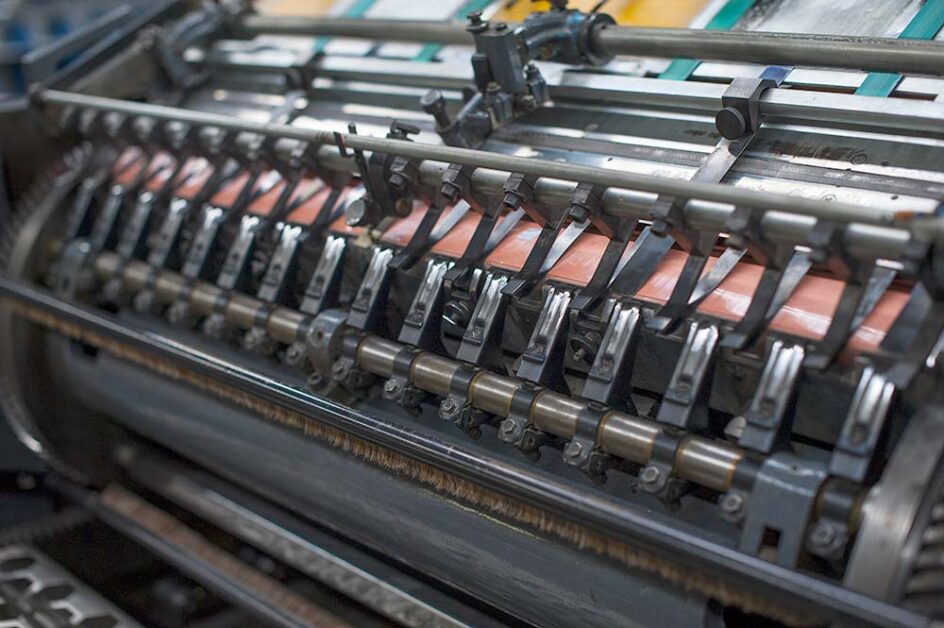
Packaging demand is the second growth engine. FMCG and pharma converters require continuous feed production capacity for cartons, inserts, and long-run print jobs that digital systems cannot absorb profitably at industrial scale.
Why is web offset printing still important in the Indian print industry?
Web offset printing remains critical because it delivers low cost per impression, high production throughput, and substrate flexibility for large newspaper, packaging, magazine, and commercial print runs. At industrial scale, no other printing process currently matches its economics.
Web offset printing is not a legacy format waiting to disappear. It remains the high-volume capacity layer of Indian print, which is exactly why the capital decision around it matters.
The Capacity Gap in Indian Print Plant Expansion
Public data tells one story about the Indian print industry. Plant floors tell a sharper one. Demand is expanding, but capacity addition remains concentrated. Mid-tier operators carry growing order books without matching press hall capacity.
How Capital Flows Differ Across Indian Print Segments
Capital allocation across Indian print is sharply divided. Large packaging converters absorb new-line capital expenditure through institutional debt, stronger balance sheets, and multi-year FMCG contracts that support expansion planning.
Mid-tier commercial and regional plants operate differently. Order books remain healthy, but working capital stays tight. A ₹15–20 crore press investment sits outside the comfort zone of most family-run print operations.
OEM sales architecture rarely reflects this divide. The same new-line pitch reaches both large packaging groups and regional newspaper plants, even though the economics behave very differently across those businesses.
Indian Print Industry Demand Sustaining Web Offset Capacity
Packaging demand continues expanding at 8–12% annually as FMCG and pharma brands increase SKU volumes. Every additional SKU adds insert, carton, and print workload pressure across the supply chain.
Regional language newspapers across Hindi, Marathi, Tamil, Telugu, and Bengali markets continue absorbing web offset printing capacity in Tier-II and Tier-III India. Educational publishing demand and election-cycle newspaper spikes add further production pressure.
These are not short-run digital workloads. They are long-run web offset production demands requiring industrial-scale throughput.
Why is print capacity not keeping up with demand in India?
Print capacity in India is constrained more by capital access than market demand. Mid-tier print plants often have sufficient workload to justify expansion but lack the balance sheet flexibility required for large new-line capital expenditure decisions.
Capacity is no longer a binary new-line or stagnate decision. The operators recognising the middle path are quietly pulling ahead.
Certified Pre-Owned Web Offset: A Capital-Disciplined Expansion Route
Five years ago, a used press machine was a survival move. In 2026, certified pre-owned web offset is a balance sheet decision. The shift is not sentimental. It is mathematical.
Inside a Certified Refurbished Web Offset Press Package
Certified pre-owned web offset presses are not unmanaged second-hand machines. A certified refurbished press follows a structured OEM-led restoration process designed to recover production throughput, operational reliability, and lifecycle performance without full new-line capital expenditure.
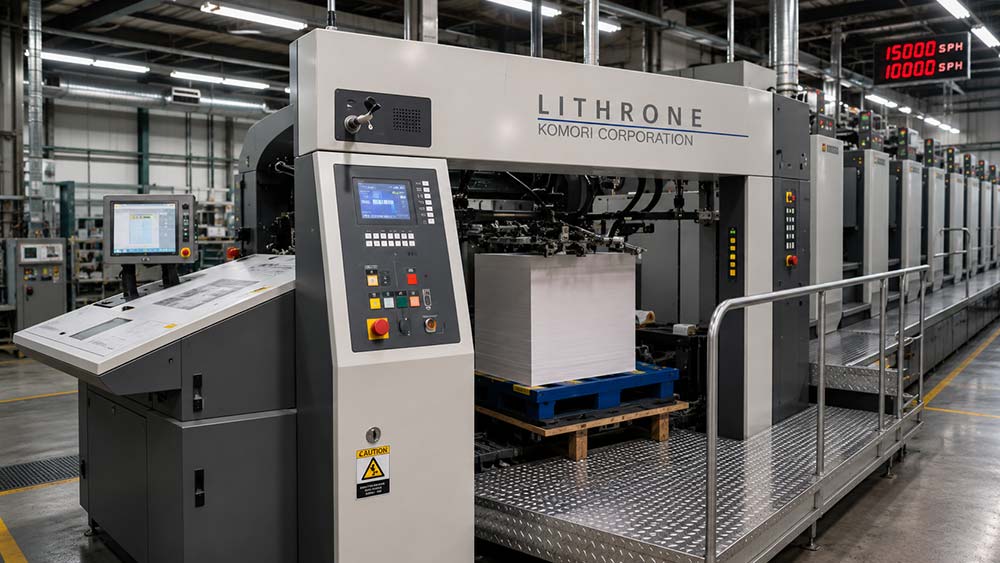
A certified refurbished press package typically includes:
- Mechanical restoration: Bearings, drives, ink rollers, blanket systems, and registration assemblies rebuilt to factory tolerance.
- Electronic upgrades: Updated control systems, modern HMI panels, and automated make-ready integration for current production environments.
- OEM component replacement: Worn parts replaced using manufacturer-approved current-generation components instead of aftermarket substitutions.
- Safety and compliance updates: Electrical systems, guarding, and operating controls aligned to current Indian industrial safety standards.
- Installation and commissioning: Press setup, calibration, testing, and production validation completed under OEM supervision.
- Operator training and support: Plant teams trained on updated controls, maintenance routines, and production optimisation workflows.
Manufacturer warranty support and a long-term spare parts roadmap complete the package. For most Indian print plants, the objective is not cheaper machinery. It is reliable print capacity with lower balance sheet pressure and faster payback periods.
The Real Economics of a Pre-Owned Web Offset Press
The economics of certified pre-owned web offset presses are no longer incremental. They materially change how Indian print plants approach print capacity expansion, balance sheet leverage, and payback period planning without carrying the financial pressure of full new-line capital expenditure.
Print capacity expansion is no longer driven by machinery ambition alone. In 2026, the strongest print businesses are the ones aligning production growth with capital discipline, utilisation visibility, and long-term operational flexibility. — Anuj Mahajan, Managing Director, Nuteq Entertainment
Key economic advantages typically include:
- Lower capital expenditure: Certified pre-owned presses usually cost 40–60% less than equivalent new-line installations.
- Faster commissioning timelines: Lead times compress from 12–18 months to roughly 4–6 months for operational deployment.
- Shorter payback period: Most print plants recover investment within 2.5–3.5 years instead of the typical 5–7 year new-line cycle.
- Faster capacity utilisation gains: Production throughput improvements often become visible within six months of commissioning.
- Reduced balance sheet pressure: Lower acquisition cost preserves financial flexibility for future print plant expansion decisions.
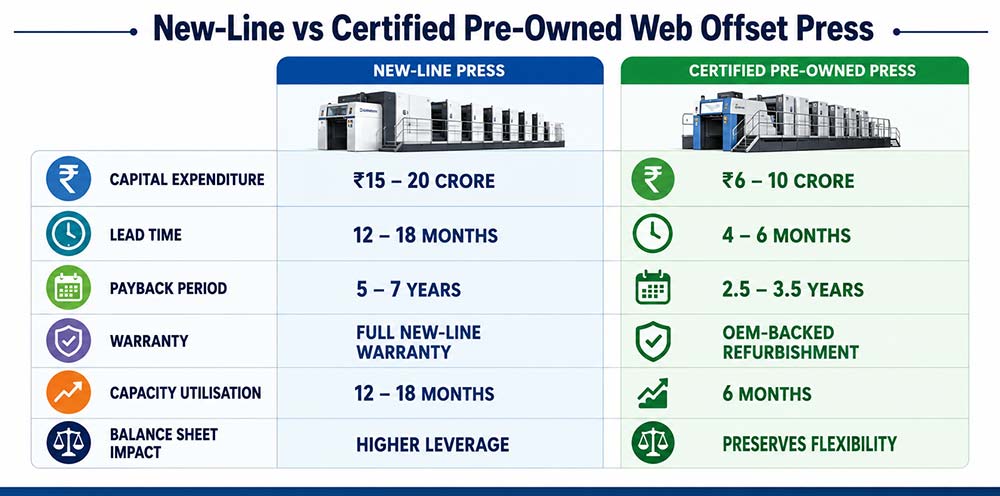
The financial gap between new-line and certified pre-owned becomes clearer when the economics are compared directly.
| Decision Parameter | New-Line Press | Certified Pre-Owned |
| Capital Expenditure | ₹15–20 crore | ₹6–10 crore (40–60% lower) |
| Lead Time | 12–18 months | 4–6 months |
| Payback Period | 5–7 years | 2.5–3.5 years |
| Manufacturer Warranty | Full new-line warranty | OEM-backed refurbishment warranty |
| Capacity Utilisation Gain | Visible in 12–18 months | Visible in 6 months |
| Balance Sheet Impact | Higher leverage burden | Preserves flexibility |
How much does a certified pre-owned web offset press cost compared to a new-line press?
A certified pre-owned web offset press in India typically costs ₹6–10 crore compared to ₹15–20 crore for a new-line press. The lower capital expenditure allows print plants to expand production throughput faster while reducing balance sheet pressure and shortening the payback period.
The certified refurbished press route is no longer a compromise. It is a capital-disciplined growth lever. Plants treating it as strategy are quietly outperforming those still anchored to new-line as default.
New-Line Web Offset Press: A Decision Framework for Indian Print Plants
Not every print plant expansion should default to pre-owned. Discipline lies in knowing which route does which job. The framework is simple. Most plant owners skip the math under sales pressure.
The Utilisation and Balance Sheet Test for New-Line Capital Expenditure
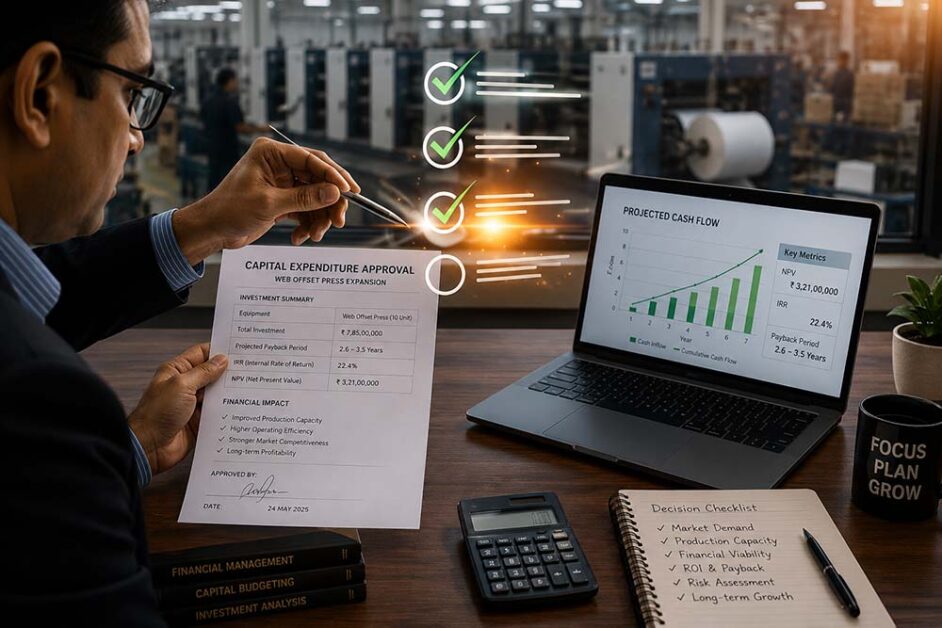
New-line capital expenditure makes sense when two conditions hold together, not separately. The first is utilisation. The second is leverage.
If projected capacity utilisation crosses 75 percent within 18 months and the work mix demands automation available only on current-generation presses, new-line economics hold. Below that threshold, pre-owned wins on every metric that matters to a non-listed plant.
Debt-to-EBITDA ratio post-acquisition is the second test. A new-line press that pushes balance sheet leverage past 3.5x is a growth move that compromises future flexibility. Even when the order book justifies it on paper, the cost of that leverage shows up in the next downturn.
Plants that get this right run the numbers before signing. They model utilisation under realistic order pipelines, not optimistic ones. They stress-test the debt servicing ratio against 12 months of slower collections.
When should a print plant choose new-line over certified pre-owned?
A new-line press wins when projected capacity utilisation crosses 75 percent within 18 months, the work mix demands current-generation automation, and post-acquisition debt-to-EBITDA stays below 3.5x. Below these thresholds, certified pre-owned delivers stronger capital expenditure economics with comparable production throughput.
Capex discipline is not about spending less. It is about ensuring each rupee deployed protects optionality for the next investment cycle, the next demand shift, the next technology transition.
Common Pitfalls When Buying a Pre-Owned Web Offset Press
The pre-owned press market has matured. The failure modes have not disappeared. They have moved. Plants treating certified refurbished as “cheaper new” miss the operational discipline this route demands across vendor, parts, training, and validation.
Plant owners evaluating certified pre-owned web offset capacity in 2026 should pressure-test four areas before signing the order.
- Vendor certification depth: OEM-certified refurbishment is not the same as third-party refurbishment using OEM parts. The first carries full manufacturer accountability. The second does not.
- Spare parts roadmap: Confirm 10-year parts availability in writing, not in sales conversation. Parts disputes in year four destroy the payback period maths.
- Operator training transfer: Refurbished presses with updated controls demand retraining. Budget it upfront. Skipping this turns production throughput gains into downtime.
- Production throughput validation: Test under load conditions before commissioning, not after delivery. Bench tests do not predict shop floor behaviour.
Most plants fail on the first trap. They assume any refurbished press is the same as another. The gap between OEM-certified and third-party refurbishment shows up in year three, when parts requests get delayed and warranty claims get contested. By then, the savings on acquisition have been erased.
Vendor verification is not paperwork. It is the foundation of the entire pre-owned economics argument. The certified pre-owned route rewards plants that treat it as a capital decision, not a discount transaction.
FAQ: Pre-Owned Web Offset Printing
Is a pre-owned web offset printing a reliable alternative to a new-line investment?
A certified pre-owned web offset printing press delivers comparable production throughput to new-line at 40 to 60 percent of the capital expenditure. Reliability depends on OEM refurbishment depth, parts availability, and warranty coverage, not on the press age.
What is the typical payback period for a pre-owned web offset printing in India?
Certified pre-owned web offset printing installations in India typically reach payback within 2.5 to 3.5 years, against 5 to 7 years on new-line. Lower capital expenditure, faster commissioning, and improved capacity utilisation drive the shorter payback period cycle.
When should a print plant choose a new-line press instead of a pre-owned system?
A new-line press wins when projected capacity utilisation crosses 75 percent within 18 months, the work mix demands current-generation automation, and balance sheet leverage stays below 3.5x post-acquisition. Below these thresholds, pre-owned wins.
Conclusion
Web offset printing is not an equipment purchase. It is a balance sheet decision. Capex discipline and a 2.5 to 3.5 year payback period sit at the centre of every capacity choice print plants make in 2026.
Packaging demand is growing at 8 to 12 percent. Regional print continues to expand. Yet capital allocation across the Indian print industry remains uneven, with mid-tier operators carrying the order book without matching press hall capacity.
The discipline that protects every rupee lies in utilisation thresholds, balance sheet leverage checks, and avoiding the four pre-owned acquisition traps. Print plant expansion now belongs to operators treating capacity as capital-disciplined growth, not OEM-led capex.
TrendVisionz brings grounded insights on industrial growth, OEM ecosystems, and capital-led business strategy through our Worth category. Stay with us for industry analysis that helps capital decisions hold long after the purchase order is signed.
Stay Connected with Me
Anshuman Mahajan is a Digital Marketing Strategist, SEO Specialist, and Co-Founder of TrendVisionz. With expertise in ROI-focused growth strategies, brand development, and media solutions, he helps businesses navigate the fast-changing digital landscape with clarity and confidence.
- Explore my work: TrendVisionz | Nuteq Entertainment
- Read our newsletters: BizTech Chronicle
- Guest writer: BizCatalyst360 | Industry Blogs
- Courses & Certification: B.Com (Hons), University of Delhi | Digital Marketing (Shaheed Sukhdev College of Business Studies) | SEO Internship, ClickSlice (London)
- Join the community: LinkedIn Group – Digital Marketing & Content Creation World
- Connect with me: LinkedIn | BizTech Chronicle | #GrowWithAnshuman
- Share your review: Leave your feedback on Google — it helps us grow.
- Subscribe: Be part of our 1.95 Lakh+ YouTube family
Believe. Transform. Succeed. Let’s grow together.


