
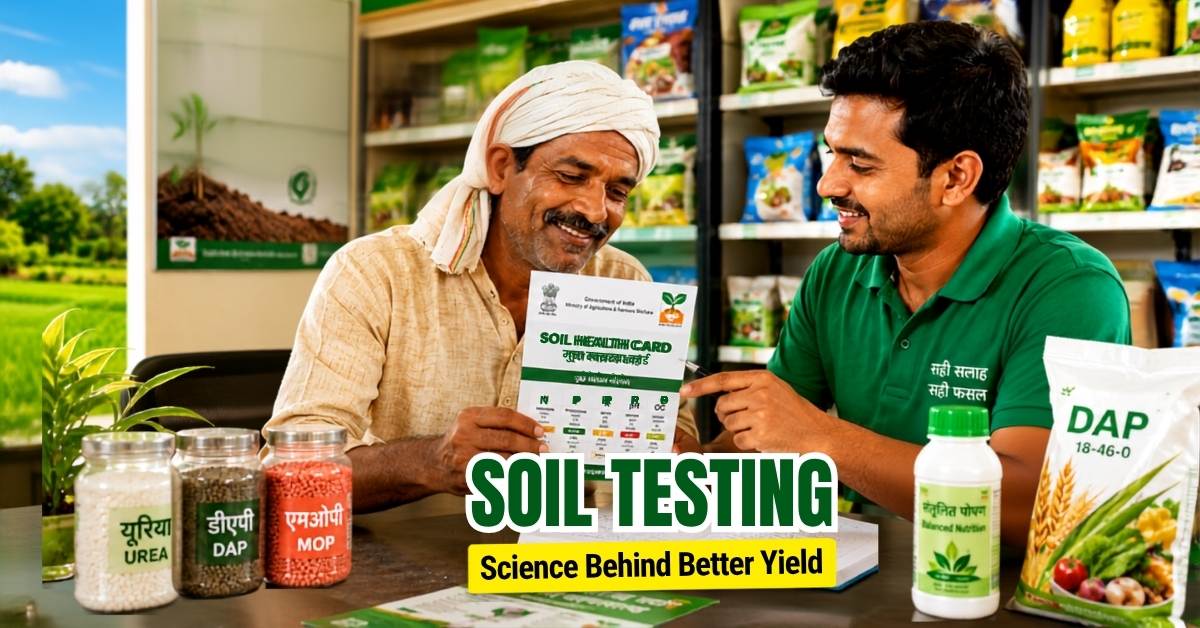
Most farmers blame the soil. When a crop disappoints, the excuses come easy — poor weather, bad luck, a tired field. The modern Indian farmer has stopped guessing. He reads a soil health card first, then decides. Soil testing has become his starting point, not an afterthought.
The shift is recent. Before the Soil Health Card scheme, more than nine in ten farmers had never tested their soil. They fed the land by memory. The scheme under the National Mission for Sustainable agriculture, has now generated over 25.79 crore cards, with more than 97.5 lakh samples collected in 2025–26 alone. Digital soil maps are taking the data plot by plot.
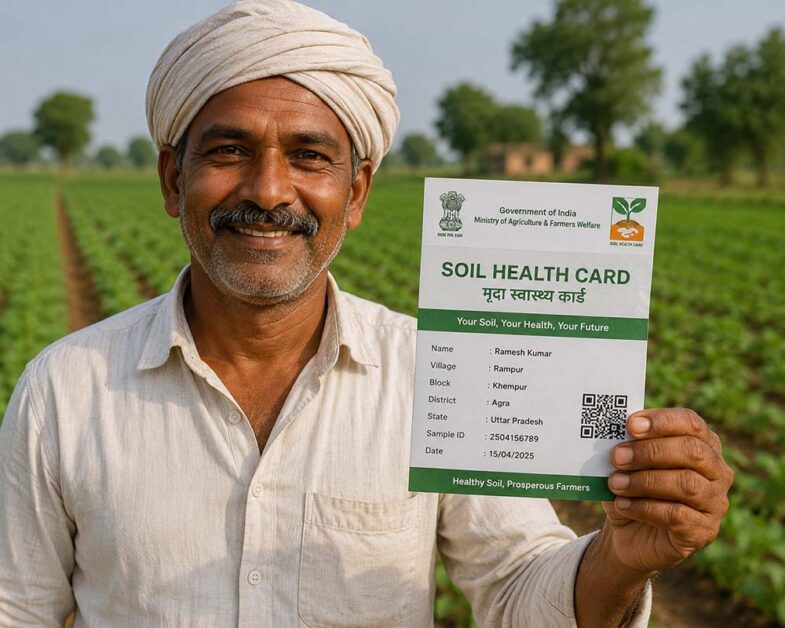
My work in communication and media has taken me across rural India, listening to how farmers actually think and work. During a shoot at CSSRI, Prof. Tripathi showed me the right method of soil testing and explained why soil health sits at the centre of crop productivity. One lesson stayed with me. You cannot manage what you have not measured. The bag of fertilizer was rarely the problem. The guess behind it was.
This featured article explains why soil testing has become essential to modern Indian farming. It shows how a soil health card guides smarter input decisions, cuts waste, and lifts yield — the same way before Kharif and before Rabi. Know the soil first, then feed it with crop specific fertilizers.
Also Read:
- Agentic AI in Education: India’s Governance Architecture Before the Technology
- App-Based Maids vs Kaam Wali Bai: India’s Quiet Labour Shift
The Hidden Cost of Farming Without Soil Data
For the farmers in India, every input decision starts with one question. What does this soil actually need? Without that answer, even good fertilizer is a guess. Soil testing replaces the guess with a number.
Soil testing tells a farmer exactly what his land lacks. Inputs then match real need instead of habit. The result is balanced nutrition, lower input waste, and a yield built on data rather than tradition — the same logic every season.
The Cost of Farming Without Soil Data
Blind input use carries a hidden cost, and it shows up in two places at once. Money goes to nutrients the soil never needed, season after season. Excess nitrogen then acidifies the land, and organic carbon steadily drops. A field fed by habit slowly loses the very fertility that habit assumes is still there. The waste is twice over. The farmer pays for the wrong input now, and pays again later in tired, unbalanced soil that yields less each year. Sustainable food systems increasingly begin at the farm itself, where better soil management influences everything from productivity to the environmental footprint of the supply chain.
How Testing Connects Directly to Yield
The link from testing to yield is direct and easy to follow. A test finds the limiting nutrient. The farmer corrects that one shortfall, and the crop responds exactly where it was being held back.
The benefits1 of soil testing are measurable. Studies on Soil Health Card recommendations show that farmers who apply nutrients according to soil requirements spend less on inputs and achieve better crop productivity.
Soil Testing by the Numbers
Farmers who match nutrients to actual soil requirements consistently spend less and harvest more, according to national studies.
| Parameter | Without Soil Testing | With Soil Testing |
| Fertilizer application | Based on habit and routine | Based on soil requirements |
| Input costs | Higher due to over-application | 8–10% lower input use* |
| Crop productivity | Nutrient imbalances remain | 5–6% higher yields* |
| Soil health | Gradual decline in fertility | Balanced long-term nutrition |
| Decision-making | Experience and guesswork | Data-driven planning |
The national picture reflects the same shift. India’s food grain output has grown from 265 million tonnes in 2013–14 to a record 357 million tonnes in 2024–25. Better input management, supported by soil testing, has contributed to this progress.
A soil test turns a season of hope into a season of plan. You cannot correct what you have not measured.
What a Soil Health Card Reveals About Your Land
A Soil Health Card is the government’s free soil testing report on a farmer’s own field. It reads the soil, lists what the land holds, and recommends what to add. For most farmers, the guesswork ends right there on the page.
A Soil Health Card reports twelve parameters for a specific plot. These include nitrogen, phosphorus, potassium, pH, and organic carbon. Each reading points to a clear action, turning soil testing2 into a simple, plot-level decision.
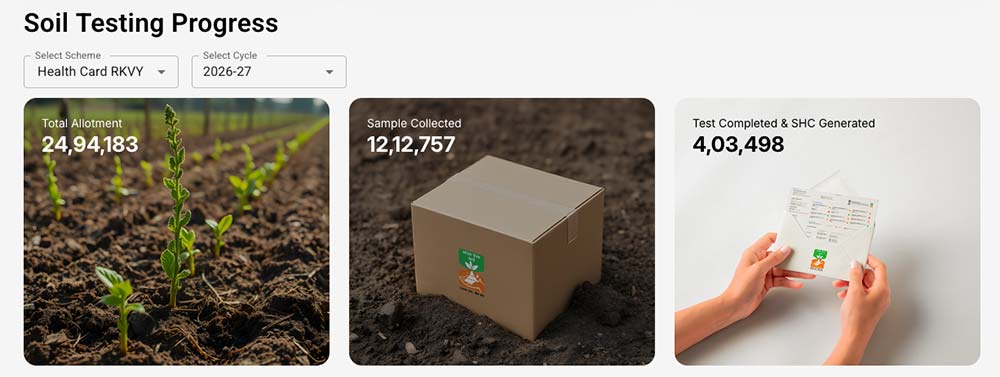
Most agricultural experts recommend testing the same field once every two to three years. Farmers should test sooner when introducing a new crop, bringing fresh land under cultivation, or when yields decline without a clear reason. Regular soil testing keeps fertilizer decisions aligned with the changing needs of the soil.
The Twelve Readings a Soil Health Card Records
Every card measures twelve parameters from a single plot. Together they describe the soil’s nutrients, its chemistry, and its long-term health in three simple groups.
- Major nutrients: Nitrogen, phosphorus, and potassium show what the standing crop will draw on most.
- Soil reaction: pH and electrical conductivity reveal whether those nutrients stay available or lock away.
- Living health: Organic carbon and key micronutrients signal the soil’s strength and nutrient balance.
How Each Reading Guides a Fertilizer Decision
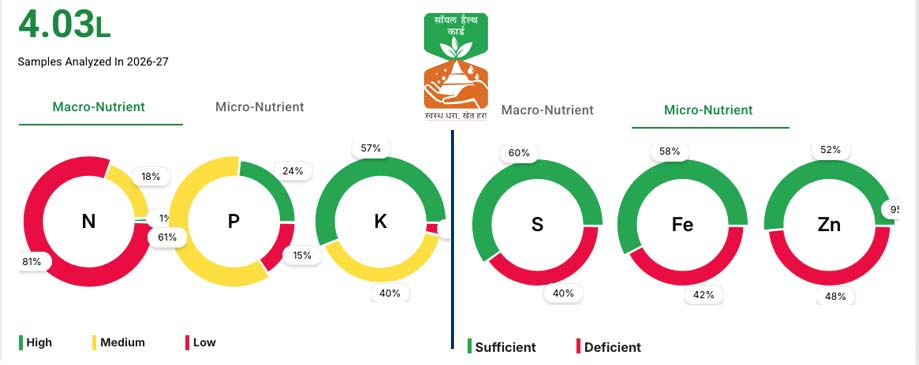
The broader trends only become useful when they guide action on an individual farm. Every number on a Soil Health Card points towards a practical decision for the next crop cycle.
- Low nitrogen: Apply a measured urea dose, matched to the crop and not to habit.
- High pH: Correct the alkaline soil before sowing, since it quietly locks up nutrients.
- Low organic carbon: Return organic matter to rebuild tired, overworked land before the next season.
The value of a Soil Health Card lies in the decisions it changes. When farmers understand what the soil needs, every bag of fertilizer works harder and every season becomes a little more predictable.
Soil Test Reports: Turning Lab Numbers Into Field Decisions
Holding a report and using it are two different things. A page of numbers means little until it becomes a plan. Reading a soil test well is what turns raw data into a better-fed crop and a sharper decision at the counter.
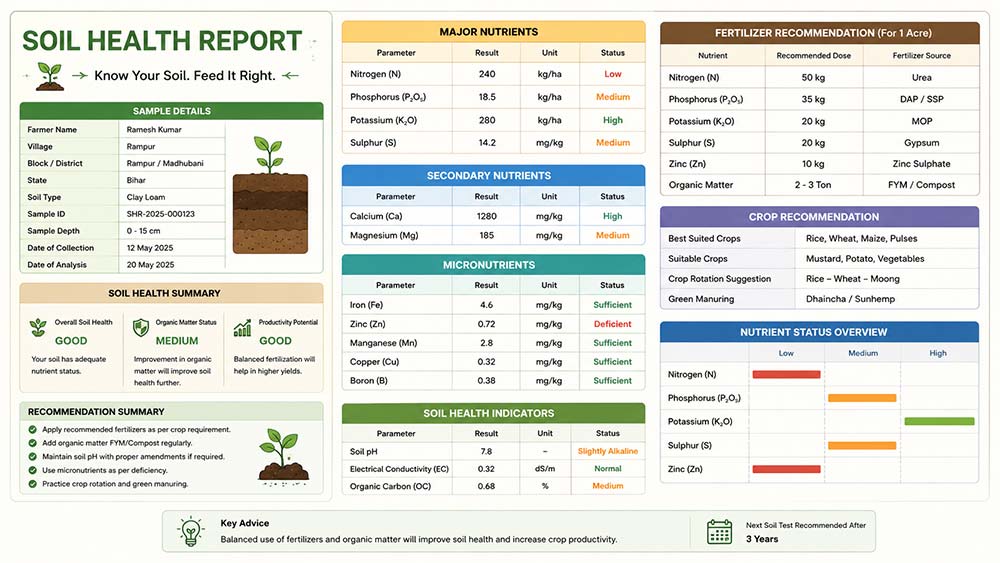
The Reading That Converts a Shortfall Into a Dose
A soil test report does one job. It converts lab readings into a clear instruction for the next crop. Take a common result. The report shows low phosphorus and a slightly acidic pH. The path follows on its own. Add the advised phosphatic dose, then correct the acidity before sowing. Each flagged shortfall points to one specific input. Low nitrogen calls for a measured nitrogen source. A pH problem calls for a soil amendment, not more fertilizer. The report does the thinking. The farmer does the matching.
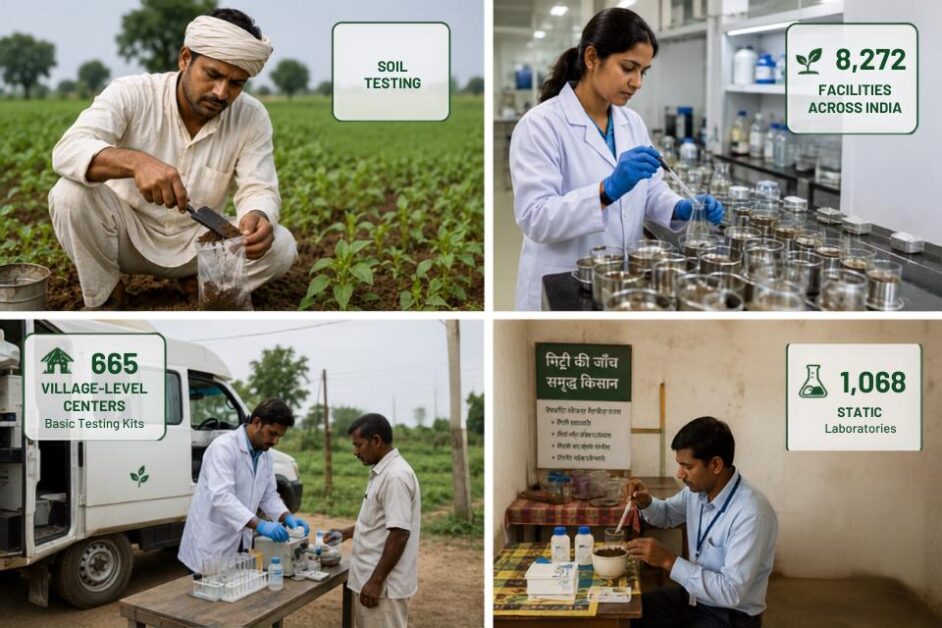
The system that supports this shift is extensive. India now operates 8,272 soil testing facilities, including 1,068 static laboratories, 163 mobile units, 6,376 mini-labs, and 665 village-level centres. Together, they bring scientific soil analysis closer to the field and strengthen the Soil Health Card programme, which tracks twelve key soil parameters for every plot. Private agritech startups are also expanding access to precision farming, digital advisories, and farm intelligence across rural India. Blockchain-based agricultural systems are beginning to improve traceability, data sharing, and trust across the farming ecosystem.
How do you read a soil test report?
Read the report in three steps. First, check pH, because it decides whether nutrients stay available. Next, note the deficient nutrients flagged against your crop. Finally, follow the recommended dose for each one before sowing.
The value lies in interpretation. When a farmer understands the report, every input decision becomes more precise, every purchase more intentional, and every season better planned.
Soil Testing Cuts Input Costs and Protects Long-Term Soil
Soil testing saves a farmer money twice over. It cuts what he spends this season, and it protects the soil that has to earn for him in the next one.
- Stops over-fertilizing: Dosing by the report instead of habit ends payment for nutrients the field never needed that season.
- Lowers cost per acre: An acre dosed by routine often carries a full bag of urea too many. Trimming that excess at every application adds up to a clear, repeatable saving across the crop cycle.
- Protects soil health: Balanced, test-based nutrition keeps land productive season after season. Blind dosing does the opposite, acidifying the soil and draining the organic carbon that holds long-term fertility.
- Eases the national load: Untested urea overuse drives India’s fertilizer subsidy past ₹1.9 lakh crore a year. A large share of that spend is balance the soil never asked for.
- Holds across seasons: The same discipline works before Kharif and before Rabi, keeping the saving steady through the year rather than as a one-time gain.
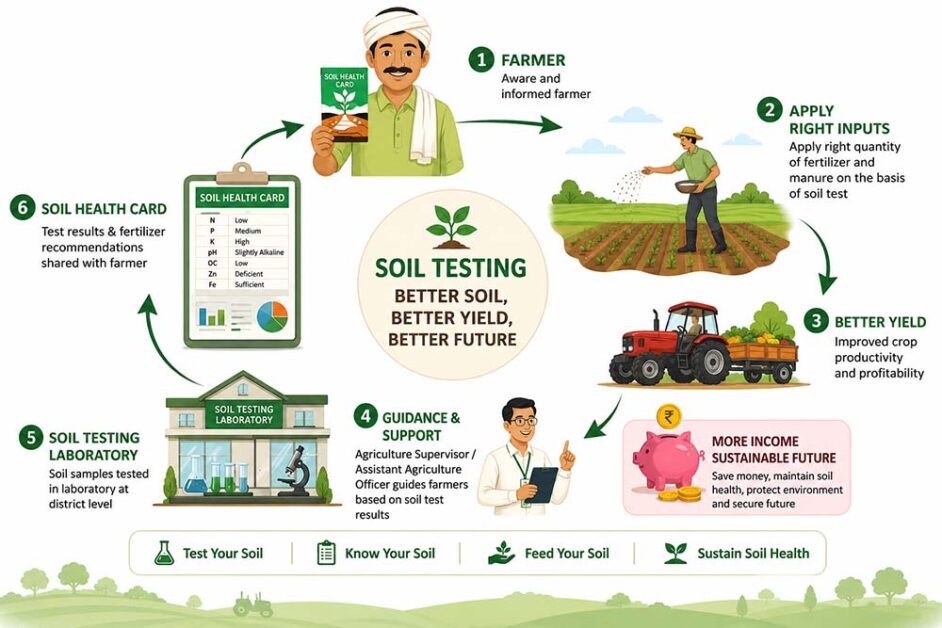
Soil testing is no longer an extra step. It is the foundation of cost control and sustainable yield in modern Indian farming. A tested field is a farm run on data, not on hope.
Also Read:
FAQs: Soil Testing
Yes. Soil testing identifies the nutrients a field actually needs, helping farmers avoid unnecessary applications. Studies on Soil Health Card recommendations show that balanced, test-based use can lower input consumption while maintaining or improving productivity.
A Soil Health Card records twelve soil parameters, including nitrogen, phosphorus, potassium, pH, organic carbon, and micronutrients. It also recommends crop-specific fertilizer doses, helping farmers make field-level decisions based on scientific measurements.
Soil testing is expanding because farmers are focusing on input efficiency and sustainable farming. The growth of laboratory networks, mobile units, and village-level centres has made scientific soil advice more accessible across rural India.
Conclusion
Soil testing has moved from agricultural science to everyday farm management. The farmer who understands his soil spends better, applies nutrients with precision, and plans each season with greater confidence. Data is replacing habit, one field at a time.
The value is practical and measurable. Soil testing improves input efficiency, supports sustainable farming, and helps protect the long-term health of the land. Before Kharif or before Rabi, the principle remains the same: know the soil first, then decide what it truly needs.
Years of travelling through rural India have taught me that the biggest changes in farming begin with better decisions, not bigger investments. In the featured section of Trendvisionz, we explore these shifts through our Modern Society stories, documenting how agriculture, communities, and everyday life in India continue to evolve.
Additional Resource:
- Tiwari, T., Sharma, S., Singh, K. K., & Sachan, R. (n.d.). Importance of soil testing in sustainable agriculture. In Sustainable Agriculture (Chapter 10). Chandra Shekhar Azad University of Agriculture and Technology, Kanpur. ↩︎
- Meena, Hari & Sharma, R & ., Roohi. (2018). Soil Testing Scenario in India and Its Significance in the Balanced Use of Fertilisers. International Journal of Plant & Soil Science. 22. 1-7. 10.9734/IJPSS/2018/39962. ↩︎
About Anuj Mahajan
Anuj Mahajan is a media entrepreneur, author, filmmaker, and Managing Director of Nuteq Entertainment. With more than 32 years of experience across media, communication, leadership, and business growth, he writes about communication architecture, human behaviour, leadership, mindfulness, business transformation, and decision-making.
He is the Co-Founder of TrendVisionZ, author of three books, creator of the StoryforBusiness podcast, and publisher of the Transforming Lives newsletter.
Explore the Ecosystem
- Explore my work: Nuteq Entertainment | TrendVisionz | Author Profile
- Read my newsletters: Transforming Lives | BizTech Chronicle | Nuteq Newsline
- Guest writer: BizCatalyst360 | Praja Today
- Books: Go Mindfulness: Practices for Professionals Coached
- Join the community: LinkedIn Group – Digital Marketing & Content Creation World
- Connect with me: LinkedIn | Twitter | #StoryforBusiness
- Share your review: Leave your review on Google — your feedback helps us grow.
- Listen on Spotify: Leadership Podcast | Guided NLP (7 Episodes) | Daily Motivation – 21 Episodes
Believe. Practice. Perform.


