
For decades, one bag did everything. The same all-purpose fertilizer went on wheat, on paddy, on cotton, season after season. That habit is fading. More farmers now reach for crop-specific fertilizers, matching nutrition to the crop and its growth stage. It is a quiet change, but it changes how a whole season gets decided.

Years in media kept me close to India’s farms. Time around commodity markets like NCDEX taught me to read inputs as economics. The shift to crop-specific practice tracks what science has long advised. IPNI’s 4R nutrient stewardship and ICAR field trials point one way — the right nutrient, the right amount, the right time. On the ground, I now watch farmers ask what a crop needs, not what the shop stocks.
This featured article explains why that shift is happening. Crop-specific fertilizers cut waste, lift yield, and protect the farmer’s margin. The change is not about a better product. It is about a farmer who decides with more care — a sign of Indian agriculture growing up.
Also Read:
- Women Entrepreneurs and PM Mudra: A Quiet Financial Uprising
- App-Based Maids vs Kaam Wali Bai: India’s Quiet Labour Shift
Why Crop-Specific Fertilizers Are Replacing Generic Approaches
Indian farming once followed a simple rule. The same fertilizer worked for every crop. That approach is changing as farmers increasingly understand that soil conditions, crop varieties, and growth stages require different nutritional support.
Crop-specific fertilizers supply nutrients according to a crop’s unique needs and growth stage, while generic fertilizers apply the same formula everywhere. Different crops require different NPK ratios, making precision nutrition more effective and economically sensible.
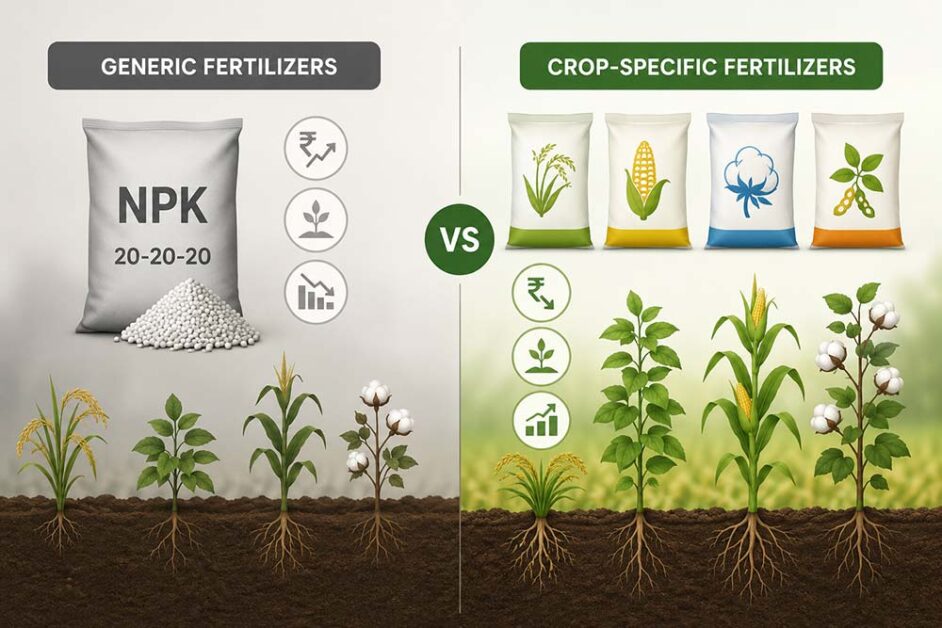
The Limits of One-Size Fertilizer
Convenience often came at the cost of efficiency. Applying the same nutrient mix across crops meant some nutrients remained unused while others stayed deficient.
During my work on agricultural films and interactions with farming communities, I have seen farmers move away from asking for a standard fertilizer bag. The discussion now centres on what a particular crop actually needs. That shift reflects growing confidence in scientific farming practices.
Field demonstrations by agricultural institutions have shown that matched nutrition can improve yields by 10 to 15 percent compared with routine fertilizer use, especially in nutrient-deficient soils. Of course, precision begins with trust. Farmers can only adopt crop-specific practices when they are confident that the nutrient composition printed on the bag matches what reaches the field, making certified fertilizers an important first step towards scientific farming.
Crop Nutrition Across Different Growth Stages
Nutrient demand changes throughout a crop’s life cycle. Nitrogen drives early vegetative growth and helps build strong foliage, while potassium becomes more important during flowering and fruit development. Micronutrients such as zinc and sulphur also play a vital role in improving grain quality and overall yield. Farmers adopting crop-specific fertilizers increasingly align nutrient application with these changing requirements, leading to better nutrient use efficiency and healthier crops.
Maize, sugarcane, and vegetable crops all follow different growth cycles and require crop-specific nutrient formulations to achieve better nutrient use efficiency. The lesson is straightforward. Precision begins when farmers recognise that crops are not interchangeable, and neither are their nutritional needs.
Balanced Nutrient Management and Better Crop Productivity
Crop-specific fertilizers work best when they follow a larger principle: balance. Modern farming is moving beyond the idea that adding more fertilizer automatically means better yield. The focus today is on supplying nutrients in the proportion a crop can actually use.
Balanced fertilization supplies macro and micronutrients in the ratio a crop actually uses, improving nutrient use efficiency and supporting healthier crop development throughout the growing season.
Correcting Hidden Micronutrient Deficiencies
Many productivity losses begin with deficiencies that farmers cannot easily spot during the early stages of growth.
- Zinc deficiency: Maize and paddy crops often show stunted growth and pale leaves when soil zinc levels remain low, affecting overall yield potential.
- Sulphur deficiency: Oilseeds and pulses require adequate sulphur for better protein formation and stronger plant development across the season.
During field interactions, I have seen farmers surprised by the visible improvement that follows a simple zinc or sulphur application. Sometimes, balanced nutrition solves problems that additional urea never could.
The 4R Approach and Nutrient Efficiency
The principle behind balanced fertilization aligns closely with the 4R Nutrient Stewardship framework promoted by agricultural scientists.
- Right source: Selecting nutrients suited to the crop and local soil conditions.
- Right time: Applying fertilizers according to crop growth stages for better absorption and yield optimization.
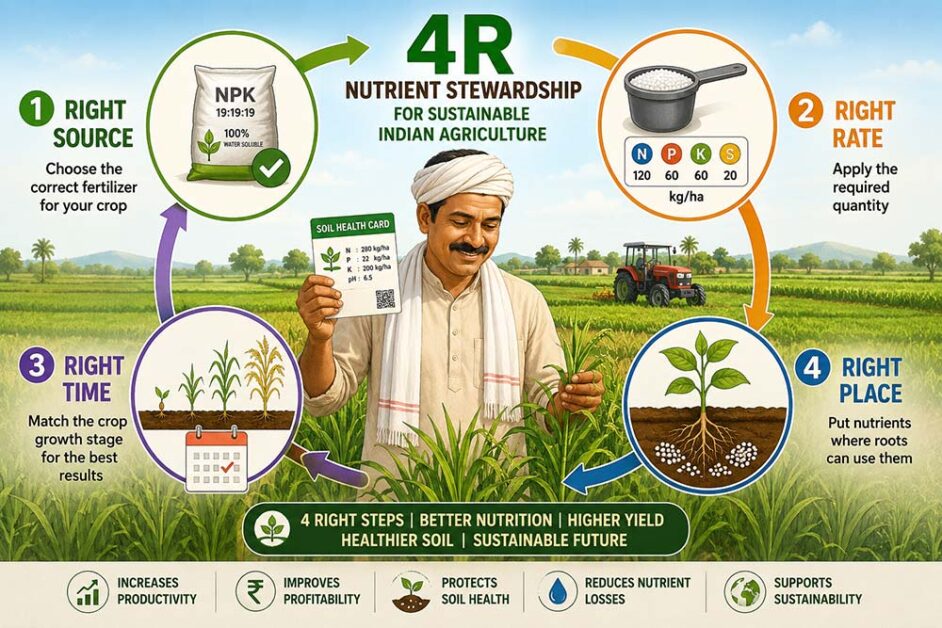
Studies under the 4R framework1 have reported nutrient use efficiency improvements of up to 15 to 20 percent, showing that precision and timing matter as much as quantity.
Indian agriculture is gradually learning an important lesson. Higher productivity comes from balanced nutrition, not from applying larger volumes of fertilizer.
Economic Benefits of Crop-Specific Fertilizer Practices
The shift towards crop-specific fertilizers is continuing because farmers can see the difference in their margins. Better nutrient planning improves productivity, controls input costs, and supports sustainable agriculture without increasing unnecessary fertilizer application rates.
Matched nutrition lifts yield per rupee of input, improving the farmer’s margin and helping optimize fertilizer use according to the actual needs of the crop.
Better Returns Through Smarter Input Decisions
The real calculation happens at the end of the season, not at the fertilizer shop. A slightly higher investment in customized fertilizer blends often delivers stronger yields and better crop quality, improving overall returns per acre.
A maize farmer following a generic fertilizer routine may spend less upfront, but balanced nutrition can raise productivity enough to offset the additional input cost. Agricultural studies have shown that nutrient-based management 2practices can improve farm profitability by 10 to 20 percent through better resource utilization and reduced wastage.
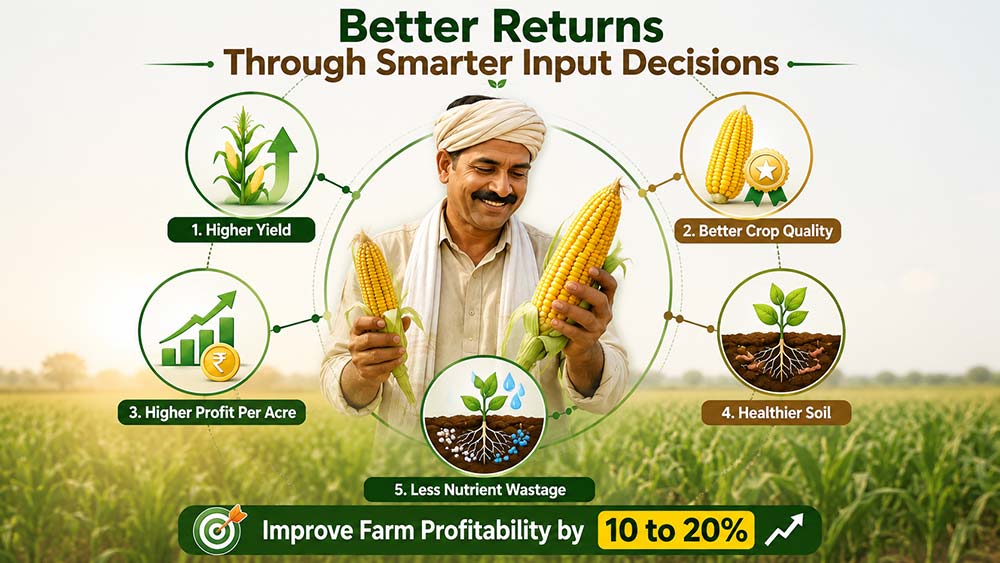
From my interactions with farming communities, I have seen experienced growers focus less on the price of a fertilizer bag and more on the value it creates over an entire season. That change in thinking is driving wider adoption of precision practices.
Why Does Precision Farming Deliver Better Returns Over Time?
Precision farming creates long-term value because improvements in nutrient use efficiency, soil health, and crop productivity accumulate across seasons. Farmers invest in better decisions today and benefit from healthier land and stronger margins year after year.
Precision is not a premium practice reserved for large farms. It is a practical investment that rewards farmers through balanced nutrition, higher productivity, and more dependable economic returns.
Precision Farming and Modern Agricultural Decisions in India
Precision nutrition3 is part of a broader shift in Indian agriculture. Farmers are increasingly combining soil data, digital tools, and precision-formulated fertilizer practices to make decisions that improve productivity and protect long-term soil health.

Many farmers begin their journey towards precision farming with soil testing. A Soil Health Card helps them identify nutrient gaps in the field. That information supports better crop-specific fertilizer choices and reduces dependence on routine application methods and traditional assumptions.
- Soil Health Cards: Millions of farmers now use soil-test reports to select fertilizers based on actual soil nutrient levels rather than routine applications.
- Crop-specific recommendations: Agricultural universities and extension services increasingly promote nutrient plans tailored to individual crops and local conditions.
- Digital advisory platforms: Mobile applications provide timely guidance on fertilizer application rates, irrigation schedules, and crop management practices.
- Precision-formulated fertilizers: Manufacturers are developing customized products designed for specific crops, improving yield optimization and reducing nutrient wastage.
- Sustainable agriculture practices: Better data helps farmers use fewer resources while maintaining productivity, strengthening both profitability and environmental outcomes.
The direction is clear. Trust certified inputs, understand the soil, and apply nutrients with precision. That combination is helping Indian agriculture become more scientific, productive, and economically resilient with every passing season.
Also Read:
FAQs: Crop-Specific Fertilizers
Balanced fertilization supplies macro and micronutrients according to crop and soil requirements, while traditional practices often rely on routine applications. The balanced approach improves nutrient use efficiency, supports soil health, and helps farmers achieve more consistent yields over time.
Crop-specific fertilizers may sometimes cost slightly more upfront, but the higher yield, better nutrient utilization, and lower input wastage often improve overall farm returns. Many farmers view them as an investment in productivity rather than an additional expense.
Crop-specific fertilizers are often more effective because they match the nutrient requirements of individual crops. Generic fertilizers still have value, but tailored nutrition generally supports better productivity, healthier soils, and improved fertilizer efficiency over the long term.
Conclusion
The rise of crop-specific fertilizers reflects a deeper change in Indian agriculture. Farmers are moving beyond routine practices and making decisions based on soil conditions, crop requirements, and long-term farm economics. The shift is practical, not promotional.
Over the years, I have seen greater confidence among farmers who understand that better results come from precision rather than quantity. Balanced nutrition, efficient input use, and scientific planning are helping agriculture become more productive and sustainable with every season.
Indian farming is growing more informed and economically sharp. The future belongs to those who trust genuine inputs, read their soil carefully, and apply the right nutrition to the right crop at the right time.
At Trendvisionz, our Modern Society cluster explores how everyday decisions, technologies, and practices are reshaping communities and livelihoods. The evolution of Indian agriculture reflects that larger story, where informed choices, scientific thinking, and sustainable methods are creating a more confident rural future.
Additional Resources:
- Johnston, A.M. & Bruulsema, Tom. (2014). 4R Nutrient Stewardship for Improved Nutrient Use Efficiency. Procedia Engineering. 83. 10.1016/j.proeng.2014.09.029. ↩︎
- Jat, M. L., Saharawat, Y. S., & Gupta, R. (2011). Conservation agriculture in cereal systems of South Asia: Nutrient management and resource-use efficiency. Crop and Pasture Science, 62(10), 943–954. ↩︎
- Tripathi, Rahul & Shahid, Mohammad & Nayak, A.K. & Raja, R. & Panda, Bipin & Mohanty, Sangita & Thilagam, V. Kasthuri & Kumar, Anjani. (2013). Precision Agriculture in India: Opportunities and Challenges. ↩︎
About Anuj Mahajan
Anuj Mahajan is a media entrepreneur, author, filmmaker, and Managing Director of Nuteq Entertainment. With more than 32 years of experience across media, communication, leadership, and business growth, he writes about communication architecture, human behaviour, leadership, mindfulness, business transformation, and decision-making.
He is the Co-Founder of TrendVisionZ, author of three books, creator of the StoryforBusiness podcast, and publisher of the Transforming Lives newsletter.
Explore the Ecosystem
- Explore my work: Nuteq Entertainment | TrendVisionz | Author Profile
- Read my newsletters: Transforming Lives | BizTech Chronicle | Nuteq Newsline
- Guest writer: BizCatalyst360 | Praja Today
- Books: Go Mindfulness: Practices for Professionals Coached
- Join the community: LinkedIn Group – Digital Marketing & Content Creation World
- Connect with me: LinkedIn | Twitter | #StoryforBusiness
- Share your review: Leave your review on Google — your feedback helps us grow.
- Listen on Spotify: Leadership Podcast | Guided NLP (7 Episodes) | Daily Motivation – 21 Episodes
Believe. Practice. Perform.


