
If you’ve searched for contractor payroll vs. certified payroll, you’re probably trying to figure out which one applies to your business or whether you need both. The confusion is common, especially for contractors expanding into new projects or government-funded work.
Both terms involve paying contractors and maintaining payroll records. However, they serve entirely different purposes, follow different compliance requirements, and apply in very different business situations. Understanding those distinctions is essential before choosing the right payroll process.

As government infrastructure projects continue to create new opportunities, more businesses are encountering certified payroll requirements for the first time. Knowing how these payroll systems differ helps contractors stay prepared and make informed decisions with confidence.
In this guide, you’ll learn exactly what separates contractor payroll from certified payroll, when each one applies, and how to avoid the compliance mistakes that trip up first-time government contractors. By the end, you’ll know exactly which payroll process your business needs.
Understanding Contractor Payroll
Contractor payroll is the process of paying independent contractors, freelancers, and self-employed workers for services rendered. Unlike employee payroll, it doesn’t involve tax withholding, benefits administration, or employer-paid payroll taxes.
Contractor payroll covers payments to independent contractors, typically reported on Form 1099. Certified payroll is a mandatory weekly Form WH-347 report for federally funded construction projects, proving compliance with Davis-Bacon1 prevailing wage requirements.
Instead, businesses pay contractors their full agreed rate, and the contractor handles their own tax obligations. In the US, this is reported annually using Form 1099-NEC once payments to a 1099 employee exceed $600 in a calendar year.
Contractor payroll typically includes:
- Processing invoices or timesheets submitted by the contractor
- Paying the agreed rate without tax withholding
- Collecting a signed W-9 (US) or equivalent tax form before the first payment
- Issuing 1099-NEC2 forms at year-end for US-based contractors
- Maintaining basic payment records for tax and audit purposes
This process applies to almost any contractor relationship, from a freelance designer to an international software developer. Many businesses now use integrated business software to manage contractor onboarding, payment records, tax documentation, and compliance workflows. It’s flexible, low-overhead, and doesn’t require government reporting unless your business itself is later audited.
Certified Payroll Requirements
Certified payroll is a much narrower, legally mandated reporting requirement. It applies specifically to contractors and subcontractors working on federally funded or federally assisted construction projects in the United States.
Under the Davis-Bacon and Related Acts (DBRA), any contractor performing construction, alteration, or repair work on a federal contract over $2,000 must pay workers no less than the local prevailing wage, including fringe benefits. To prove this, contractors must submit a weekly certified payroll report.
The standard form for this is Form WH-3473, issued by the U.S. Department of Labor. While using WH-347 itself is technically optional, submitting the underlying weekly payroll data in that format is mandatory under the Copeland Act and 29 CFR § 5.5(a)(3)(ii).
Certified payroll reports must include:
- Each worker’s name and identifying number
- Correct job classification for every worker
- Daily and weekly hours worked, split between straight time and overtime
- Wage rates and fringe benefit details for each classification
- A signed Statement of Compliance certifying the payroll is accurate
Reports must be submitted weekly, within seven calendar days after the regular pay date, even during weeks when no work occurs on the project. A revised version of Form WH-347 took effect in January 2025 and becomes the only valid version for federal certified payroll reporting starting October 1, 2026, adding stricter fringe benefit and apprenticeship documentation requirements.
Contractor Payroll vs Certified Payroll Comparison
The table below breaks down exactly how these two processes differ across the factors that matter most for compliance.
| Factor | Contractor Payroll | Certified Payroll |
| Applies To | Any independent contractor relationship | Federally funded construction contracts only |
| Legal Basis | Standard tax law (IRS 1099 rules) | Davis-Bacon Act & Copeland Act |
| Reporting Frequency | Annual (Form 1099-NEC) | Weekly (Form WH-347) |
| Wage Requirements | Set by contract negotiation | Must meet local prevailing wage rates |
| Documentation | W-9, invoices, payment records | Worker classifications, hours, fringe benefits, signed compliance statement |
| Enforcement | IRS audit risk if misclassified | Department of Labor audits, wage restitution, contract disqualification |
| Penalty for Errors | Fines, back taxes, misclassification penalties | Withheld payments, wage restitution, audits, loss of future public contracts |
The right payroll process depends on the type of work your business performs. Standard contractor payroll applies to most independent contractor relationships, while certified payroll is mandatory only for qualifying federally funded construction projects that must comply with prevailing wage regulations.
Certified Payroll Eligibility Requirements
Understanding certified payroll requirements for contractors helps businesses meet reporting obligations and avoid costly compliance violations. You need certified payroll if your business meets all of the following conditions:
- You’re a contractor or subcontractor on a construction, alteration, or repair project
- The project is funded or assisted by the federal government
- The contract value exceeds $2,000
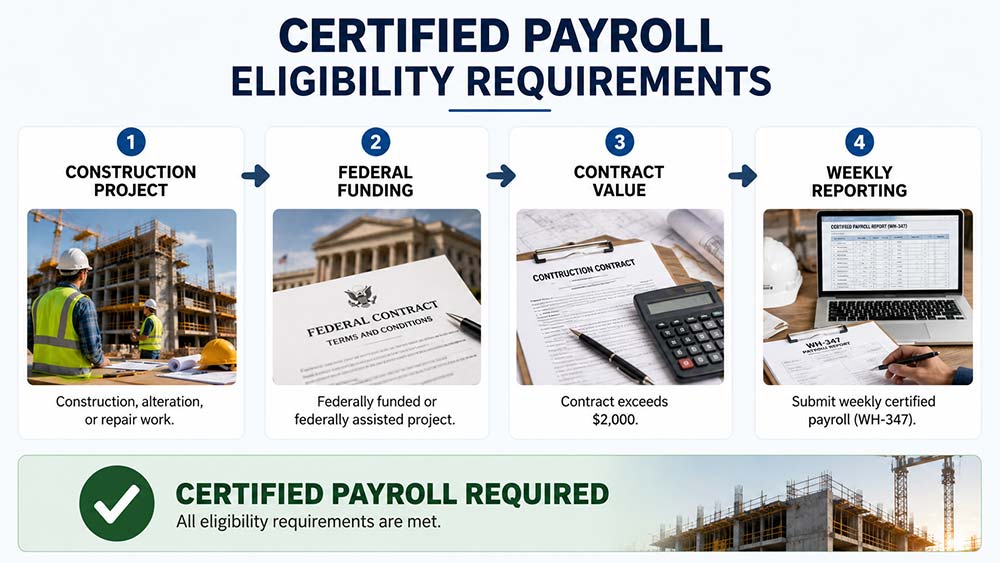
If all three apply, you must submit weekly WH-347 (or equivalent) reports for the duration of the project, including weeks with zero hours worked. Some states also require certified payroll for state-funded projects, so check local prevailing wage laws in addition to federal requirements.
Contractor Payroll Requirements
Standard contractor payroll applies to virtually every other independent contractor relationship: freelance designers, remote developers, marketing consultants, and any self-employed worker you pay for a defined scope of work.
The key compliance question here isn’t about wage rates; it’s classification. Misclassifying an employee as a contractor to avoid payroll taxes is one of the most common and costly payroll mistakes businesses make. Contractor wage reporting requirements vary depending on project funding, worker classification, and applicable labour laws.
Understanding the difference between contractors and freelancers, and between contractors and employees, protects you from back taxes, penalties, and employment law disputes.
If you’re managing a global contractor workforce, the classification question gets more complex. Rules differ by country, and what qualifies as a contractor in the US may look like disguised employment elsewhere..
Common Compliance Mistakes to Avoid
Both contractor payroll and certified payroll come with recurring, avoidable errors. Watch for these:
- Misclassifying workers: Listing a worker as a laborer when they perform skilled trade work (or vice versa) is a leading cause of certified payroll audits.
- Incorrect fringe benefit calculations: Fringe credits must match the hourly rate exactly. Small errors compound over a multi-week project.
- Missing apprentice documentation: Apprentices must be individually registered in an approved program, with the correct journeyworker-to-apprentice ratio maintained on-site.
- Late or missing weekly submissions: Certified payroll is due within seven calendar days of the regular pay date, even for zero-hour weeks.
- Inconsistent hours between timecards and payroll: Auditors cross-check field records against submitted payroll. Any mismatch invites scrutiny.
For standard contractor payroll, the biggest risk is treating contractor compliance as an afterthought. Missing W-9 collection, inconsistent payment records, and unclear scope-of-work documentation all increase your exposure if a contractor relationship is ever challenged.

Also Read:
- The Impact of Google Business Model on Modern Online Marketing
- What Families Should Do First After an ICE Detention
FAQs: Contractor Payroll vs Certified Payroll
No. Contractor payroll covers payments to independent contractors. Certified payroll is a legally required weekly report for federally funded construction projects that demonstrates compliance with prevailing wage laws under the Davis-Bacon Act.
Certified payroll is required for contractors and subcontractors working on federally funded or federally assisted construction projects exceeding $2,000. Weekly payroll reports must document wages, hours, worker classifications, and compliance with prevailing wage requirements.
Incorrect certified payroll reports can result in withheld payments, wage restitution, Department of Labor investigations, financial penalties, and possible disqualification from future government-funded construction contracts. Accurate reporting and timely submissions are essential for compliance.
Final Thoughts
Choosing between contractor payroll vs certified payroll starts with understanding the type of work your business performs. While contractor payroll supports most independent contractor relationships, certified payroll applies only to qualifying government-funded construction projects with strict compliance obligations.
Understanding these payroll requirements helps businesses avoid reporting mistakes, maintain accurate documentation, and meet legal obligations with confidence. A proactive approach to payroll compliance reduces audit risks and supports smoother project execution, especially when working on public contracts. Strong payroll governance also improves operational efficiency and supporting consistent compliance across projects.
Whether you’re managing private contractors or bidding for federally funded projects, selecting the right payroll process protects your business and strengthens long-term compliance. Stay informed with Trendvisionz for practical business insights, compliance guidance, and industry intelligence that support better operational decisions.
Discover more expert insights in our Worth category and Business Performance & Industry Intelligence cluster to make more informed business decisions.
Additional Resource:
- U.S. Department of Labor, Wage and Hour Division. (n.d.). Davis-Bacon and Related Acts. U.S. Department of Labor. ↩︎
- Internal Revenue Service. (n.d.). Independent contractor (self-employed) or employee? IRS. ↩︎
- U.S. Department of Labor, Wage and Hour Division. (n.d.). Form WH-347: Payroll (For Contractor’s Optional Use). U.S. Department of Labor. ↩︎


