
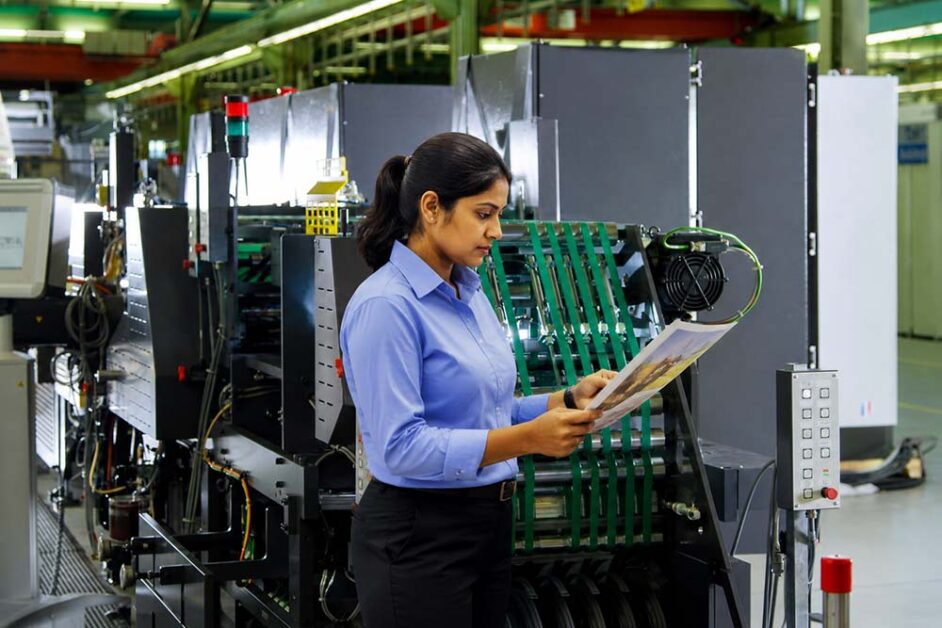
Raghav was clearly upset when the production schedule began slipping even though the press was still running. His team had missed early warning signs that better printing press maintenance could have identified before rising waste, repeated adjustments, and inconsistent output began affecting delivery commitments.
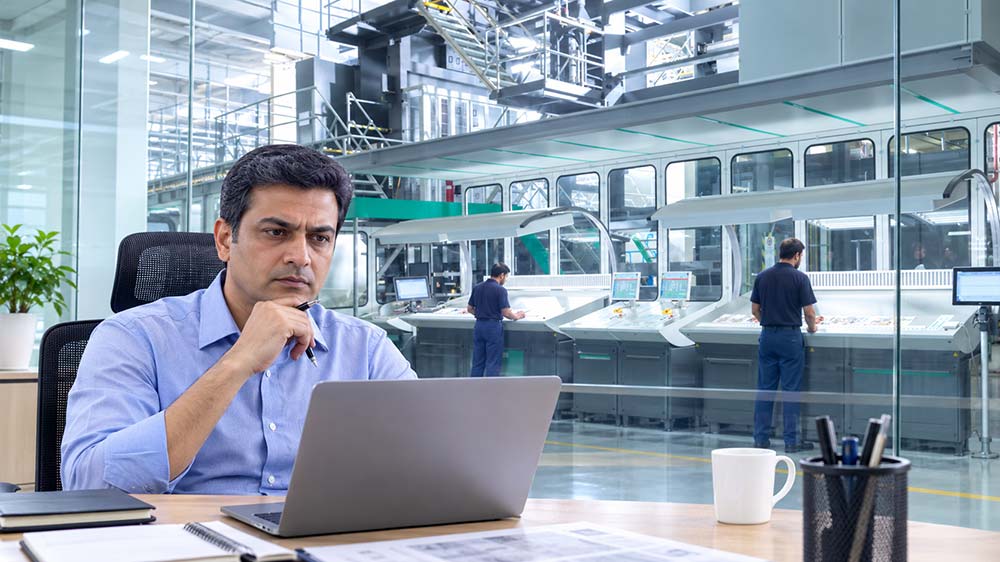
Printing press maintenance goes beyond servicing equipment after a breakdown. In India, routine servicing may cost a few thousand rupees, while major offset press repairs can exceed ₹50,000 depending on the machine and component. The larger cost appears when small maintenance issues grow into waste, disruption, and complex repairs.
At Trendvisionz, we combine current research with practical observations and insights from printing-industry professionals. This helps us examine how maintenance decisions influence production reliability, downtime, and long-term asset performance across real print operations.
The article explores the factors supporting long-term press reliability. The focus includes consumable condition, preventive maintenance, early fault detection, service continuity, downtime reduction, and lifecycle performance.
Also Read:
- Contractor Payroll vs Certified Payroll: What’s the Difference?
- Employee Burnout in India: The Silent Crisis Inside Modern Work
Pressroom Consumables and Print Performance
Pressroom consumables are the everyday materials and components that interact directly with the printing process. Their condition can influence output quality, waste, and machine behaviour long before a major fault becomes visible.
Pressroom consumables support consistent printing by controlling conditions around ink transfer, dampening, cleaning, lubrication, and contact surfaces. Blankets, rollers, chemistry, lubricants, and cleaning materials can influence print quality, waste levels, production stability, and the maintenance demands placed on a press.
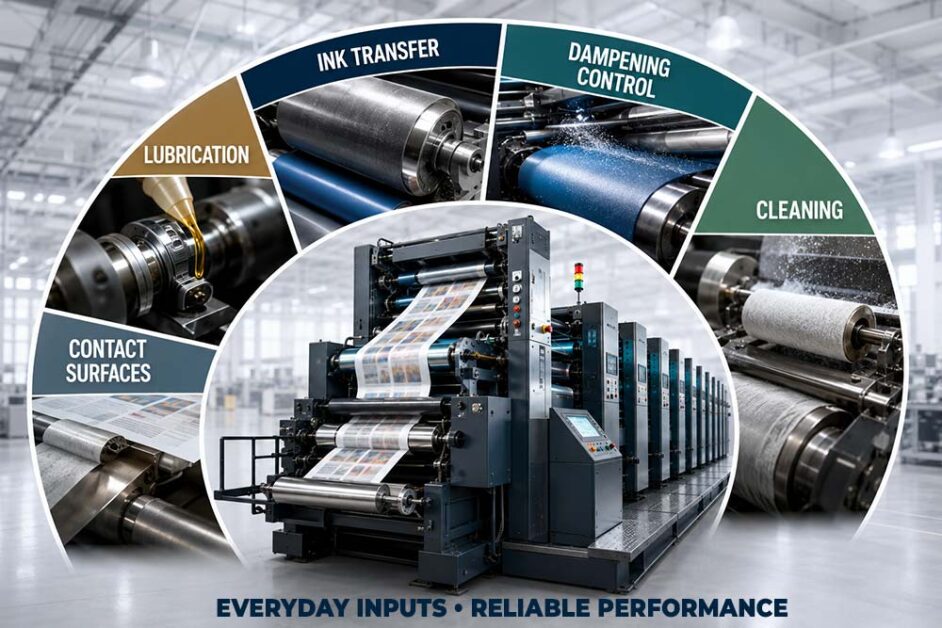
Key Categories of Pressroom Consumables
The main categories include printing blankets, printing press rollers, pressroom chemistry, lubricants, maintenance fluids, cleaning materials, and routine wear items. Each performs a different role, but together they help maintain stable conditions across daily pressroom operations.
Blankets influence image transfer, while rollers help control ink and dampening stability. Pressroom chemistry supports consistent process conditions. Cleaning materials prevent contamination from affecting critical surfaces, while lubricants and maintenance fluids reduce friction and protect moving components from avoidable wear.
Consumable Condition and Production Stability
Consumables rarely move from good condition to complete failure without warning. Gradual deterioration may first appear as print variation, rising waste, repeated operator adjustments, unstable ink transfer, longer makeready, or inconsistent performance between production shifts.
These signals matter because they can increase the maintenance burden before a larger mechanical problem develops. Monitoring consumable condition gives teams an opportunity to respond earlier, replace worn items at the right time, and prevent normal wear from placing unnecessary pressure on the press. Research on cost reduction and quality improvements in printing1 shows how tighter process control can support both production quality and operating efficiency.
Pressroom consumables therefore form the first operational layer around printing press reliability. Managing their condition consistently supports stable production and creates the foundation for preventive maintenance before breakdown becomes the trigger for action.
Preventive Maintenance and Production Reliability
Maintenance becomes expensive when action begins only after production has already been disrupted. Effective printing machine maintenance shifts the focus from emergency repair towards protecting output, reducing avoidable downtime, and keeping press performance predictable. Research into maintenance practice in the printing industry 2found that structured maintenance remains central to controlling equipment condition and production reliability.
Planned Maintenance Before Breakdown
Preventive maintenance works best when scheduled attention is combined with observation of actual press condition. The aim is to identify deterioration early without turning maintenance into a rigid checklist.
- Routine Inspection: Identify wear, looseness, contamination, abnormal movement, or performance drift before production is interrupted.
- Cleaning and Lubrication: Protect operating surfaces and moving components from friction, deposits, contamination, and avoidable mechanical stress.
- Wear Monitoring: Track components and consumables whose gradual deterioration can affect print quality, machine behaviour, or production stability.
This approach helps teams respond to developing issues while they are still manageable. It also reduces the risk of routine wear becoming an unplanned production problem. Efficient print finishing workflows also help reduce delays once press production is complete.
Maintenance Discipline Across Production
The stronger shift happens when maintenance becomes part of normal production discipline rather than a separate activity handled only when something goes wrong.
- Scheduled Intervention: Plan maintenance around production windows instead of allowing breakdowns to dictate schedules and delivery commitments.
- Maintenance Records: Maintain a usable history of recurring faults, component replacement, service work, and abnormal press behaviour.
- Operator Feedback: Treat repeated adjustments, unusual noises, rising waste, and recurring faults as maintenance signals rather than isolated incidents.
The real advantage of preventive maintenance is predictability. Planned attention reduces the chance that small deterioration develops into unplanned downtime and makes early warning signs easier to identify before production reliability is affected.
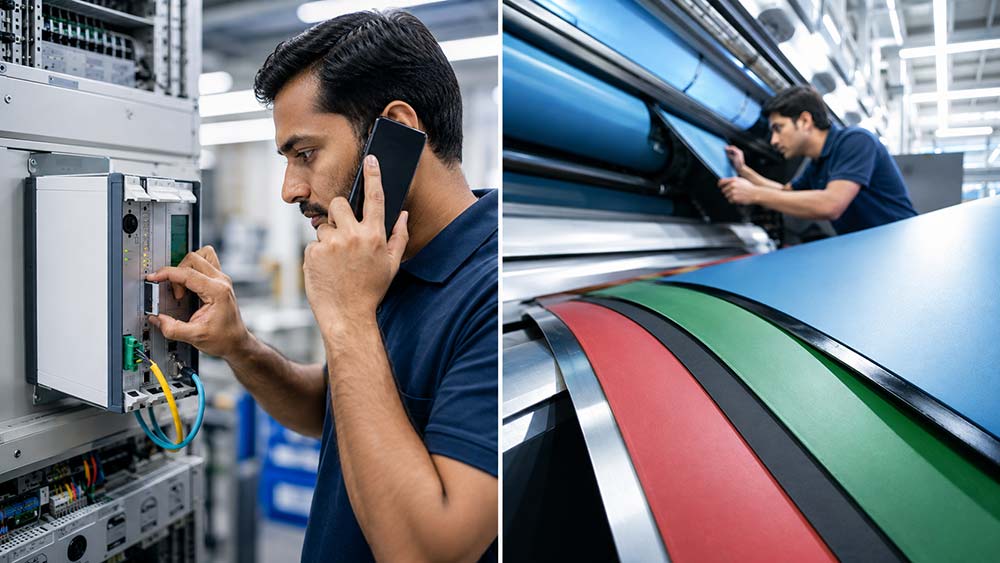
Early Signs of Press Performance Issues
A printing press rarely moves from stable operation to complete failure without warning. Reliability often weakens through small, repeated changes in output, setup time, waste levels, or machine behaviour that become easier to ignore during busy production.
Performance Drift Before Failure
Recurring print variation, rising waste, repeated operator corrections, slower makeready, inconsistent ink transfer, unusual vibration, or minor stoppages can all signal declining press performance. None of these automatically means a major fault, but repeated patterns deserve attention.
Individually, these issues may appear manageable. Together, they can point to equipment wear, contamination, deteriorating consumables, adjustment problems, or developing mechanical faults. Recognising that pattern early helps maintenance teams investigate causes before reliability falls further.
When Does a Printing Press Need Maintenance?
A printing press needs maintenance when recurring changes appear in print quality, waste, setup time, operating noise, vibration, component condition, or stoppage frequency. The clearest warning is a pattern showing that normal production increasingly depends on operator correction.
Early intervention protects production before breakdown becomes the only trigger for action. It also helps teams separate routine operating variation from problems that require deeper technical diagnosis or external service support.
Service Support and Technical Continuity
Reliable press performance depends on more than internal maintenance routines. As equipment ages, access to technical knowledge, compatible parts, service history, and experienced support becomes increasingly important for restoring production quickly and avoiding repeated faults.
Technical Knowledge Across the Press Lifecycle
Technicians need to understand more than the immediate fault. Knowledge of the specific press, its maintenance history, recurring issues, control systems, and operating behaviour helps narrow the diagnosis and reduces unnecessary trial-and-error during service intervention.
As presses remain in operation for many years, continuity becomes more valuable. Maintenance records, technical documentation, original equipment knowledge, compatible parts, and established service expertise help teams diagnose faults accurately, avoid unnecessary replacement, and reduce printing press downtime.
Parts, Diagnostics and Service Readiness
Three support factors often determine how quickly a press can return to stable production after a maintenance issue develops.
- Parts Availability: Access to suitable replacement components reduces delays when wear, damage, or component failure requires intervention.
- Accurate Diagnostics: Correct fault identification helps avoid unnecessary replacement and repeated maintenance on symptoms rather than the underlying cause.
- Technical Support: Experienced assistance becomes important when complex or recurring issues move beyond routine plant-level maintenance and require deeper technical knowledge.
Service continuity reduces uncertainty around maintenance decisions. Over time, disciplined support, accurate diagnosis, and timely intervention help protect the useful performance of installed printing infrastructure.
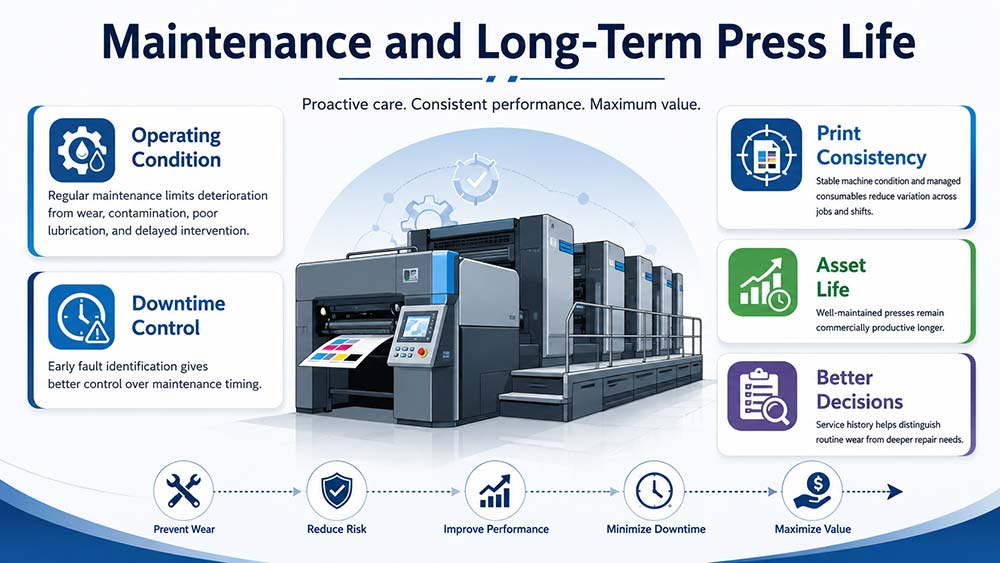
Maintenance and Long-Term Press Life
Printing press life depends partly on how well existing equipment is maintained during daily operation, especially as wear accumulates over years of production. Long-term press performance depends on how well existing equipment is maintained during daily operation.
Planned press modernization can complement maintenance when ageing systems begin limiting reliable performance. Good maintenance helps preserve dependable performance as wear accumulates over years of production.
- Protects Operating Condition: Regular maintenance limits deterioration caused by contamination, wear, poor lubrication, and delayed intervention.
- Reduces Unplanned Downtime: Early identification of developing faults gives plants greater control over when maintenance work is carried out.
- Supports Print Consistency: Stable machine condition and well-managed consumables help reduce unnecessary variation across jobs and production shifts.
- Preserves Useful Asset Life: Well-maintained presses can remain commercially productive longer because performance decline is monitored and managed.
- Improves Maintenance Decisions: Reliable service history helps teams distinguish routine wear from faults requiring deeper repair, component replacement, or specialist intervention.
Research into the long-term impact of maintenance policy3 shows how maintenance decisions influence lifecycle costs and capacity over time. Good maintenance does not determine whether a press should eventually be modernized or replaced. It protects current operating condition, supports dependable production, and helps installed equipment deliver useful performance for longer.
Also Read:
- 3D Photo Crystal: A Global Craft and Complete Buyer’s Guide for 2026
- How to Balance Travel and Remote Work in a Digital World
FAQs — Printing Press Maintenance
Service frequency depends on press type, workload, operating hours, and manufacturer guidance. High-volume presses generally require more frequent inspection than lightly used equipment.
Yes. Poor maintenance can increase waste, consumable usage, setup time, rework, and operator intervention long before a complete machine failure occurs.
Often, yes. Ageing presses may require closer monitoring of wear parts, lubrication, controls, electrical systems, and recurring faults as component deterioration becomes less predictable.
Conclusion
Reliable printing depends on more than avoiding major breakdowns. Small changes in wear, consumable condition, setup behaviour, and machine performance can gradually affect output long before production comes to a complete stop.
Effective printing press maintenance connects consumable control, preventive attention, early fault recognition, service continuity, and ongoing equipment condition. Together, these disciplines help reduce disruption and keep production more predictable.
The objective is not simply to keep a press running. It is to protect consistent output, reduce avoidable downtime, and preserve the useful value of installed printing infrastructure over time. Reliable infrastructure also strengthens the economics of web offset printing by protecting productive capacity over time.
Explore more Trendvisionz insights from Worth and Business Performance & Industry Intelligence on building stronger, more reliable industrial operations.
Additional Resource:
- Moreira, A. & Correia, Aldina & Pereira, Thomas & Pinto Ferreira, Luís & Almeida, Fátima De. (2018). Cost reduction and quality improvements in the printing industry. Procedia Manufacturing. 17. 623-630. 10.1016/j.promfg.2018.10.107. ↩︎
- Jewell, Eifion & Claypole, Tim & wells, nigel. (2005). A study of maintenance practice in the printing industry. ↩︎
- Durán, O., Afonso, P., & Minatogawa, V. (2020). Analysis of Long-Term Impact of Maintenance Policy on Maintenance Capacity Using a Time-Driven Activity-Based Life-Cycle Costing. Mathematics, 8(12), 2208. https://doi.org/10.3390/math8122208 ↩︎
Stay Connected with Me
Anshuman Mahajan is a Digital Marketing Strategist, SEO Specialist, and Co-Founder of TrendVisionz. With expertise in ROI-focused growth strategies, brand development, and media solutions, he helps businesses navigate the fast-changing digital landscape with clarity and confidence.
- Explore my work: TrendVisionz | Nuteq Entertainment
- Read our newsletters: BizTech Chronicle
- Guest writer: BizCatalyst360 | Industry Blogs
- Courses & Certification: B.Com (Hons), University of Delhi | Digital Marketing (Shaheed Sukhdev College of Business Studies) | SEO Internship, ClickSlice (London)
- Join the community: LinkedIn Group – Digital Marketing & Content Creation World
- Connect with me: LinkedIn | BizTech Chronicle | #GrowWithAnshuman
- Share your review: Leave your feedback on Google — it helps us grow.
- Subscribe: Be part of our 1.95 Lakh+ YouTube family
Believe. Transform. Succeed. Let’s grow together.


