

Most people would call it unreasonable—an eight-hour round trip through mountain roads for a single destination. But some journeys are not about efficiency. They are about attention. As the year turned and 2026 began, we chose to slow down and spend intentional time with family. That decision took us from Binsar to Gangolihat in Pithoragarh for my second visit to Patal Bhuvaneshwar Cave.

Travel has never only been about movement for me. It has shaped how I observe and reflect. Some of the most meaningful lessons did not come from planned settings. They arrived quietly, while moving through unfamiliar terrain. Sacred spaces rooted in Shaiva tradition rarely rely on scale or spectacle.
Often described as a subterranean sanctuary, Patal Bhuvaneshwar is more than a mythological site. Texts like the Skanda Purana establish its spiritual lineage, but its relevance today lies in experience.
This article explores Patal Bhuvaneshwar Cave through legend and lived experience, examining how certain sacred spaces recalibrate attention and reveal stillness without instruction. For those seeking clarity beyond routine, this journey offers a quiet invitation to notice what stillness can reveal.
Also Read:
- How to Plan a Mahakaleshwar and Omkareshwar Pilgrimage in Madhya Pradesh
- Tirumala’s Lord Venkateswara: The Eternal Presence of Faith
Mythology and Legends That Shape Patal Bhuvaneshwar
The mythology of Patal Bhuvaneshwar Cave Temple does not exist as a collection of isolated stories. It unfolds as a layered narrative, where descent becomes a prerequisite for vision and surrender becomes the gateway to understanding. Across yugas, the cave appears not as a site to be claimed, but as a space that reveals itself only to those who arrive without force.
King Rituparna and the First Human Descent
In the mythology surrounding Patal Bhuvaneshwar, the first human to enter the cave is believed to be King Rituparna of the Surya dynasty during the Treta Yuga, a moment preserved in the Manas Khand (Chapter 103) of the Skanda Purana as an encounter shaped by destiny rather than exploration.
His journey into the cave is not described as an act of discovery, but as a sequence of events shaped by circumstance and restraint. While aiding King Nala during his exile from Queen Damayanti, Rituparna wandered into the Himalayan forests. Drawn by a mysterious deer, he followed it deep into the woods, only to lose sight of it and fall into a dreamlike state beneath a tree.
Upon waking, Rituparna encountered a guarded cave entrance. Permission, not curiosity, determined his entry. Inside, he is said to have met Sheshnag, who carried him through the cave on his hood.
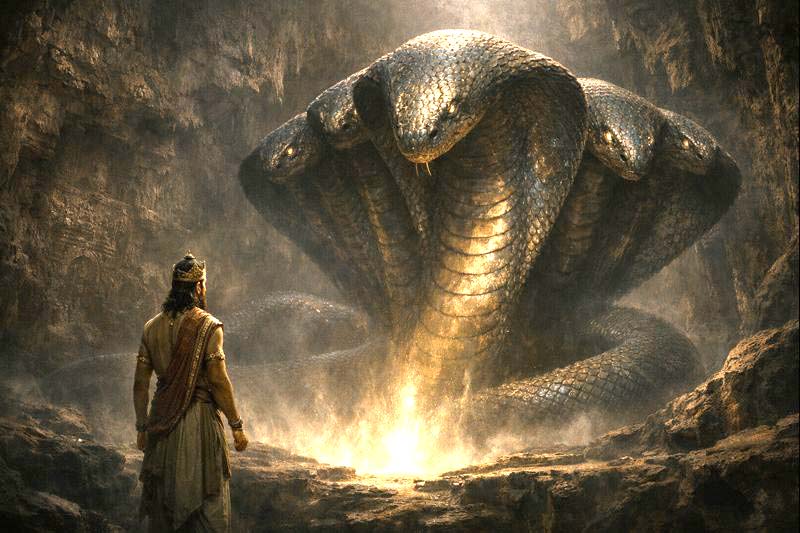
What followed was not conquest, but darshan—a vision of the 33 koti devtas. In Vedic tradition, the 33 koti devtas refer to thirty-three categories of deities—12 Adityas, 8 Vasus, 11 Rudras, along with Indra and Prajapati (or Vishnu/Ashvins in some texts)—symbolising cosmic forces, natural elements, and inner principles rather than 33 crore individual gods. The legend emphasises that revelation came through surrender, not pursuit.
Pandavas, Rediscovery, and Continuity
In the Dwapara Yuga, the Pandavas are believed to have rediscovered the cave during their period of exile. Their association reinforces an important pattern within the cave’s mythology:
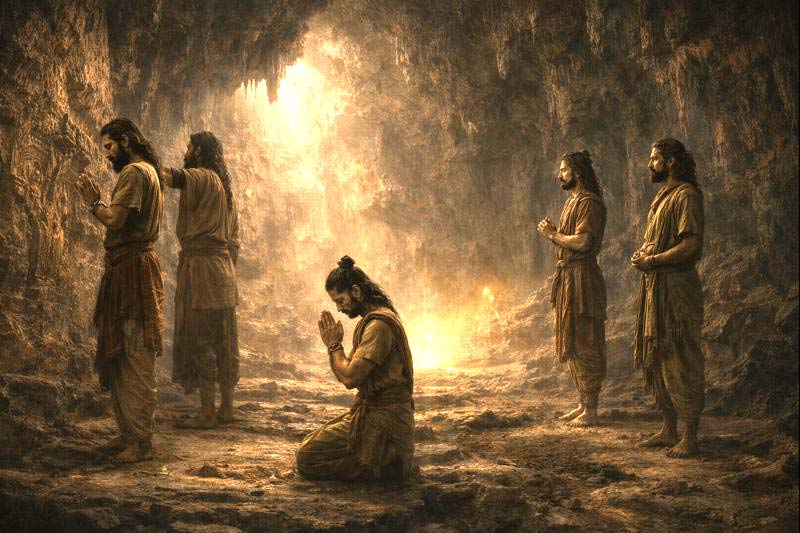
Patal Bhuvaneshwar surfaces during moments of withdrawal from power and certainty. For the Pandavas, the cave functioned as a place of worship and reflection, not as a refuge or stronghold. The emphasis remains consistent—this is a space for alignment, not assertion.
Adi Shankaracharya and Ritual Continuity
In 1191 AD, Adi Shankaracharya is believed to have re-established ritual continuity at Patal Bhuvaneshwar. His rediscovery marked a shift from occasional mythic encounters to structured Shaiva worship.

Through this transition, the cave moved from legend into living practice, ensuring it remained an active spiritual environment rather than a forgotten sacred site.
Why is Patal Bhuvaneshwar linked to Lord Ganesha?
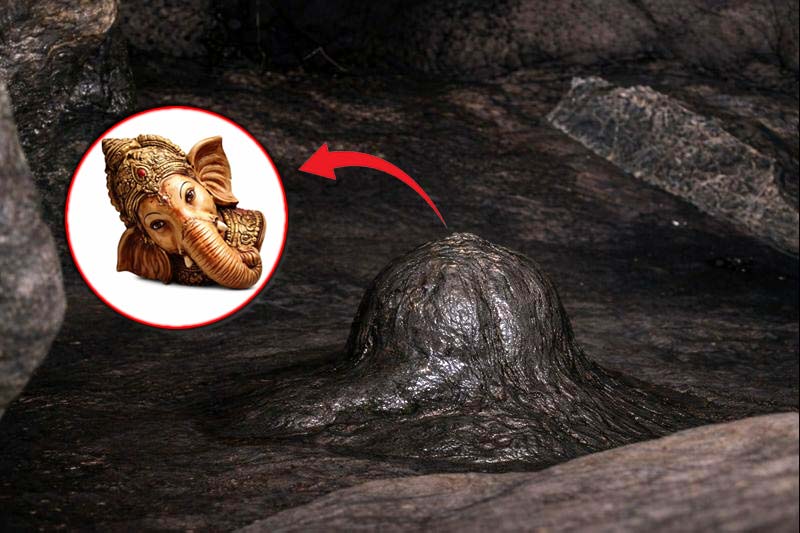
Puranic tradition holds that the severed head of Lord Ganesha, revered here as Adi Ganesha, resides within the cave. This belief, rooted in references from the Skanda Purana and sustained through temple tradition, reinforces the cave’s role as a site where cosmic events are symbolically held within physical space.
My Takeway: Across these legends, a clear pattern emerges. Patal Bhuvaneshwar does not reward ambition or speed. It responds to those willing to descend, pause, and relinquish control—suggesting that insight, like stillness, arrives only when pursuit ends.
Inside the Cave — What You See and What You Feel
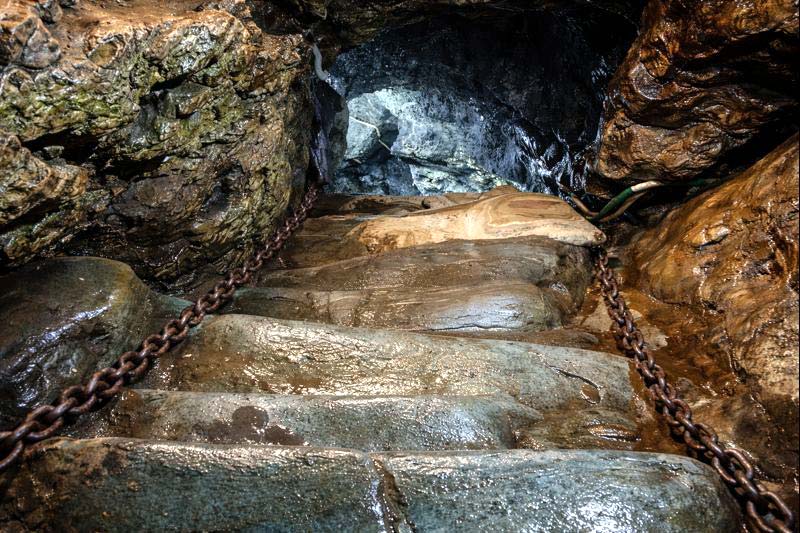
Entering Patal Bhuvaneshwar Cave is a physical descent that quickly turns inward. The shift happens fast. Light reduces, movement slows, and the outside world drops away. What begins as a walk down stone steps becomes an encounter shaped by attention, restraint, and silence.
Sacred Formations as Lived Darshan
As I moved through the cave, what stood out was not any single formation, but how each revealed itself briefly and then receded. Patal Bhuvaneshwar descends nearly 90 feet below ground, creating a gradual shift from daylight into controlled darkness and silence. The descent involves roughly 350 uneven stone steps, requiring steady footing, patience, and physical awareness throughout the journey.
Symbolic Architecture and Mythic Thresholds
What appears inside the cave is not arranged for explanation. Meaning emerges through movement, proximity, and the quiet logic of symbolism.
- The four symbolic gates: Tradition speaks of four gateways within Patal Bhuvaneshwar—Ranadwar, Papdwar, Dharmadwar, and Mokshadwar—representing stages of moral and spiritual passage. Mythology holds that Papdwar closed after the fall of Ravana, and Ranadwar after the Mahabharata war, marking the end of earlier yugas.
- Adi Ganesha and the four yuga pillars: The cave is believed to house the severed head of Lord Ganesha, revered here as Adi Ganesha. Four natural stone pillars symbolise the four yugas—Satya, Treta, Dwapara, and Kali. The Kali Yuga pillar described as the longest, reflecting the present age’s extended duration.
- The growing Shivalinga: A naturally formed Shivalinga inside the cave is said to grow gradually over time. Symbolically, the belief that the world ends when it touches the cave ceiling reflects cyclical time in Hindu thought, not catastrophe.
Geological Forms Interpreted as Living Darshan
Meaning inside the cave is not fixed. It appears briefly, shaped by movement, shadow, and attention.
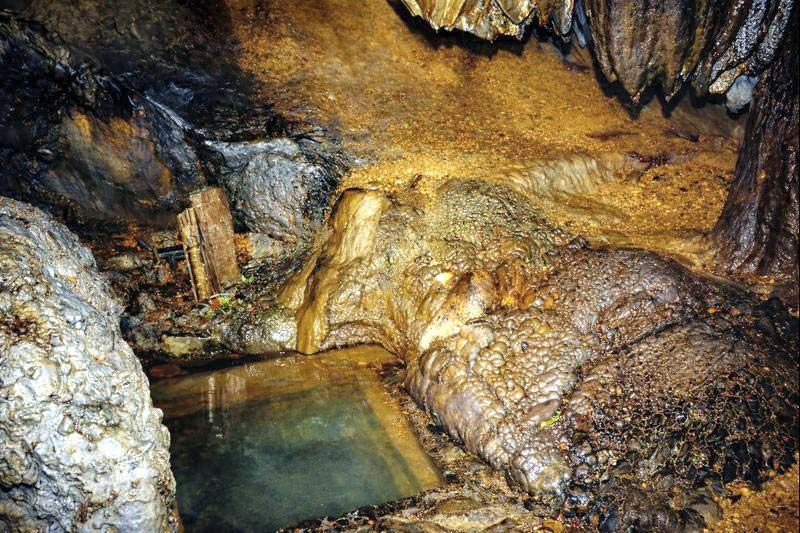
- Sheshnag-like ribbed floor: The stone floor rises and folds in repeating patterns that resemble a coiled body. Walking over it feels deliberate, almost ceremonial. Traditionally associated with Sheshnag.
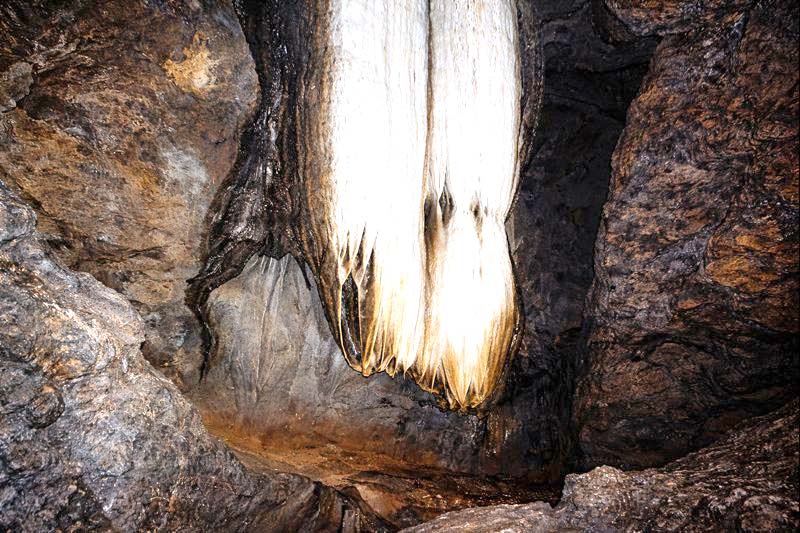
- Shiva’s Jatas overhead: Stalactites hang from above like matted locks, uneven and unpolished. They do not draw attention upward dramatically, yet their presence is constant. In Shaiva understanding, these formations reflect restraint, vertical stillness, and the containment of energy.
- Ganesha, Garuda, and Narasimha forms: Certain rock contours resemble familiar forms only when light strikes them at specific angles. These are not precise likenesses. They emerge momentarily through shadow and suggestion, reinforcing the idea that recognition depends on awareness, not clarity.
- Flowing Ganga symbolism: Thin streams of water run silently through narrow channels. They are easy to miss. Yet their presence introduces movement into an otherwise still space, echoing the idea of purification and continuity without force.
The experience builds quietly. No formation demands explanation. Attention stays with the body, the breath, and the next step. Meaning does not arrive through instruction. It forms through movement, restraint, and presence.
Why the Cave Experience Feels Intense
The intensity of Patal Bhuvaneshwar does not come from drama. It comes from compression. Darkness limits sight. Silence reduces mental noise. Confined movement removes choice. Chanting, when it occurs, echoes briefly before dissolving into stone.
The cave offers no instruction. It does not explain symbolism or direct interpretation. Instead, it creates conditions where awareness sharpens naturally. In that sense, the cave functions less as a site of teaching and more as a mindfulness environment, shaped by Shiva energy and the principle of inward descent.
Inside Patal Bhuvaneshwar, meaning is not delivered. It is encountered. What remains after the ascent is not information, but a quiet recalibration of attention.
Cosmic Convergence and Shiva Energy
Patal Bhuvaneshwar is often described as a point of cosmic convergence, where multiple forces, deities, and dimensions symbolically meet within a single sacred space. This idea is not presented as spectacle or doctrine, but as an experiential truth revealed through descent, stillness, and perception.
Convergence of Brahma, Vishnu, and Mahesh
Within the cave’s symbolic geography, the functions of creation, preservation, and dissolution are understood as coexisting rather than competing. Brahma represents emergence, Vishnu continuity, and Mahesh transformation. These forces are not separated into temples or timelines. They are held together within the same subterranean space.
Shiva’s role here is central, but not destructive. He appears as the axis around which these forces stabilise. In Shaiva understanding, Shiva is not the end of form, but the still point that allows form to arise, sustain, and dissolve without collapse. The cave reflects this principle. This understanding of Shiva as stillness and sustaining axis aligns with the Jyotirlinga tradition of Shiva consciousness. Here the presence is expressed not through form alone, but through energy, light, and awareness across sacred geographies.
This framing shifts attention away from myth as narrative and toward myth as structure. The cave becomes a model of balance rather than hierarchy.
How is Lord Brahma connected to Patal Bhuvaneshwar?
According to Hindu mythology, Patal Bhuvaneshwar is not associated with Shiva alone. It is believed to be a space where the divine trinity—Brahma, Vishnu, and Shiva—coexist in symbolic unity.
Folklore describes this cave as a place where Brahma contemplated creation itself. Natural stalagmite formations inside are interpreted as representing the heads of the trinity. Rather than separate shrines, the cave presents creation, preservation, and transformation as inseparable forces held within one subterranean space.
Connection with Kedarnath, Badrinath, and Amarnath
Patal Bhuvaneshwar is also associated with the symbolic presence of Kedarnath, Badrinath, and Amarnath within its formations. This is not positioned as comparison or replacement. Instead, it reflects a Shaiva–Vaishnava continuum, where different expressions of the divine are understood as interconnected rather than divided.
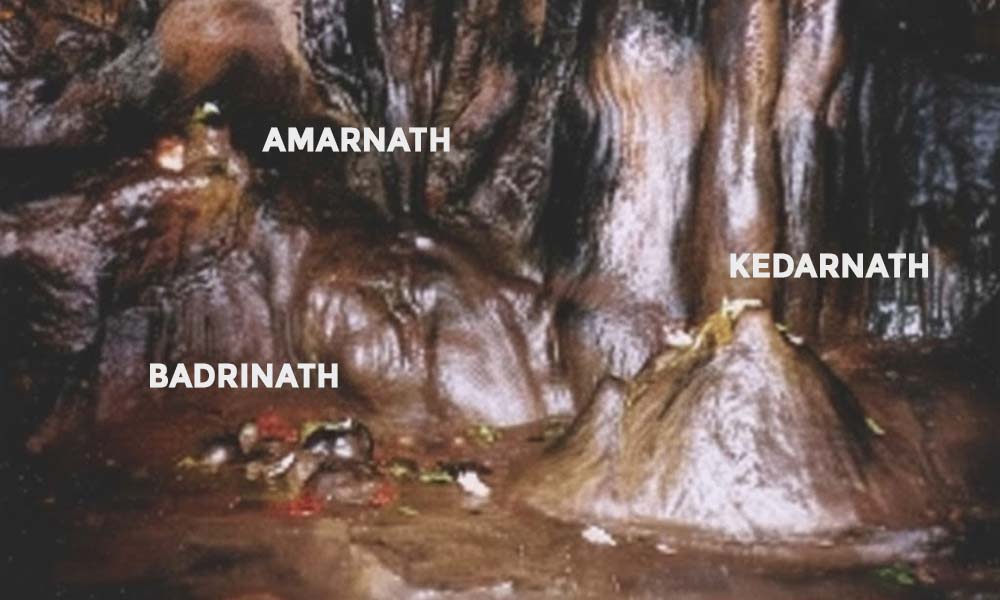
Seen this way, the cave functions as a compressed Himalayan sacred network. What is geographically dispersed across peaks and valleys appears here as a unified inner map. The emphasis is not on pilgrimage completion, but on recognition of underlying coherence.
What does “cosmic convergence” mean at Patal Bhuvaneshwar?
Cosmic convergence refers to the symbolic meeting of yugas, lokas, and divine functions within one space. It reflects the Hindu view that time and reality are cyclical and layered, not linear. At Patal Bhuvaneshwar, these layers are experienced together rather than separately.
The power of this space lies in integration. Nothing is isolated. Nothing is emphasised at the cost of something else. The cave does not demand belief. It invites alignment. In that alignment, Shiva energy is not felt as force, but as clarity.
Spiritual Symbolism and Mindfulness Meaning
Beyond mythology and visible form, Patal Bhuvaneshwar Cave is often understood as a symbolic inward journey. The physical descent mirrors a shift in awareness, where attention narrows naturally and stillness emerges without effort or instruction.
Meaning of “Patal” and “Bhuvaneshwar”
In Sanskrit understanding, Patal does not simply mean an underworld. It refers to depth—layers beneath the surface that are usually unseen. In this context, descent is not about moving away from the world, but about moving beneath habitual perception. Similar qualities appear in other Himalayan spaces shaped by silence and restraint. Landscape, stillness, and Shiva symbolism together create environments that regulate attention rather than stimulate it.
Bhuvaneshwar translates as the lord of worlds. Interpreted symbolically, it points to an inner axis that holds multiple layers of experience together. When combined, Patal Bhuvaneshwar suggests a journey toward the core where different realms—outer life, inner thought, memory, and silence—intersect.
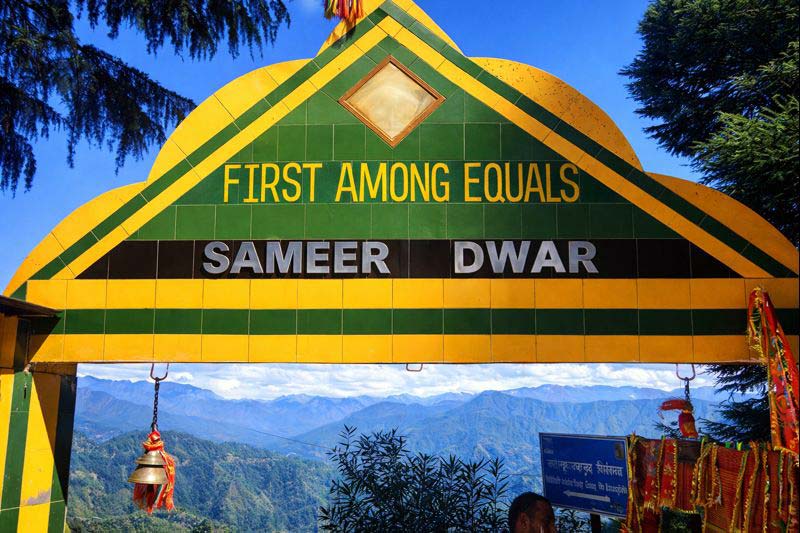
The cave expresses this idea physically. Movement is downward, visibility is limited, and orientation depends on attention rather than sight. The environment reinforces the idea that depth precedes clarity.
Silence, Stillness, and Regulation
What many visitors describe as Shiva energy inside the cave is not dramatic or overwhelming. It is regulatory. The space reduces sensory input. Sound softens. Light fades. Choices narrow. In doing so, the nervous system begins to settle.
This is mindfulness without method. There is no posture to hold, no breath to count, no instruction to follow. The environment itself shapes awareness. Stillness appears as a response, not an objective.
Shiva, in this sense, represents balance rather than destruction. He holds movement and rest together. The cave reflects this equilibrium. Water flows, yet the space feels unmoving. People move through it, yet the atmosphere remains constant.
Why is Patal Bhuvaneshwar relevant today?
In modern life, attention is fragmented and overstimulated. Patal Bhuvaneshwar offers the opposite condition. Sensory reduction creates clarity. Confinement sharpens focus. Silence restores perspective.
The cave does not ask for belief. It asks for presence. Its relevance lies not in what it claims to represent, but in what it allows the mind to experience directly.
The value of this space is subtle but enduring. It reminds us that stillness does not need to be learned. Sometimes, it only needs the right conditions to reveal itself.
Practical Travel, Safety, and Planning
While spiritually profound, Patal Bhuvaneshwar Cave is also a physical site that demands preparation. The terrain, climate, and cave structure require visitors to plan carefully, assess personal limits, and approach the journey with respect rather than haste.
How to Reach and Best Time to Visit
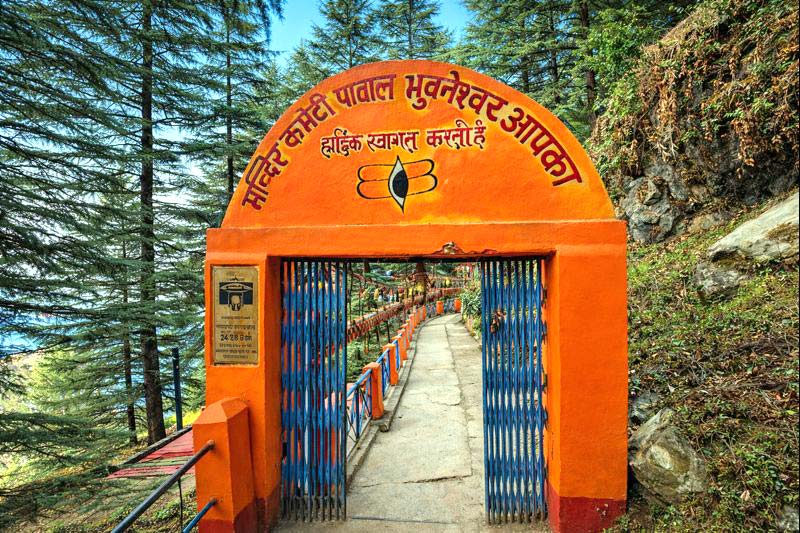
Patal Bhuvaneshwar cave temple lies close to Gangolihat in Uttarakhand’s Pithoragarh district, nestled within the Kumaon Himalayan region. The most common rail access points are Kathgodam and Tanakpur, both well connected to major cities. From either station, the journey continues by road through Almora, Chaukori, or Pithoragarh, taking approximately six to seven hours depending on conditions.
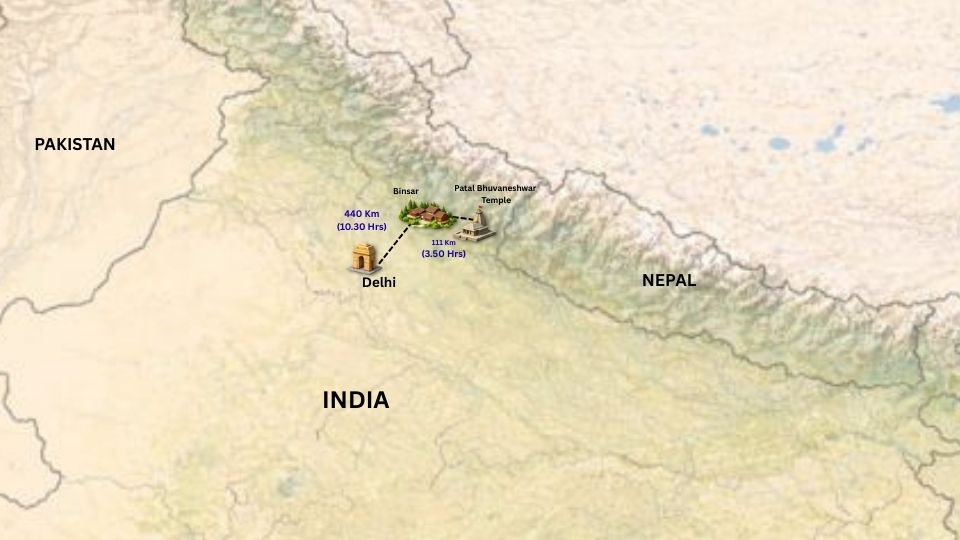
Gangolihat serves as the closest base town, with basic accommodation and road access to the cave entrance. Travelers seeking a quieter stay or mountain views often choose Chaukori or Pithoragarh, which also allow for flexible itineraries across the region.
The best time to visit is from October to June. During these months, weather conditions are stable and road access remains reliable. The monsoon season is best avoided, as heavy rainfall can make hill roads unsafe and increase slipperiness inside the cave.
Safety, Accessibility, and Who Should Avoid
Before entering the cave, visitors should be aware that the experience is physically demanding.
Key considerations include:
- Narrow and steep passages: The descent involves uneven limestone steps and tight spaces.
- Slippery surfaces: Moisture inside the cave can make footing unstable.
- Limited ventilation and light: Darkness and confined movement may feel intense.
Elderly visitors, individuals with joint or heart conditions, and those with claustrophobia or respiratory issues should assess their comfort levels honestly before entering. The cave is not designed for speed or ease, and turning back midway can be difficult.
Proper footwear with good grip is essential. Loose clothing and minimal belongings are recommended.
Time Required and Local Guidance Norms
A complete visit typically takes 45 to 60 minutes, including descent, darshan, and ascent. Entry is regulated, and local priests or guides oversee movement inside the cave to maintain order and safety. Following instructions is not optional; it is integral to the experience.
Photography restrictions may apply inside certain sections. Visitors are required to remain quiet and conduct themselves with respect at all times.
My Takeaway: Patal Bhuvaneshwar rewards preparation. As a certified ICF-ACC coach and NLP practitioner, Patal Bhuvaneshwar reinforced a principle I apply consistently in leadership and business training. Clarity does not emerge from adding more tools or intensity. It comes from reducing noise. The cave demonstrates how effective environments regulate attention, limit excess input, and create space where judgment stabilises.
Why Patal Bhuvaneshwar Leaves a Lasting Impact
Most visitors do not describe Patal Bhuvaneshwar Caveas sightseeing. They describe it as a memory shaped by descent, silence, and a sense of scale that places the individual within something far larger than oneself.
From Noise to Silence
The shift begins before the cave ends. As one ascends back toward daylight, the outside world feels noticeably louder. Thoughts that had settled return slowly. This contrast reveals the depth of the internal change. Inside the cave, the absence of choice, light, and excess stimulation reduces mental noise. Attention becomes focused without effort.
What lingers afterward is not awe, but calm. The experience regulates rather than overwhelms. Many visitors find themselves quieter in speech, slower in movement, and more observant for hours or even days after leaving. The cave does not create emotion. It clears space for it to settle.
A Once-in-a-Lifetime Darshan
Patal Bhuvaneshwar is rarely approached casually, even by those who live nearby. The physical effort, combined with the psychological intensity of the descent, makes repeat visits feel unnecessary rather than inviting. The experience completes itself.
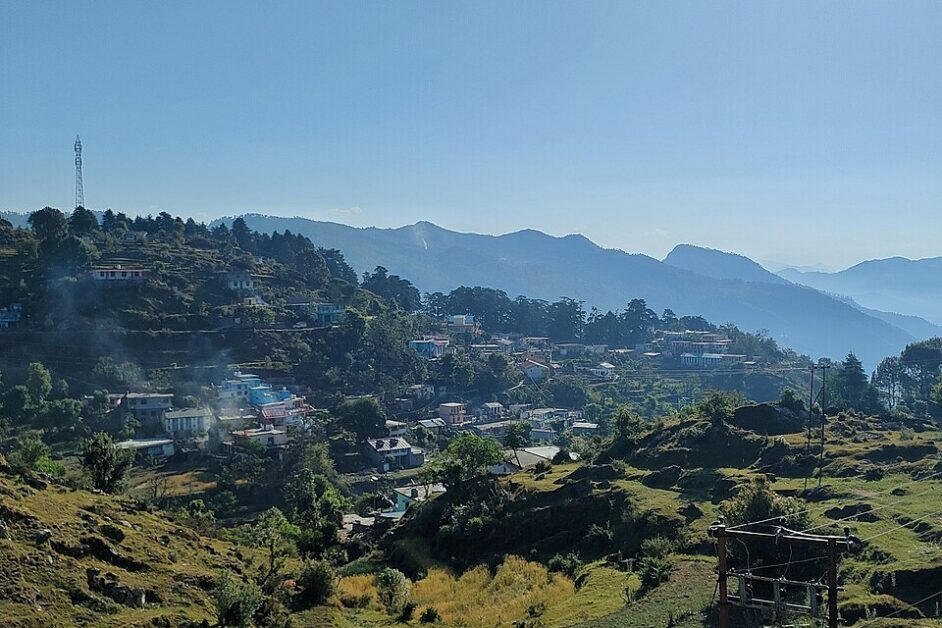
Darshan here is not about accumulation or repetition. It is about sufficiency. The cave offers a sense of closure rather than longing. For many, returning would feel like disturbance rather than devotion.
Some places stay with us not because we revisit them, but because they quietly recalibrate how we move through the world afterward. Patal Bhuvaneshwar endures in memory as a reminder that stillness, once encountered, does not need repetition to remain present.
Also Read:
- The Conscious Retreat: Why Pandori Dham is More Than a Temple Visit
- Gen Z’s Bhajan Jamming Club: The New Face of Spirituality in India
FAQ: Patal Bhuvaneshwar Cave
Where is Patal Bhuvaneshwar Cave located?
Patal Bhuvaneshwar Cave is located near Gangolihat in the Pithoragarh district of Uttarakhand. It is a limestone cave temple set within the Kumaon Himalayas, around 90 feet below ground, known for its deep mythological and spiritual significance.
Is the belief about the “end of the world” meant to be taken literally?
No. The belief symbolises cyclical time in Hindu philosophy. The growing Shivalinga represents transformation and renewal rather than a literal end. It reflects impermanence and continuity, not prediction or catastrophe.
What makes Patal Bhuvaneshwar spiritually significant?
Patal Bhuvaneshwar is significant because it integrates mythology, symbolism, and lived experience. The cave functions as a mindfulness environment where reduced sensory input and symbolic formations allow stillness, clarity, and inner awareness to emerge naturally.
Conclusion
Patal Bhuvaneshwar Cave does not ask to be understood. It asks to be experienced. Across mythology, symbolism, and physical descent, the cave consistently leads attention inward rather than outward. Its power lies in restraint, not revelation. By reducing movement, sound, and choice, it creates the conditions where clarity arises naturally.
What endures after the visit is not imagery or belief, but a recalibrated sense of presence. The cave reminds us that stillness is not something to achieve or repeat. It is something that reveals itself when excess falls away. In that sense, Patal Bhuvaneshwar remains timeless, not as a myth preserved in stone, but as a living environment that quietly reshapes how awareness moves through the world.
At TrendVisionz, we explore how places, stories, and lived experiences shape attention and clarity. Drawing from my work as a certified coach and NLP practitioner, these reflections bridge ancient wisdom with modern leadership awareness.
If this journey resonated, explore more insights grounded in real-world practice.
Stay Connected with Me:
Anuj Mahajan is a marketing and communication professional with over 30 years of experience. A senior business and media operator, he uses storytelling to bring clarity, strengthen communication, and reinforce leadership discipline to drive growth. He is an ICF-ACC Certified Coach and an experienced corporate trainer. Drawing from deep operating experience, he helps leaders and organizations translate strategy into consistent business outcomes.
- Explore my work: Nuteq Entertainment | TrendVisionz | Author Profile
- Read our newsletters: Transforming Lives | BizTech Chronicle | Nuteq Newsline
- Guest writer: BizCatalyst360 | Praja Today
- Books: Go Mindfulness: Practices for Professionals Coached
- Join the community: LinkedIn Group – Digital Marketing & Content Creation World
- Connect with me: LinkedIn | Twitter | #StoryforBusiness
- Share your review: Leave your review on Google — your feedback helps us grow.
- Listen on Spotify: Leadership Podcast | Guided NLP (7 Episodes) | Daily Motivation – 21 Episodes
Believe. Practice. Perform. Let’s create impact together.
✍️ A Note from the Editor
Independent storytelling thrives with you. Contribute $15/month via PayPal or email us at anujmahajan@trendvisionz.com. [Guest write for us — Free or Paid.]


