

How should a business be designed to survive and scale in 2026, when efficiency is no longer optional? Amidst a steady 2.7% global growth, Amidst a steady 2.7% global growth, value is shifting unevenly across industries. Reflecting a K-shaped economy in 2026 where structurally stronger businesses pull ahead. At its core, the Efficiency Economy is about business system design. Growth depends on scalable business systems that prioritise structure, clarity, and execution over tools or headcount
As organizations expand, complexity almost always arrives before true scale. Many founders respond by adding more tools or more people, but in 2026 this often compounds the chaos. This is no longer a growth problem. It is a design problem. Operational efficiency now depends on how workflows, accountability, and execution are structurally orchestrated.
Across three decades working in media and leadership environments, I have repeatedly seen growth outpace alignment. My work has consistently focused on decision-led growth and helping leadership teams navigate the complexity that naturally follows expansion.
This article explores how businesses must redesign systems and leadership models to succeed in this new landscape. By removing friction structurally, organisations can move beyond siloed optimisation and build businesses that are not just larger, but inherently more efficient at their core.
Also Read:
- Global Education Trends: Student Immersion Programs
- Financial Discipline in Your 20s: How To Avoid Slow Financial Suicide
The Rise of the Process Architect in the Efficiency Economy
Growth bottlenecks in 2026 rarely come from lack of effort. They come from disconnected systems that fail to convert intent into outcomes. In the Efficiency Economy, the constraint is not ambition or talent. It is whether the business has been designed to hold complexity as it grows.
While global GDP growth appears stable at 2.7%, the economy is undergoing a fundamental transformation as business investment in AI and intra-regional trade shifts offset softening consumption.
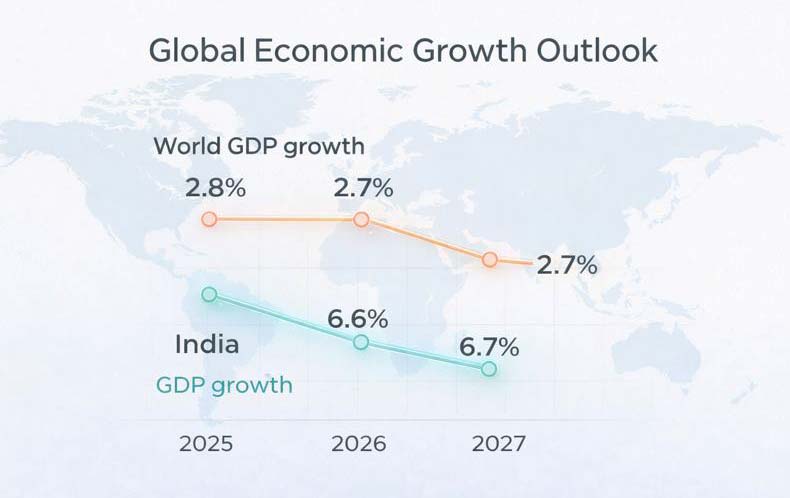
As growth moderates globally, businesses that redesign systems for efficiency will outperform those relying on scale, spend, or incremental optimisation.
Why Systems Now Matter More Than Tools
For years, growth teams responded to pressure by adding tools. A CRM for sales, another platform for marketing, separate systems for finance, delivery, and reporting. Each tool solved a local problem, but together they created fragmentation.
As organisations grow, scale demands a single source of truth. When leads, finance, marketing, and operations are aligned inside one operating structure, information flows cleanly and decisions happen faster.
This external stability often masks internal strain. As observed in the World Economic Situation and Prospects 2026 published by the United Nations:
“In 2025, a sharp increase in United States tariffs created new trade frictions. Despite the tariff shock, global economic activity proved resilient, supported by front-loaded shipments, inventory accumulation, and solid consumer spending amid monetary easing and broadly stable labour markets.”

Designing for Operational Efficiency, Not Activity
Many organisations stay busy but fail to move forward. Teams optimise activity rather than outcomes, mistaking motion for progress. This is where execution quietly breaks at scale. Decisions take longer, approvals stack up, and accountability diffuses across functions.

Operational efficiency improves when workflows are designed end to end, not function by function. Decision latency becomes a visible cost when execution is fragmented. By redesigning how work flows across the business, leaders reduce delays, prevent rework, and allow teams to act with confidence rather than constant coordination.
Takeaway: Efficiency today is no longer about working harder or buying better software. It is about designing systems that remove decision friction before it compounds and quietly caps growth.
Vertical SaaS and the End of Generic Platforms
As businesses specialise, software must follow. Platforms built for everyone increasingly serve no one particularly well. In the Efficiency Economy, the cost of generic tools shows up as friction, workarounds, and slow execution rather than outright failure. Vertical tools succeed because they support workflow orchestration and focus on reducing operational friction1, rather than forcing teams to adapt processes around generic software.
In the Efficiency Economy, AI workflow automation2 enables businesses to remove manual friction from processes, reduce decision latency, and scale execution without adding operational complexity.
Why Vertical SaaS Wins on Efficiency
Vertical SaaS tools are designed around how work actually happens in a specific industry. Before scale, this alignment matters more than flexibility.
Key efficiency advantages include:
- Industry language built in. Teams work in familiar terminology instead of translating generic fields and dashboards.
- Workflow specificity. Processes mirror real operational sequences, reducing configuration and manual overrides.
- Lower coordination cost. Fewer handoffs, fewer clarifications, and less internal friction across functions.
This design alignment allows decisions to move faster because information reflects business reality, not abstract system logic. When applied correctly, AI workflow automation shifts teams from task execution to judgment-driven work.
Automation can free up employees to focus on higher-value, judgment-based work rather than routine tasks- — McKinsey & Company
For instance, a boutique consultancy using a specialised tool built for project-based billing, rather than a generic CRM, can eliminate manual reconciliation. This allows the founder to focus on high-level decision clarity instead of administrative oversight.
Design Implications for Founders and Operators
Choosing software in 2026 is less about features and more about fit. Founders must evaluate tools as components of a system, not standalone solutions.
Key design considerations include:
- Buy versus build decisions. Purpose-built tools often outperform custom builds when speed and clarity matter.
- Integration over feature depth. A simpler tool that connects cleanly into the broader system usually delivers more value than a powerful platform operating in isolation.
Scalable business systems design emerge when tools reinforce flow rather than introduce complexity. Efficiency improves when systems mirror how work truly flows across teams and decisions, not how platforms imagine it should. Alignment reduces friction, shortens feedback loops, and allows execution to keep pace with intent as organisations scale.
Fractional Leadership as a Structural Advantage
The full-time leadership model is being quietly rewritten. In the Efficiency Economy, expertise is no longer embedded permanently in hierarchy. It is accessed on demand, aligned to risk, timing, and decision intensity rather than organisational charts.
In the Efficiency Economy, the fractional leadership model allows businesses to access senior judgment precisely when decision risk peaks, without carrying permanent overhead.
Why Experience Is Now Pulled, Not Hired
Modern businesses do not face risk evenly. Pressure arrives in spikes, not straight lines. Fractional leadership aligns experience to these moments instead of carrying permanent overhead.
Key forces driving this shift include:
- Risk spikes. Expansion phases, restructuring, funding cycles, or market entries create short windows where senior judgment matters most.
- Algorithm shifts. Changes in platforms, search behaviour, or AI-driven systems introduce sudden exposure that cannot be learned through trial and error.
- Compliance and operational complexity. Regulatory changes and cross-functional dependencies raise the cost of delayed or uninformed decisions.
Pulling experience when risk peaks allows organisations to act decisively without slowing execution or inflating leadership layers. Unlike traditional full-time roles, a fractional leadership model embeds expertise directly into decision flows, improving judgment without slowing execution.
Designing Modular Leadership into the Business
Fractional leadership delivers value only when it is designed into the operating model rather than treated as ad hoc advice. Its impact comes from being activated at moments where decisions carry long-term consequences, not from constant presence.
Designing leadership modularly prevents overstaffing by allowing organisations to access senior judgment precisely when needed. Integration is critical. Fractional roles must plug directly into decision flows and accountability structures. When embedded, expertise improves judgment and execution.
When does modular leadership actually add value?
Modular leadership adds value when expertise is embedded into decision flows, not layered on top. When integrated, it sharpens judgment and speeds execution.
Takeaway: In the Efficiency Economy, leadership is a design choice. It works best as a modular input to decision quality, not as a permanent layer carried regardless of need.
The Economics Bridge — Efficiency Without the Theory Trap
Economic efficiency matters in 2026 not as theory, but as a practical lens to expose where businesses quietly leak value. In the Efficiency Economy, these ideas are useful only when they help leaders diagnose friction inside systems, decisions, and execution.
In economic terms, economy efficiency is discussed through multiple lenses. The commonly cited types of economic efficiency may sound academic, but in practice they describe everyday operational failure. This is where productive efficiency economics becomes relevant only as a translation tool, not a teaching framework.
What are the 4 Economic Efficiencies?
For founders and business owners, understanding types of economic efficiencies is not about learning economics. It is about spotting misalignment before inefficiency turns into cost, delay, or lost momentum.
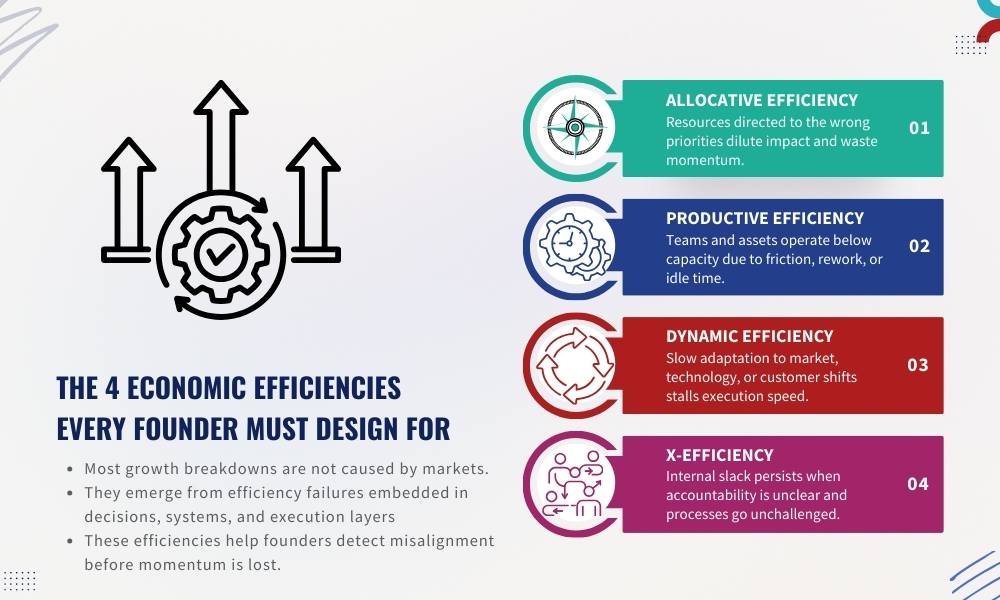
- Allocative efficiency. Resources are directed to the wrong priorities, showing up as wasted spend, misaligned initiatives, and effort applied to low-impact work.
- Productive efficiency. Teams or assets operate below capacity, creating idle time, rework, and inflated operating costs.
- Dynamic efficiency. The organisation struggles to adapt, leading to slow responses to market, technology, or customer behaviour shifts
- X-efficiency. Internal slack is tolerated because accountability is unclear, allowing inefficient processes to persist unnoticed.
Productive vs Allocative Efficiency
For founders, the difference between productive and allocative efficiency3 explains why teams can work hard yet still miss results. One measures how well work is done. The other determines whether the right work is being done.
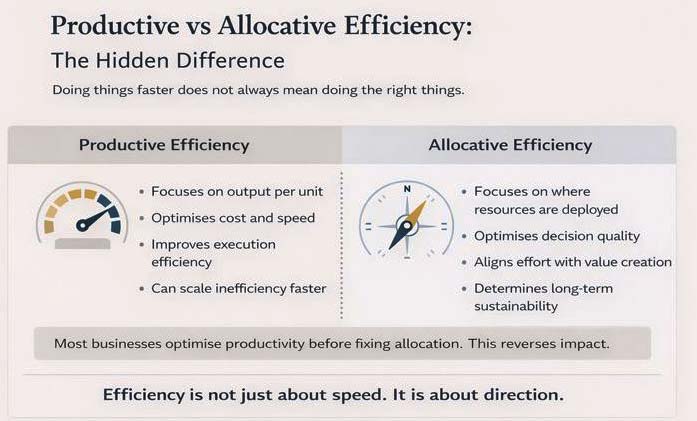
This distinction highlights why decision-led growth matters more than activity. When decisions drive execution, resources flow with intent instead of inertia. The gap between execution speed and decision direction often determines whether efficiency compounds or quietly erodes value
In the demand and supply model, efficiency means that the economy is getting as much benefit as possible from its scarce resources and all possible gains from trade have been achieved- Khan Academy
| Aspect | Productive Efficiency | Allocative Efficiency |
| Core question | How efficiently is work executed with available resources? | Are resources directed toward the right outcomes? |
| Primary focus | Process execution and output | Priority setting and decision direction |
| Common success signal | Teams deliver faster with fewer inputs | Effort aligns with business goals |
| Typical failure mode | Work is done well but creates limited value | High-value opportunities are underfunded |
| How inefficiency shows up | Idle capacity, rework, inflated operating cost | Wasted spend, misaligned initiatives, poor ROI |
| Real-world business risk | Optimising processes that should not exist | Investing in the wrong problems despite efficient execution |
| Founder mistake | Mistaking activity for progress | Assuming direction is correct because execution looks smooth |
Economic efficiency becomes practical only when it guides how businesses design systems, allocate attention, and remove friction early, before inefficiency compounds quietly at scale.
Why Economic Efficiency Matters for Business Design
Economic efficiency is often treated as an abstract idea, but for founders and leadership teams it has direct operational consequences. It shapes how decisions are made, how resources are used, and whether growth compounds smoothly or becomes harder over time. When efficiency breaks down, the damage appears quietly, long before it shows up in financial results.
What is the difference between allocative efficiency and productive efficiency?
The difference lies in where value is lost. Allocative efficiency fails when resources are directed toward the wrong priorities. Teams may work hard, but effort is spent on low-impact outcomes. Productive efficiency fails when execution itself is weak. The right priorities exist, but work is slow, inconsistent, or below capacity. Many organisations suffer from both, executing well in the wrong direction while struggling to execute where it matters most.
Importance of economic efficiency
Economic efficiency matters because its absence rarely appears suddenly. It builds quietly inside systems, decisions, and execution until growth becomes harder to sustain. As organisations scale, process architecture 4and integrated business operations determine whether complexity compounds value or quietly creates friction.
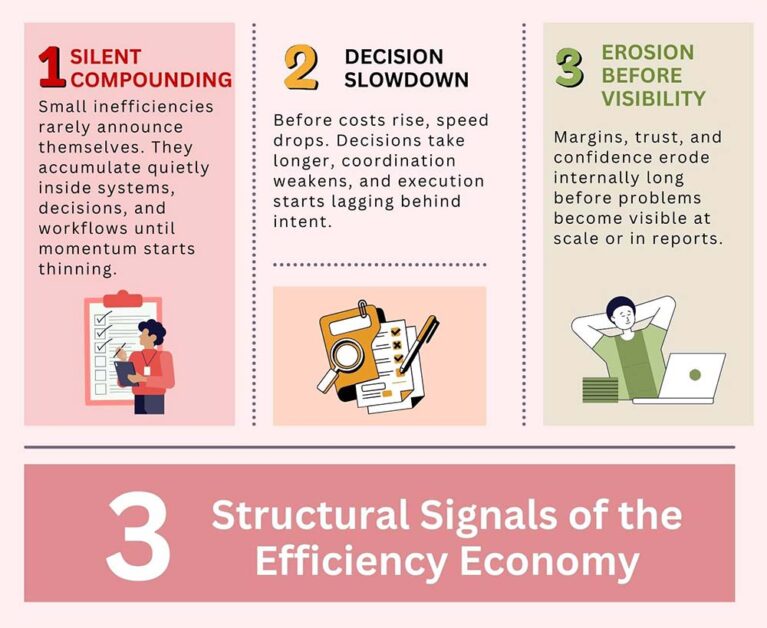
- Silent compounding of inefficiency. Small inefficiencies accumulate over time, creating hidden drag before results visibly decline.
- Early decision slowdown. Decisions slow first, followed by rising costs and delayed execution.
- Erosion before visibility. Margins and trust weaken long before problems become obvious at scale.
Economic efficiency creates leverage only when it shapes how businesses design systems, direct attention, and remove friction early, allowing execution to stay aligned with intent as organisations grow and complexity increases.
Subscription Models and the Shift to Always-On Reliability
One-time projects struggle in environments where systems decay continuously. In 2026, reliability no longer comes from periodic interventions. It comes from continuity. Subscription business models respond to this reality by aligning operational efficiency with ongoing responsibility rather than episodic delivery.
Why Maintenance Beats Campaign Thinking
- Predictable cash flow. Subscription structures smooth revenue volatility and allow businesses to plan resources, staffing, and investments with greater confidence.
- Reduced operational surprises. Continuous oversight catches issues early, preventing small failures from escalating into costly disruptions across integrated business operations.
Designing Subscription-First Services
- Trust compounding over time. Reliability delivered consistently builds confidence, reducing churn and strengthening long-term relationships.
- Lower coordination cost. Fewer renegotiations, rebriefings, and restarts mean teams spend more time executing and less time resetting expectations.
Subscription busines models succeed not because they recur, but because they stabilise systems that would otherwise degrade silently, allowing businesses to operate with confidence instead of constant firefighting.
Hyper-Local Execution and the Last-Mile Efficiency Battle
Global scale breaks easily. Local execution wins quietly through speed, coordination, and clarity. In 2026, operational efficiency is increasingly determined at the last mile, where delays, handoffs, and small errors directly affect cost, trust, and outcomes.
Why Efficiency Is Won at the Last Mile
- Time saved. Local routing, scheduling, and handoffs reduce delays that compound across larger systems.
- Errors avoided. Fewer transfers and clearer ownership cut rework and missed steps.
- Trust retained. Consistent, on-time delivery builds confidence where customers experience the service.
Why does last-mile execution matter more than central scale?
Last-mile execution matters because it is where strategy meets reality. No amount of central planning can compensate for friction at the point of delivery. Efficiency gained upstream is often lost locally if execution is slow, unclear, or poorly coordinated. Businesses that design for last-mile clarity convert effort into outcomes more reliably than those relying on scale alone.
Designing for Neighborhood-Scale Advantage
- Logistics designed for proximity. Shorter routes and smarter sequencing reduce friction and operating cost.
- Services built around local realities. Processes reflect actual conditions, not central assumptions.
- Local dominance through clarity. Small operators win by coordinating faster and responding better than scaled competitors.
The most durable efficiency gains are rarely visible at headquarters. They are designed into daily execution, where reducing friction consistently outperforms expanding control.
Micro-Academies and Outcome-Driven Learning
Learning overload has reduced trust. As content volume has increased, application has declined. In the Efficiency Economy, learning creates value only when it leads directly to action and improves decision quality.
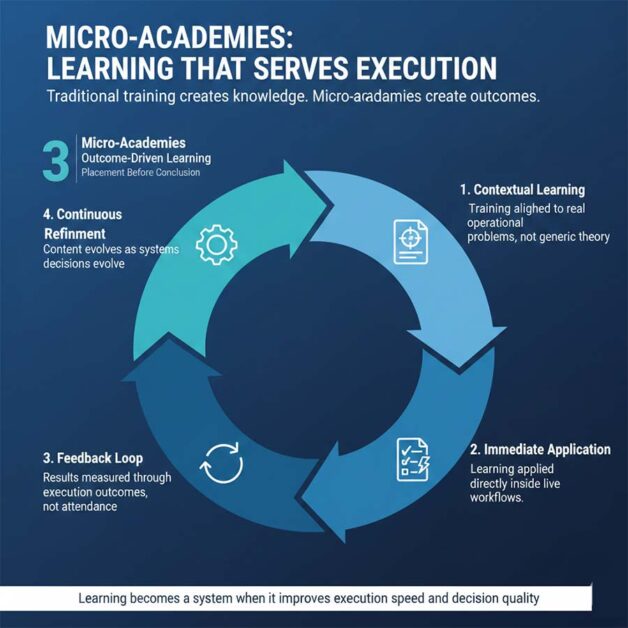
- Cognitive overload reduces conversion. Broad courses overwhelm learners with concepts that are difficult to prioritise, leading to low retention and poor execution.
- Low application weakens credibility. Knowledge that is not applied quickly remains theoretical and rarely changes behaviour.
- Skill sprints restore focus. Micro-academies narrow learning to one specific capability with a clear outcome, making execution immediate and measurable.
- Immediate execution reinforces learning. When learning is applied within days, not months, it sharpens judgment and embeds new habits.
- Systems over tools drive impact. Outcome-driven learning aligns with real decisions and current constraints rather than abstract frameworks.
In the Efficiency Economy, learning is designed to change behaviour and improve execution, not to accumulate information without impact.
Also Read:
- Choosing Blindly: Deconstructing India’s Invisible Career Counseling Crisis
- Europe Work Opportunities: Who Leads the New Job Wave?
FAQs: Efficiency Economy 2026
What does the Efficiency Economy mean for businesses in 2026?
The Efficiency Economy means businesses compete on how well they remove friction from systems, decisions, and execution. Success depends less on scale or spend and more on designing operations that convert effort into outcomes reliably.
Why are frictionless business models gaining popularity?
Frictionless business models reduce delays, rework, and decision latency. As complexity increases, businesses prefer models that simplify workflows, align systems, and lower coordination costs, allowing teams to move faster without adding people or tools.
Can small businesses succeed in the Efficiency Economy?
Yes. Small businesses often adapt faster than large ones. By designing clear systems, focusing on local execution, and removing friction early, they can outperform larger competitors burdened by complexity and slower decision-making.
Conclusion
The Efficiency Economy of 2026 rewards businesses that are intentionally designed, not endlessly optimised. Growth no longer fails because of effort or ambition. It fails when systems cannot hold complexity, decisions slow under pressure, and friction accumulates across execution. The organisations that scale sustainably are those that design for clarity, align systems end to end, and treat efficiency as a structural choice rather than a tactical fix.
For founders, the real question is no longer how to grow faster, but how to design a business where execution keeps pace with intent as complexity increases. What would you redesign today if efficiency, not expansion, became your primary growth constraint?
I work with founders and leadership teams who want to design businesses that remove friction at the system level. If this perspective resonates, reflect on where complexity is leaking value before it shows up in results.
Additional Resources:
- Brand, D., Parody, T. E., Orban, J. E., & Brown, V. J. (2004). A benefit/cost analysis of the commercial vehicle information systems and networks (CVISN) program. Research in Transportation Economics, 8, 379–401 ↩︎
- Druhova, Olena. (2025). Economic Efficiency of Innovative Development in Production Enterprises Based on the Use of Energy Resource-Saving Systems in the Context of Digitization: An Applied Nonlinear Analysis Perspective. Journal of Information Systems Engineering and Management. 10. 36-49. 10.52783/jisem.v10i12s.1704. ↩︎
- Geamanu, Marinela. (2011). ECONOMIC EFFICIENCY AND PROFITABILITY. Studia Universitatis Vasile Goldis Arad, Seria Stiinte Economice. 2. ↩︎
- Nowak, M., & Kokocińska, M. (2024). The Efficiency of Economic Growth for Sustainable Development—A Grey System Theory Approach in the Eurozone and Other European Countries. Sustainability, 16(5), 1839. https://doi.org/10.3390/su16051839 ↩︎
Stay Connected with Me:
Anuj Mahajan is a marketing and communication professional with over 30 years of experience. A senior business and media operator, he uses storytelling to bring clarity, strengthen communication, and reinforce leadership discipline to drive growth. He is an ICF-ACC Certified Coach and an experienced corporate trainer. Drawing from deep operating experience, he helps leaders and organizations translate strategy into consistent business outcomes.
- Explore my work: Nuteq Entertainment | TrendVisionz | Author Profile
- Read our newsletters: Transforming Lives | BizTech Chronicle | Nuteq Newsline
- Guest writer: BizCatalyst360 | Praja Today
- Books: Go Mindfulness: Practices for Professionals Coached
- Join the community: LinkedIn Group – Digital Marketing & Content Creation World
- Connect with me: LinkedIn | Twitter | #StoryforBusiness
- Share your review: Leave your review on Google — your feedback helps us grow.
- Listen on Spotify: Leadership Podcast | Guided NLP (7 Episodes) | Daily Motivation – 21 Episodes
Believe. Practice. Perform. Let’s create impact together.
✍️ A Note from the Editor
Independent storytelling thrives with you. Contribute $15/month via PayPal or email us at anujmahajan@trendvisionz.com. [Guest write for us — Free or Paid.]


6 comments
naturally like your web site I will surely come again again.
I really like reading through a post that can make men and women think. Also, thank you for allowing me to comment!
wow your article is simply a masterpiece, i like that, keep it up and will be checking for new update. do you post often? you can check the biggest webdesign freelancer in platform. Thank you for your wonderful post
Hi there to all, for the reason that I am genuinely keen of reading this website’s post to be updated on a regular basis. It carries pleasant stuff.
Wonderful guide — very helpful and packed with useful insights.
as a professional seo expert in hamburg, i can tell your article is professionally written, i enjoy reading it, keep up the good work, do you post more often ? i am now a follower,
Comments are closed.