
Most of us never think about what goes into the food we eat or the soil that produces it. Farmers do, every single season. One of their most important decisions is choosing between products they can trust and those that merely promise results. That is why certified fertilizers are becoming increasingly important across Indian agriculture.
Working on more than 500 documentaries and corporate films has taken me across the length and breadth of India. Those journeys helped me understand farmers’ challenges at the grassroots, while my work with organizations such as IFFCO and Bharat Insecticides offered insights into fertilizer quality standards, best practices, and the systems that support modern Indian agriculture.
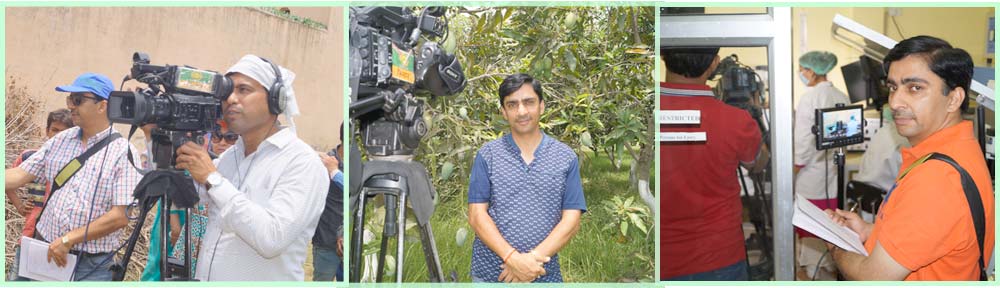
My communication work has allowed me to stand as a bridge between farmers and fertilizer manufacturers. It has connected field realities with scientific and industry perspectives, giving me a deeper understanding of how trust in agricultural inputs is earned and sustained.
In this feature article, I explore how certification, clear standards, and honest labelling are reshaping what Indian farmers trust. The shift is quiet, but it reflects a larger movement towards more informed, transparent, and modern farming practices. It begins with one bag a farmer can finally buy without doubt.
Also Read:
- The Great AI Giveaway: How Big Tech and India Are Shaping the Future
- Recent Cloudbursts in India: Causes, Impact, and Preparedness
How Farmers Can Spot a Fake Fertilizer Bag
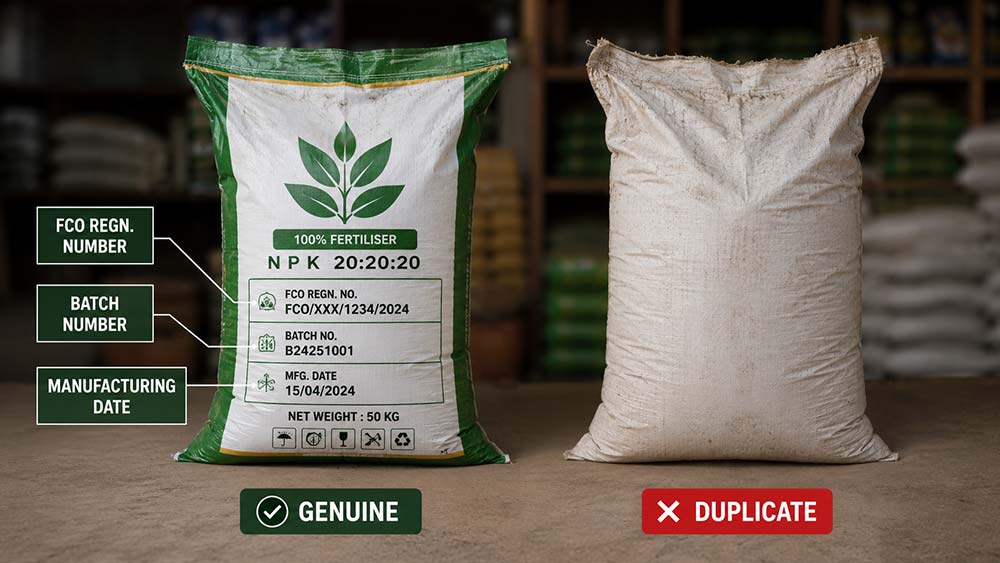
At the shop counter, a genuine bag and a fake one can look identical. Same weight, same colour, almost the same print. Most farmers cannot tell them apart by eye alone. The real difference hides in the details.
Genuine fertilizers carry an FCO mark, a batch number, and verifiable certification. Fake fertilizers usually skip at least one.
Visual and Physical Checks Farmers Can Do
Farmers do not need a laboratory to perform basic quality checks before buying fertilizers. Simple observations can help identify genuine products. Real urea dissolves completely in water, while adulterated fertilizers may leave residue or appear cloudy. Genuine granules are usually uniform in size and colour, whereas fake products often look dusty or uneven. The factory seal should be intact, and the batch number must be clearly printed. Spending a few extra minutes at the shop can help avoid costly mistakes and protect an entire season’s hard work.
Fake Fertilizers Spread Fast in Rural India
Counterfeit products spread for two simple reasons. At sowing time, money is tight. A cheaper bag is hard to refuse. Checking quality across thousands of village shops is also hard. One dishonest dealer can supply a whole area before anything is tested. The scale is real. Government laboratories declare roughly 4,000 to 5,000 fertilizer samples non-standard every year. Most fail on nutrient content, the very thing the farmer pays for. Weak last-mile checks let these bags slip through. Fertilizer quality standards exist on paper. They rarely reach the village counter.
My interactions with farmers across the country have shown me that trust is built slowly, but one poor harvest can break it in a single season.
Fertilizer Control Order: India’s Legal Guarantee of Fertilizer Quality
Agricultural experts often emphasise that good harvests begin with genuine inputs. The Department of Agriculture & Farmers Welfare frames policies and regulations that support quality inputs, farmer welfare, and sustainable agricultural development across India. Clear regulations and quality standards ensure that farmers receive exactly what they expect from every fertilizer purchase.
The Fertilizer Control Order is the legal framework that defines what can be sold as fertilizer in India. It sets nutrient standards, fixes labelling rules, and decides who is licensed to sell, giving fertilizer quality the backing of law.
A Fertilizer Inspector’s Checks at the Dealer Point
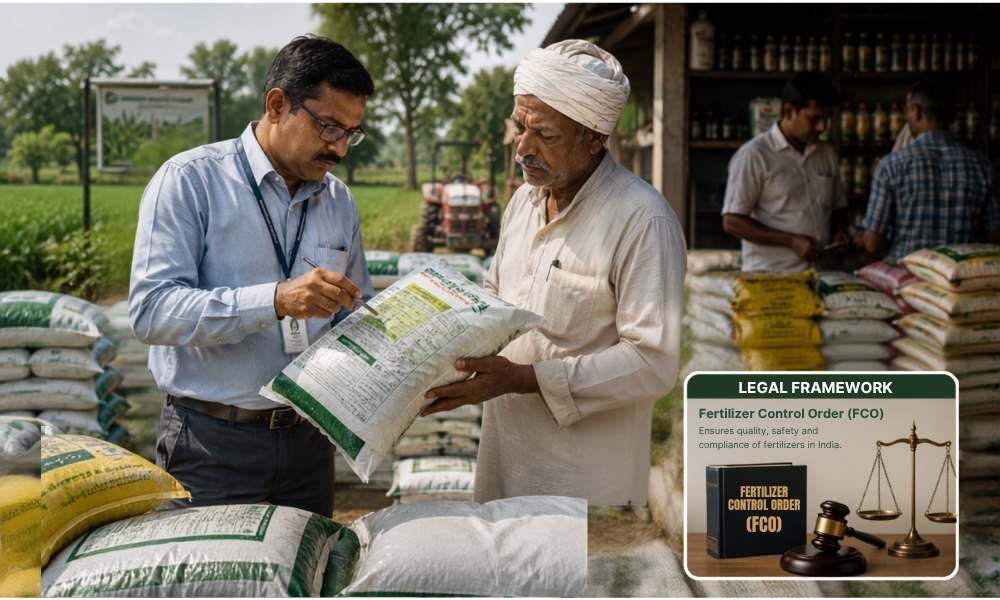
Introduced in 1985 under the Essential Commodities Act, the FCO gives quality standards the backing of law. A fertilizer inspector can act without warning.
- Unannounced Sampling: Inspectors can collect fertilizer samples from any licensed dealer without prior notice to check product quality and authenticity.
- Three-Sample System: Under the 2024 guidelines, one sample remains with the dealer, one is sent for laboratory testing. And one is retained by the authorities for record and verification.
- Right to Re-Test: If a fertilizer sample fails quality standards, the seller can request a re-test within fifteen days to ensure a fair and transparent process.
Conditions FCO Compliant Fertilizers Must Meet
Compliance is not a label alone. FCO compliant fertilizers must meet fixed conditions before they reach the shelf.
- Nutrient Standards: The actual NPK content must match the nutrient values declared on the packaging to ensure farmers receive the quality they pay for.
- Clear Labelling: Every bag should display the source, batch number, manufacturing date, and FCO registration details in a clear and readable format.
- Licensed Sale: Only authorised dealers can sell these products, making quality assurance and traceability easier across the supply chain.
- Non-Compliance Matters: Failure to meet even one of these conditions makes a fertilizer non-compliant, regardless of its price or popularity.
A law only works where it reaches. The FCO’s real value is simple. It gives the farmer a standard to point to, and a fair question to ask.
Fertilizer Labels and Certification: The Farmer’s Proof of Quality
While filming for DD Kisan, I realised that one of the most powerful tools available to farmers costs nothing at all—the fertilizer label. Reading it carefully helps verify the product, trace its source, and confirm that it meets established quality standards.
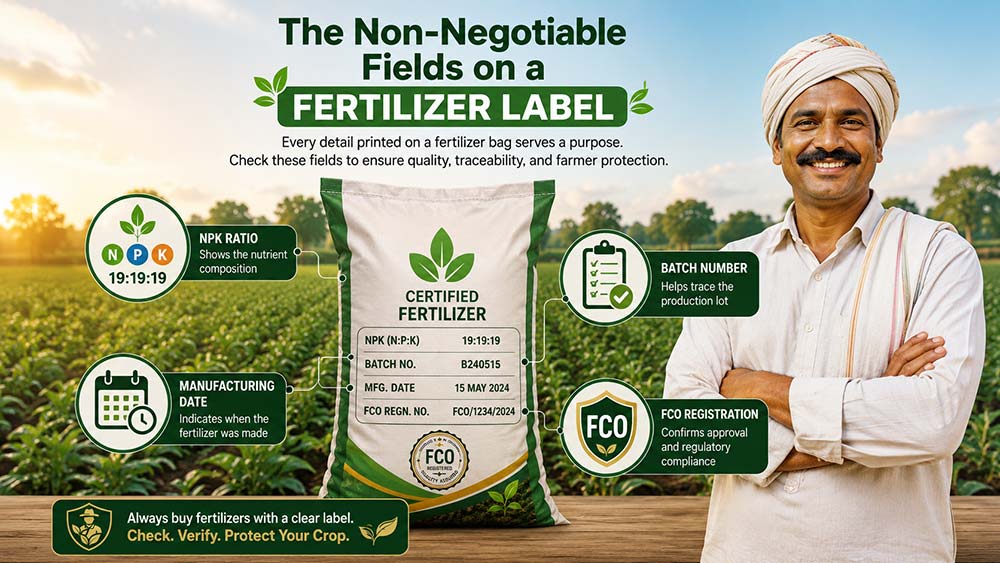
The Non-Negotiable Fields on a Fertilizer Label
Every detail printed on a fertilizer bag serves a purpose. The NPK ratio tells farmers the nutrient content they are paying for. The batch number and manufacturing date make the product traceable if any issue arises. The FCO registration number confirms that the fertilizer meets recognised quality standards and complies with national regulations. Together, these details turn a simple bag into a reliable record of trust and accountability.
The Fertilizer Control Order (FCO) is India’s legal framework for regulating fertilizer quality, labelling, licensing, and sales. It ensures that farmers receive genuine products that meet prescribed nutrient standards and can be traced back to authorised manufacturers and dealers.
The label is only the first layer of trust. Behind every certified product lies a system of testing, verification, and regulation that ensures farmers receive exactly what the manufacturer promises.
How Do Testing Labs Verify Fertilizer Quality?
Approved laboratories perform fertilizer testing by measuring the actual nutrients in a sample. They compare the result against the label’s claim. When the two do not match, the product fails. This check confirms that agricultural inputs deliver exactly what they promise.
While documenting a film on 4R Nutrient Stewardship1 for IPNI, I saw how strongly agricultural scientists emphasised one principle: the right source2, at the right rate, at the right time, and in the right place. The framework connects fertilizer quality with responsible nutrient management. A label that survives this test is one a farmer can trust.
Watch My DD Kisan Program
Muthi Mein Hai Aasman, a 26-episode series on DD Kisan, was produced as part of my documentary work on Indian agriculture. The program reflects years of engagement with farmer awareness, scientific farming practices, and rural development across the country.
Watch on YouTubeThe information printed on a fertilizer bag may look ordinary, but it represents years of testing, regulation, and scientific effort to protect the farmer’s investment.
Quality Standards Are Changing Buying Decisions Across Indian Agriculture
Indian farmers today have more information and greater awareness about input quality than ever before. Certification, clear labelling, and scientific farming practices are gradually shifting buying decisions from price alone to long-term value and reliability.
Technology is helping Indian farmers move from intuition-based decisions to data-driven agriculture. Agritech platforms are improving access to information, markets, finance, and scientific practices, making farming more resilient and productive.” — Anshuman Mahajan

Next time you stand at the counter, a few simple habits protect you. None of them cost a rupee.
- Ask for proof: You can ask for the FCO number before paying, not after harvest fails.
- Check the brand: You can weigh verified quality assurance over an unmarked discount at the counter.
- Choose certified: You can pick certified fertilizers, trusting the label over the lowest price.
- Trust the mark: You can read a clear FCO label faster than any dealer’s pitch.
- Pass it on: You can tell your neighbour, so good judgement spreads between farmers.
The change is slow, because old habits run deep. Years of cheap, subsidised urea pushed nitrogen use out of balance across Indian agriculture. But the direction has turned. Knowing your bag is genuine is step one. Balanced fertilizer 3use and scientific farming practices also help reduce their carbon footprint and promote sustainable agriculture. The next challenge is understanding what your soil actually needs, which is why soil testing is becoming an essential part of modern farming decisions.
Also Read:
- App-Based Maids vs Kaam Wali Bai: India’s Quiet Labour Shift
- Agentic AI in Education: India’s Governance Architecture Before the Technology
FAQs: Certified Fertilizers
Certified fertilizers are products tested and approved under India’s Fertilizer Control Order. They carry a verified NPK ratio, a batch number, and an FCO registration mark. The certification confirms the bag is genuine, correctly labelled, and safe to apply.
To check FCO compliance, look for a clear FCO registration number, batch number, and intact seal. Buy only from a licensed dealer and keep the receipt. If anything looks tampered or missing, report it before using the product.
Sometimes certified fertilizers cost slightly more than unbranded ones. That small premium is minor next to the real risk. A fake or substandard bag can destroy an entire season’s harvest, a loss far larger than the cheaper bag ever saved.
Conclusion
Certified fertilizers are not a luxury. They are the solid ground a good harvest stands on. Genuine inputs, clear standards, and honest labels remove a risk that farmers should never have carried alone.
The Fertilizer Control Order gives this trust the backing of law, while testing laboratories provide the proof. Together, they help farmers make informed decisions and support the shift towards more transparent and modern farming practices across India. Trust in genuine inputs creates the foundation for scientific farming, and crop-specific fertilizers are helping farmers apply the right nutrients to the right crops
Indian agriculture is changing, not because the tools changed, but because the farmer has. Once awareness takes root, it stays. The same movement towards trust and transparency now extends to agritech startups driving rural innovation and blockchain in agriculture improving traceability across the farming ecosystem.
In the Featured section of Trendvisionz, our Modern Society stories document how Indian communities are making better decisions — in their fields, their homes, and their lives.
About Anuj Mahajan (Author)
Anuj Mahajan is a media entrepreneur, author, filmmaker, and Managing Director of Nuteq Entertainment. With more than 32 years of experience across media, communication, leadership, and business growth, he writes about communication architecture, human behaviour, leadership, mindfulness, business transformation, and decision-making.
He is the Co-Founder of TrendVisionZ, author of three books, creator of the StoryforBusiness podcast, and publisher of the Transforming Lives newsletter.
Explore the Ecosystem
- Explore my work: Nuteq Entertainment | TrendVisionz | Author Profile
- Read my newsletters: Transforming Lives | BizTech Chronicle | Nuteq Newsline
- Guest writer: BizCatalyst360 | Praja Today
- Books: Go Mindfulness: Practices for Professionals Coached
- Join the community: LinkedIn Group – Digital Marketing & Content Creation World
- Connect with me: LinkedIn | Twitter | #StoryforBusiness
- Share your review: Leave your review on Google — your feedback helps us grow.
- Listen on Spotify: Leadership Podcast | Guided NLP (7 Episodes) | Daily Motivation – 21 Episodes
Believe. Practice. Perform.
Aditional Resources:
- A.M. Johnston, T.W. Bruulsema, 4R Nutrient Stewardship for Improved Nutrient Use Efficiency, Procedia Engineering, Volume 83, 2014, Pages 365-370, ISSN 1877-7058, ↩︎
- Mikkelsen, Robert & Schwab, G. & Randall, G.. (2009). The four fertilizer rights: Selecting the right source. Crops Soils. 42. 28-31. ↩︎
- A.Mahajan, & Bhagat, R. & R.D.Gupta,. (2008). Integrated nutrient management in sustainable rice-wheat cropping system for food security in India. SAARC J. Agric. 6(2): 149-163.. SAARC Journal oF agriculture. 6. 149-163. ↩︎


