

A faculty member at a private university in Pune noticed something unusual during semester evaluations. Students who rarely participated in classroom discussions were suddenly submitting detailed research summaries within hours. The quality looked impressive, but one question quietly spread across the faculty room: had the student truly learned the subject, or had an AI system done most of the thinking? That uncertainty is now shaping the rise of agentic AI in education.
That uncertainty defined the first wave of AI adoption across higher education. Universities responded with plagiarism advisories, AI usage guidelines, and classroom restrictions. But the next shift is structurally different. Agentic AI systems are now entering learning environments, administrative workflows, and institutional processes across Indian universities. Peer-reviewed research confirms the shift: agentic AI 1represents a ‘qualitative leap’ from reactive to autonomous systems that plan, use tools, maintain memory, and self-adjust to accomplish multi-step goals

Over three decades working across mass communication, digital ecosystems, and institutional transformation, I have consistently observed one pattern: technology evolves faster than governance structures.
This article examines what makes agentic AI categorically different, whether Indian universities are structurally ready, and the AI governance architecture institutions must build before deployment.
Also Read:
- App-Based Maids vs Kaam Wali Bai: India’s Quiet Labour Shift
- AI Drug Discovery: The Future of Drug Development
- Digital Payments Under Threat: UPI Scams and Digital Arrest
Agentic AI vs Generative AI in Higher Education
Most universities still treat AI as one category of tool. Agentic AI does not fit that framing. It plans, decides, and acts without prompts. Understanding the shift is the first governance decision institutional leaders must make.
Agentic AI in education refers to autonomous AI systems capable of planning, executing, adapting, and making task-level decisions without continuous human prompting.
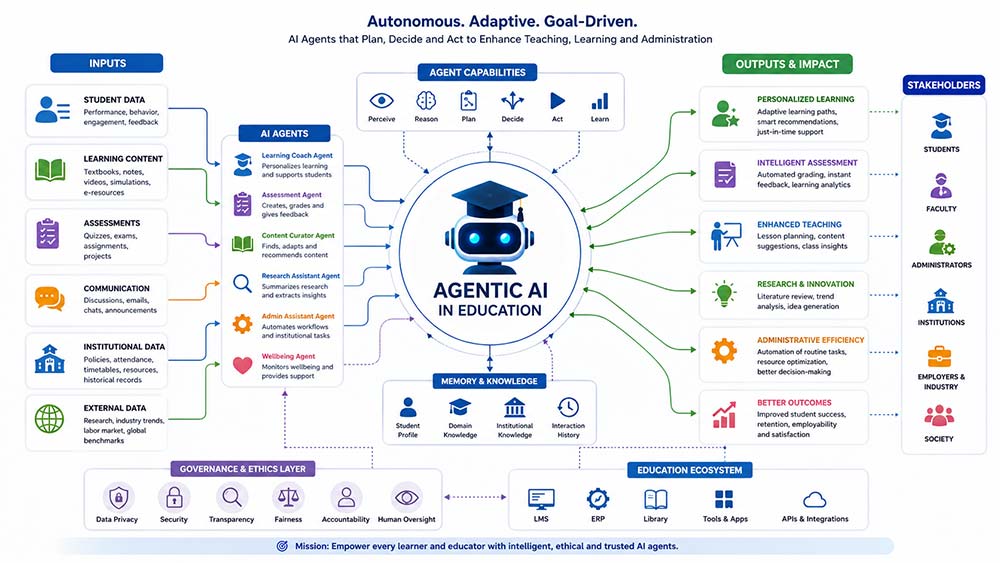
The signals are already visible globally. IGNOU’s Vice Chancellor recently described open universities as emerging “agentic AI universities.” Arizona State University is building AI-enhanced institutional partnerships in India. The technology conversation has reached leadership and policy circles. Institutional readiness has not evolved at the same pace.
We are using AI-enabled agents to support our learners, faculty, administrators and governance systems. Teachers will look beyond being subject experts, to work as learning designers and innovation leaders— Prof Uma Kanjilal, Vice Chancellor, IGNOU
From Prompt to Goal: The Shift in AI Behaviour
Generative AI operates inside a prompt and response loop. The student asks. The system answers. The interaction ends.
Agentic AI behaves differently. It takes a goal, breaks it into tasks, selects tools, and executes steps until the work is done. Multi-agent learning systems are already operating inside international universities at the orchestration layer.
The leap is autonomy, not capability. A faster chatbot is still a chatbot. An AI agent can independently determine and execute the next appropriate action without constant human input.
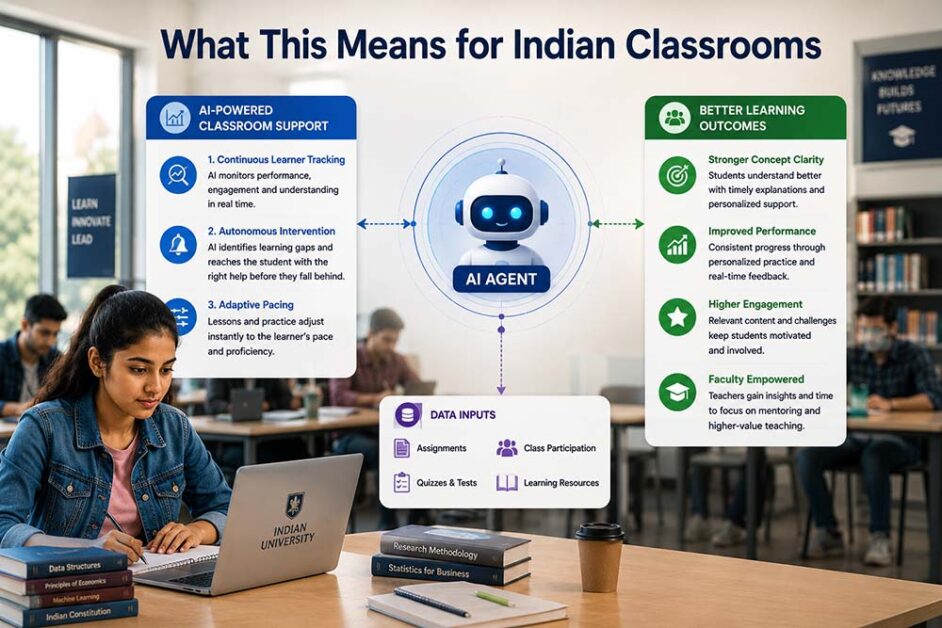
What This Means for Indian Classrooms
The classroom logic changes when agents enter. In AI-powered classrooms, continuous learner tracking happens without faculty prompts. Autonomous intervention reaches the student before the faculty member notices the gap, while adaptive pacing adjusts in real time.
Intelligent tutoring systems shift from assistive to autonomous. They no longer wait for the learner to ask. These systems continuously monitor learning behaviour, pacing, and intervention pathways in real time.
Industry forecasts reinforce the trajectory. Gartner estimates that by the end of 2026, nearly 40% of enterprise applications will incorporate task-oriented AI agents. Higher education will not stay outside that curve.
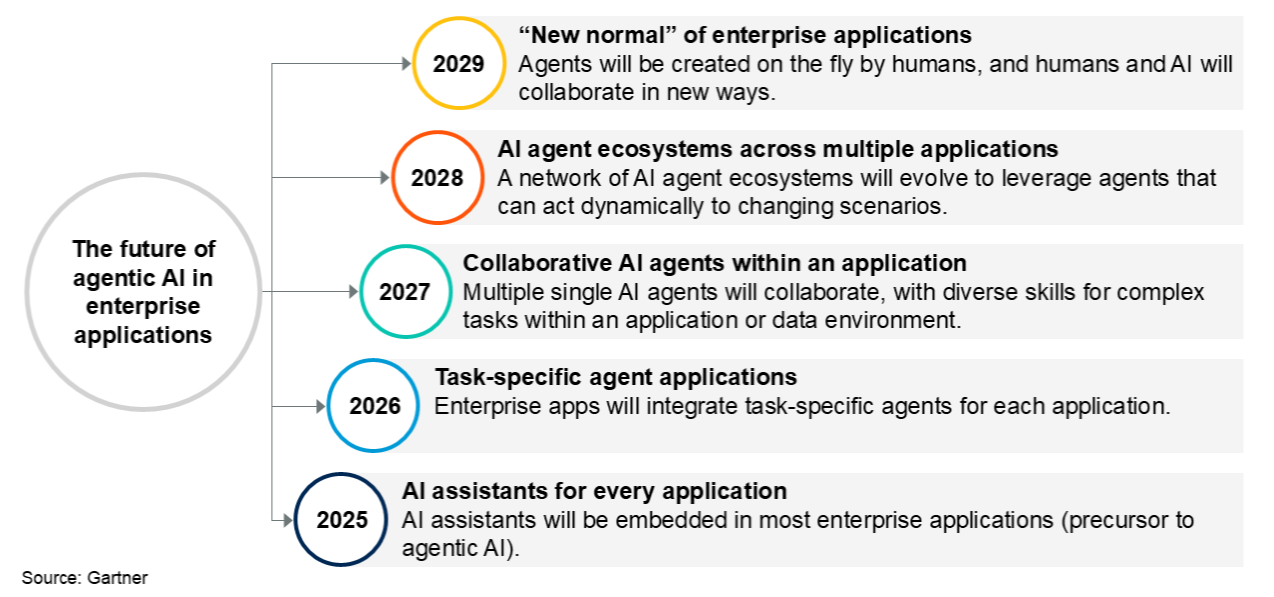
The shift is not about better tools. It is about systems that operate inside the institution without continuous oversight. That changes what governance must cover before deployment begins.
The Agentic AI Readiness Gap in Indian Universities
Readiness is not measured by technology procurement. It is measured by data architecture, faculty preparation, and institutional clarity. On all three counts, most Indian universities are structurally behind where agentic AI deployment requires them to be. Institutional AI readiness depends more on governance clarity, unified data systems, and faculty preparedness than software adoption.
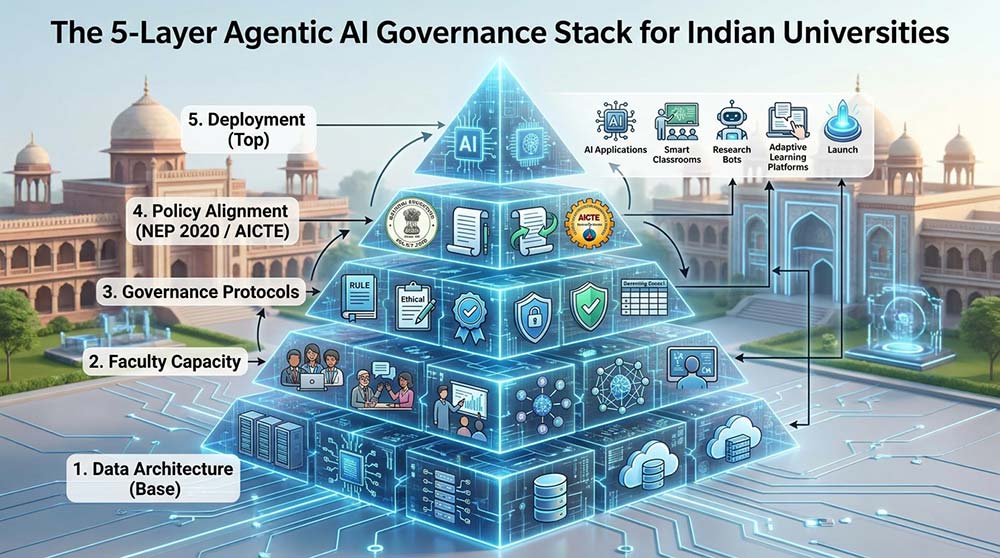
Mapping India’s Higher Education Readiness Gaps
The gaps are not visible from the outside. They surface when systems start operating across departments.
Learner records sit in separate silos. Admissions hold one dataset. The LMS holds another. The ERP holds a third. No unified institutional data layer exists for agentic systems to read across. An agent that cannot read across silos cannot decide on a learner’s behalf.
Faculty preparation is the second gap. Most faculty are trained for content delivery. Agentic AI needs faculty who can orchestrate human-AI learning ecosystems, supervise autonomous interventions, and step in where judgment is required.
AICTE Guidelines do not yet address AI-augmented teaching. Faculty development still treats AI as an external tool, not as an embedded operating layer.
Distance learning carries its own asymmetry. IGNOU alone contributes nearly 50% of India’s Gross Enrollment Ratio. Agentic AI at that scale, without governance scaffolding, is not a pilot. It is a population-level experiment.
Are Indian universities prepared for autonomous AI deployment today?
Indian universities are not prepared for autonomous AI deployment today. Most institutions lack unified data architecture, faculty training for AI-augmented teaching, and governance frameworks aligned with NEP 2020 and AICTE Guidelines. Readiness must be built before deployment, not retrofitted.
Structural readiness is a precondition, not a deliverable. Without data unification and faculty preparation, agentic AI deployment becomes a procurement decision dressed as a transformation strategy.
AI Governance for Indian Universities: Building the Architecture Before Deployment
AI governance is not a compliance layer added after deployment. It is the operating architecture that determines whether agentic systems serve the institution or expose it. Governance defined late is governance that does not hold.
The same principle applies across sectors. IBM’s playbook makes the institutional case directly. IBM’s Senior Partner on Enterprise AI Strategy and Governance puts it directly:
It’s not about measuring agentic AI performance. It’s about how well you use these tools in every function within your organization.” — Manish Goyal, Senior Partner, Enterprise AI Strategy & Governance, IBM
The same logic applies inside academic institutions, where deployment without governance creates risk that compounds across faculty, learners, and administrative systems.
The Three Governance Layers Every University Needs
Every Indian university preparing for agentic AI deployment must build three governance foundations before any system goes live across academic functions.
- Decision rights: Define who owns calls an agent makes on a learner’s behalf.
- Data governance: Establish collection, storage, access, and consent protocols upfront.
- Audit architecture: Build review mechanisms for outcomes when autonomous systems err.
Aligning Governance with NEP 2020 and Outcome-Based Education
Indian higher education already operates within national policy frameworks that can absorb agentic AI governance, provided institutions extend them deliberately.
- Policy alignment: NEP 2020 already mandates outcome-based education frameworks.
- Academic governance models: Update institutional bylaws to reflect AI agency in evaluation and advising.
- Real-world precedent: IIT Delhi has formed AI policy committees; most universities have not.
Institutional readiness is a governance question first and a technology question second. The order matters. Universities that invert it pay the cost in trust, not just performance.
Faculty Readiness and Human-AI Learning Ecosystems
Faculty are not obstacles to agentic AI integration. They are the load-bearing layer. When agents handle routine work, faculty roles shift toward judgment, mentorship, and orchestration. That shift demands a different kind of preparation. Emerging research 2also suggests that agentic AI may significantly influence learner autonomy, self-efficacy, and self-learning motivation inside higher education
From Content Delivery to Orchestration of Learning Ecosystems
Agentic AI changes the faculty role. It does not erase it. When agents handle attendance, grading, and routine queries, faculty time shifts to what AI cannot do. Debate. Mentorship. Judgment under pressure.
An AI literacy framework must sit inside faculty development, not just student curriculum. Pedagogical AI integration is institutional investment, not individual upskilling.
The Modern Language Association’s October 2025 Statement on Educational Technologies and AI Agents made this explicit. MLA named the deeper risk that emerges when institutions defer this layer:
If we do not act, we risk seeing the development of a fully automated loop in which assignments are generated by AI with the support of a learning-management system, AI-generated content is submitted by an agentic AI on behalf of the student, and AI-driven metrics evaluate the work on behalf of the instructor.
Indian universities have not yet built that institutional layer. Faculty are navigating agentic AI as private practitioners — without policy, without training infrastructure, without escalation pathways.

How should Indian universities train faculty for agentic AI integration?
Indian universities should train faculty across three layers: working alongside multi-agent learning systems, designing assessments resistant to autonomous tool misuse, and orchestrating human-AI learning ecosystems where judgment, mentorship, and ethical oversight remain firmly in faculty hands.
Faculty preparation is the single most underfunded layer of agentic AI readiness. Institutions that invest here build the bridge between technology promise and academic integrity.
Building AI-Native Education Infrastructure for Autonomous Decision-Making Systems
AI-native infrastructure combines data architecture, governance systems, and institutional decision-making capacity. The transition toward AI-powered classrooms will require universities to redesign accountability, escalation pathways, and operational oversight for autonomous academic systems.
Indian universities preparing for agentic AI deployment need to sequence five infrastructure decisions before any pilot goes live.
- Start with distance learning: Open and distance learning institutions are best positioned for early agentic AI deployment3. IGNOU’s “agentic AI universities” framing is structurally correct.
- Run institutional readiness audits: Map data architecture, faculty capacity, and governance gaps before any pilot deployment begins.
- Design adaptive learning environments with governance baked in: Treat agent oversight, escalation pathways, and audit trails as core infrastructure.
- Build cross-functional deployment teams: Academic leadership, IT, legal, faculty, and student welfare at the same table, not in sequence.
- Sequence infrastructure ahead of procurement: Buy capacity after governance is built. The reverse order is where institutions lose control.

Infrastructure is the slowest, hardest layer to retrofit. Universities that build AI-native foundations now will lead the next decade. Those that wait will spend it catching up.
Also Read:
- The Great AI Giveaway: How Big Tech and India Are Shaping the Future
- QS Rankings Explained: How Top Universities Are Ranked Worldwide
- AI & Robotics: How Early Integration Is Shaping Modern Healthcare
FAQ: Agentic AI in Education
What is agentic AI in education and how is it different from generative AI?
Agentic AI in education refers to autonomous systems that can plan, decide, and act without continuous prompts. Generative AI responds to user instructions. Agentic AI works toward a defined goal, breaks tasks into steps, executes actions, and adapts dynamically until completion.
Are Indian universities ready for agentic AI deployment?
Indian universities are not yet fully ready for agentic AI deployment. Most institutions still lack the data infrastructure, faculty training, and governance frameworks required for autonomous systems. AI in education readiness depends on institutional clarity, AI literacy, and policy alignment before large-scale implementation.
How can Indian higher education prepare for agentic AI integration?
Indian higher education can prepare for agentic AI integration through institutional vision alignment, faculty development for AI-augmented teaching, and strong data governance systems. Distance learning environments may provide the safest testing ground before full-scale deployment across traditional university ecosystems.
Conclusion
Agentic AI is not the next phase of generative AI. It is a categorical shift in how autonomous systems operate inside academic institutions. The institutional response cannot mirror the first AI wave.
Agentic AI in Education for Indian universities cannot be procurement-led. Universities that treat agentic AI as a procurement exercise will inherit governance problems at institutional scale. The order is not optional. Institutions that invert it pay the cost in trust, accountability, and academic integrity.
The institutions that build governance first will lead the next decade of Indian higher education. Those that wait will spend it catching up to questions they should have answered before deployment began.
The next decade of Indian higher education will be built by leaders who govern before they deploy. TrendVisionz equips that thinking — engage with us.
References:
- Kostopoulos, G., Gkamas, V., Rigou, M., & Kotsiantis, S. (2025). Agentic AI in education: State of the art and future directions. IEEE Access, 13, 177467–177491. ↩︎
- Alqurni J. Exploring the role of agentic AI in fostering self-efficacy, autonomy support, and self-learning motivation in higher education. Front Artif Intell. 2026 Jan 22;9:1738774. doi: 10.3389/frai.2026.1738774. PMID: 41658242; PMCID: PMC12872872. ↩︎
- Simmhan, Y., & Kulkarni, V. (2025). Towards AI agents for course instruction in higher education: Early experiences from the field (Tech. Rep.). Department of Computational and Data Sciences, Indian Institute of Science, Bangalore. ↩︎
Stay Connected with Me:
Anuj Mahajan is a senior marketing and communication professional with over three decades of operating experience across complex business environments. A business and media operator at core, he uses structured storytelling to sharpen judgement, strengthen communication architecture, and reinforce leadership discipline that drives sustainable growth. An ICF-ACC Certified Coach and seasoned corporate trainer, he works closely with leaders and organisations to translate strategy into consistent execution and measurable business outcomes.
- Explore my work: Nuteq Entertainment | TrendVisionz | Author Profile
- Read our newsletters: Transforming Lives | BizTech Chronicle | Nuteq Newsline
- Guest writer: BizCatalyst360 | Praja Today
- Books: Go Mindfulness: Practices for Professionals Coached
- Join the community: LinkedIn Group – Digital Marketing & Content Creation World
- Connect with me: LinkedIn | Twitter | #StoryforBusiness
- Share your review: Leave your review on Google — your feedback helps us grow.
- Listen on Spotify: Leadership Podcast | Guided NLP (7 Episodes) | Daily Motivation – 21 Episodes
Believe. Practice. Perform. Let’s create impact together.
✍️ A Note from the Editor
Independent storytelling thrives with you. Contribute $15/month via PayPal or email us at anujmahajan@trendvisionz.com. [Guest write for us — Free or Paid.]


