

“Some are born great, some achieve greatness.” Diana Pundole taught that Shakespeare line to schoolchildren in Pune for years. Then, in November 2025, she strapped herself into a Ferrari at Yas Marina Circuit and raced wheel-to-wheel against 20 international drivers. Her story is not an isolated breakthrough anymore. It represents a much larger structural shift unfolding across Indian motorsport.
The story of women in motorsport in India is no longer about symbolic firsts. It is about pipeline. Drivers, engineers, data scientists, pit crew members, and team owners are now entering through pathways that barely existed a decade ago. Indian women racing drivers are progressing through talent hunts, academies, scholarships, and policy-backed opportunities that have slowly widened access to the sport.
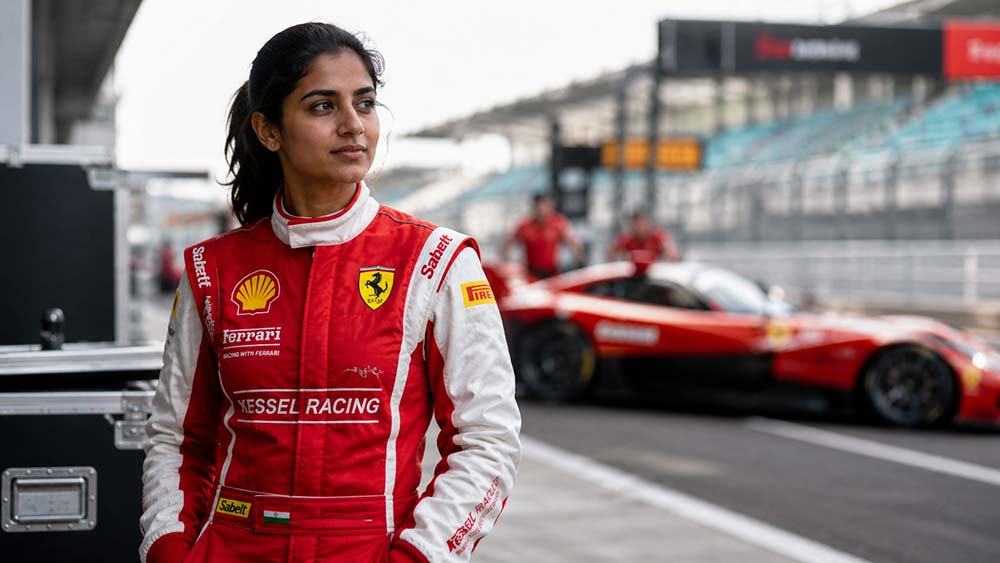
As a filmmaker, I have spent three decades building platforms where women’s stories get told and women’s work gets seen. Across every sector I have tracked, the victory a woman celebrates is downstream of the institutional decision that quietly let her in. In motorsport, that distinction matters more than the trophy.
This article explores how Indian women in motorsport1 are reshaping the sport through structured access, institutional backing, and a growing ecosystem that is finally beginning to treat talent as gender-neutral.
Related Stories of Sports Psychology
- Women in Sports: Overcoming Obstacles to Achieve Athletic Success
- Sports Psychology: Building Mental Strength for Peak Performance
Women in Motorsport: The Shift from Participation to Presence
The first woman to compete in Formula 1 was Italian racer Maria Teresa de Filippis, who debuted at the 1958 Belgian Grand Prix. India took another five decades to catch up. The country’s motorsport landscape was almost entirely male until the mid-2010s — when access, structured and institutional, finally arrived.
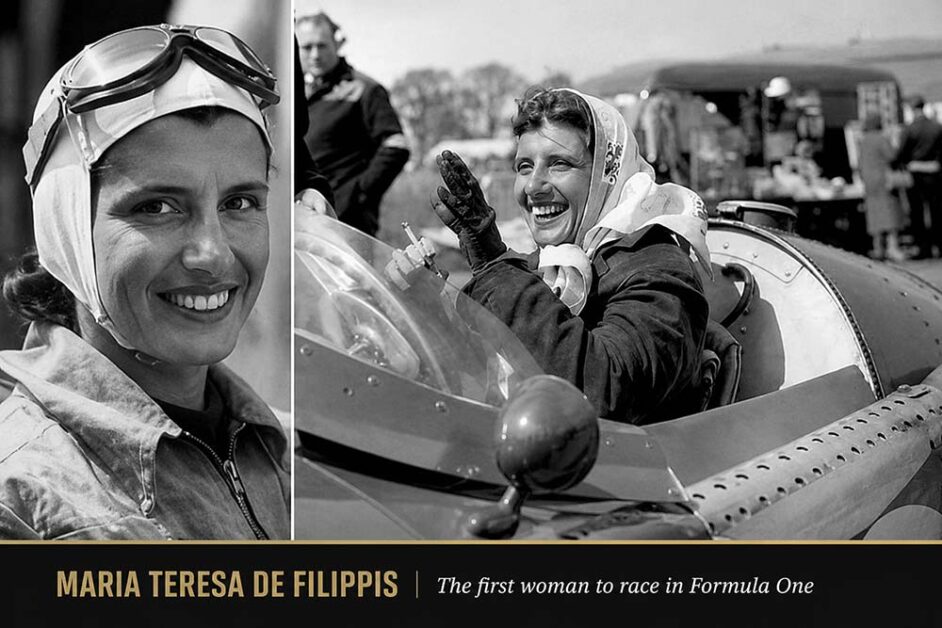
Maria Teresa de Filippis opened Formula One’s doors in 1958. Her breakthrough inspired generations of female F1 drivers to pursue opportunities in top-level racing.
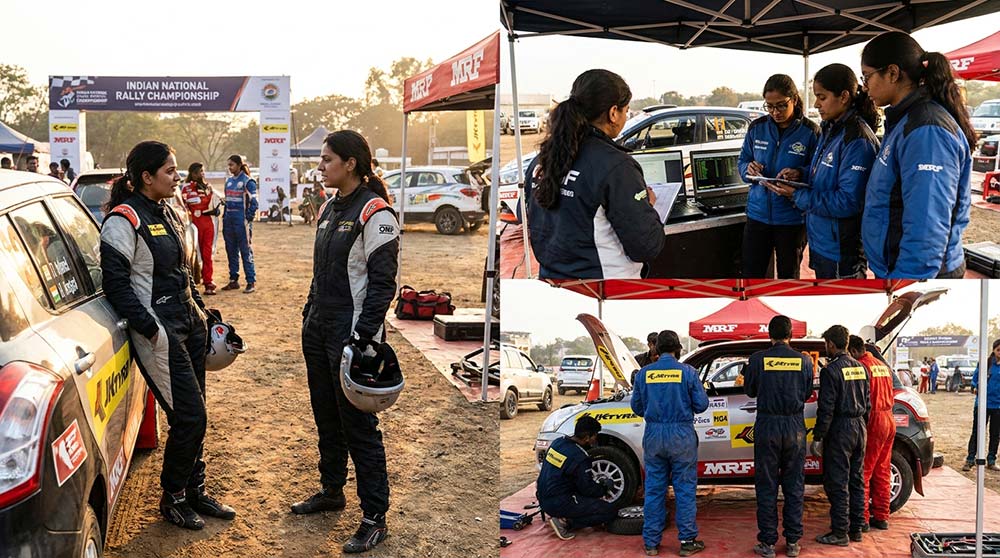
Motorsport is one of the few sports where athlete performance depends on a complete ecosystem of engineers, mechanics, analysts, and strategists working alongside the driver
From Zero to the Grid — How the Entry Points Opened
The first wave of women in motorsport entered through karting circuits and structured talent hunts that did not exist for the previous generation. JK Tyre’s national talent search became the first formal gateway — Diana Pundole was selected from over 200 applicants in 2014. She become one of the most recognised examples of a female car racer in India competing internationally.Diana was the first Indian woman to win a national title in a mixed-gender field.
TVS Racing, India’s first factory racing team since 1982, opened a parallel pipeline focused on grassroots access.
TVS Racing has led the way in women’s racing since 2016, training over 500 women racers under champion riders like Aishwarya Pissay, supporting their passion on the track. — Vimal Sumbly, Head Business Premium, TVS Motor Company
Two parallel pipelines now exist — corporate talent hunts producing circuit drivers and factory programmes producing grassroots riders. Together, they have moved Indian motorsport from accidental discovery to institutional sourcing of women’s talent.
The IRL Signal — Policy Before Performance
The Indian Racing League introduced a mandate in 2022 that no other premier racing league in the world has matched. Every team must field at least one female driver, and that driver must complete a defined share of race laps. This is policy, not optics. It was the first time an Indian motorsport body decided that participation could not be left to chance. The proof arrived quickly. Fabienne Wohlwend won the 2025–26 IRL championship outright, defeating an all-male field. The FMSCI national championship grids have grown more diverse season after season.
The shift from participation to presence did not happen because the sport became more welcoming. It happened because institutions stopped waiting for women to ask, and started building the door.
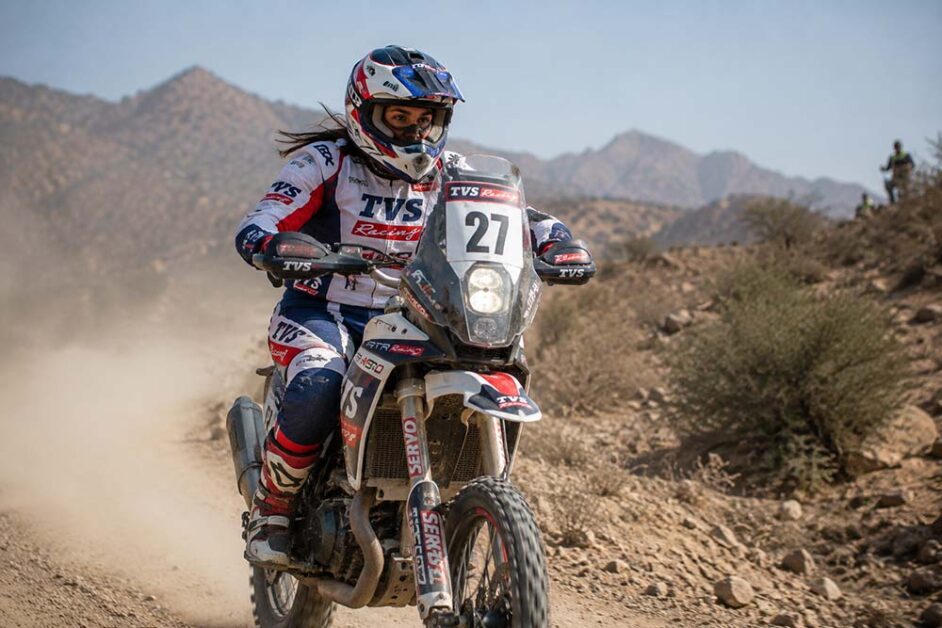
Women in Motorsport: The Champions Who Changed What Winning Looks Like
India’s first female motorsport world champion did not come from a racing family. She came from Bengaluru, started late, crashed hard, and kept going. That trajectory is the real story behind India’s rise in women’s competitive racing.
Aishwarya Pissay — The World Title Nobody Saw Coming
Pissay became the first Indian drivers to win a motorsport world title in 2019. Backed by TVS Racing, she has built a career across rally, baja, and circuit formats.
- 2019 FIM Bajas World Cup: First Indian, of any gender, to win a world motorsport title.
- 12 national championships: Across road racing, supercross, and rally categories combined.
- W2RC Portugal 2025: Class win at the World Rally-Raid Championship round.
- Rallye du Maroc silver: First Asian woman to complete the event in 2024.
- Injury comeback: Returned to top-tier competition after fracturing both wrists in 2019.
- Dakar 2027: Stated target, in active preparation through TVS Racing’s factory programme.
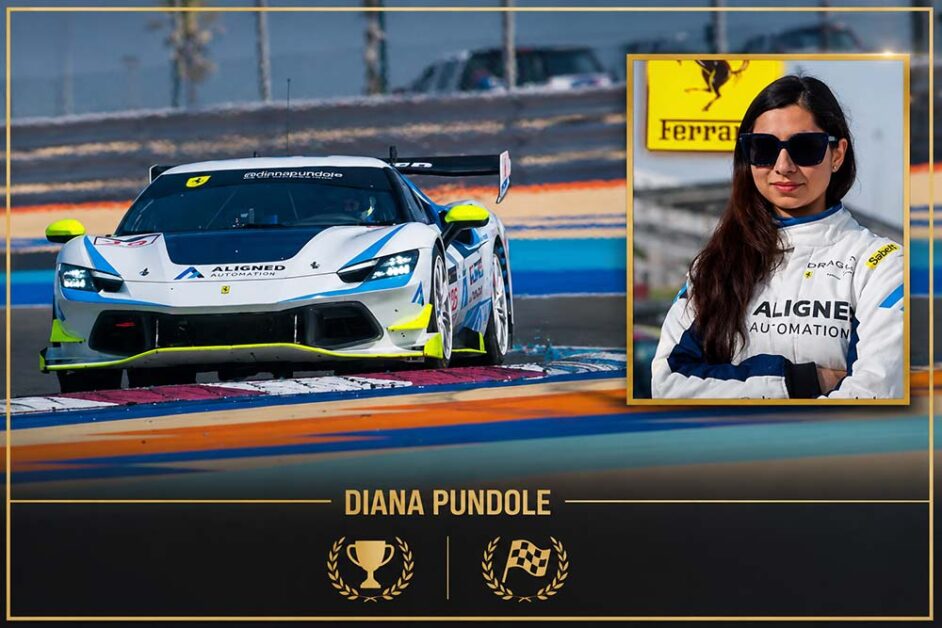
Diana Pundole — From Saloon Cars to Ferrari
Pundole became the first Indian woman to win a four-wheeler national title in a mixed-gender category. Her 2025 Ferrari debut placed Indian women’s racing on the international map for the first time.
- 2024 MRF Saloon Cars Championship: First Indian woman to win on equal footing with male drivers.
- Ferrari Club Challenge Middle East: First Indian woman to race a Ferrari in international competition.
- Yas Marina debut: Finished fourth in her opening international round.
- Bahrain and Jeddah rounds: Two podium finishes, including a runner-up at 288 kmph in Jeddah.
Dr. Bani Yadav entered competitive rallying at 43, long after most professional careers begin. The Gurgaon-based women rally driver became a national champion and Asia-Pacific Rally Championship competitor. Her journey proves that talent development in motorsport is not restricted by age, background, or timing.
Behind every podium, title, and international appearance lies a longer story of persistence, preparation, and opportunity finally meeting performance when it mattered most.
Beyond the Cockpit: Women Rebuilding Indian Motorsport from the Inside
The loudest noise in a pit lane comes from the engine. But the most critical decisions happen in the seconds before the car rolls back out. Increasingly, those decisions are being made by women holding the spanners.
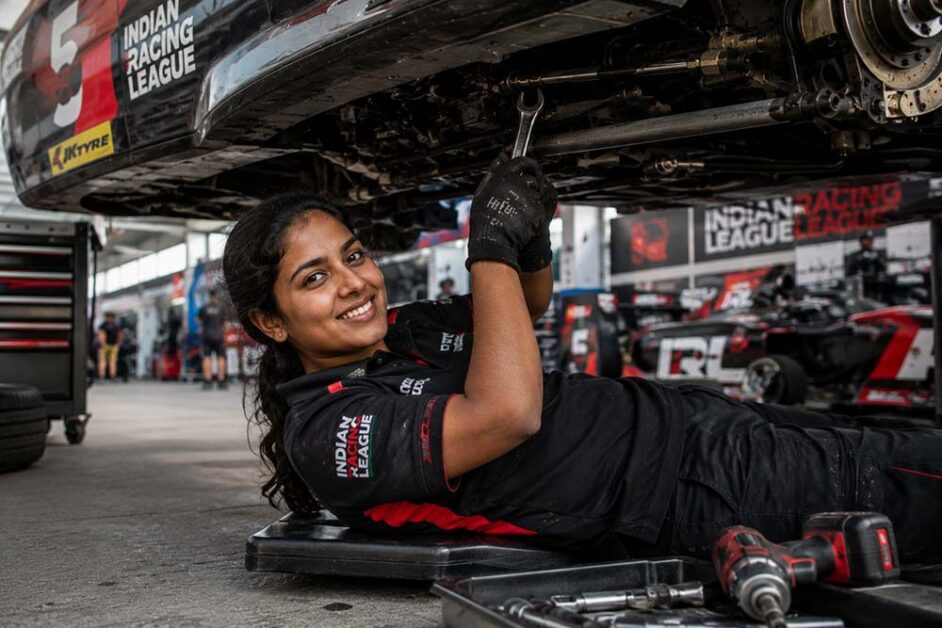
Vaishali Sharma — Precision in the Pit Lane
Sharma works as a number two mechanic for the Kolkata Royal Tigers in the Indian Racing League, having trained on the US F4 Championship circuit before returning to India. A mechanical engineer by qualification, she manages tyre changes, suspension checks, and pre-grid preparation under thirty-second windows. In her own words to Vogue India, the hardest part is not the work itself but “people asking whether you can handle the pressure” before they have seen you do the job once.
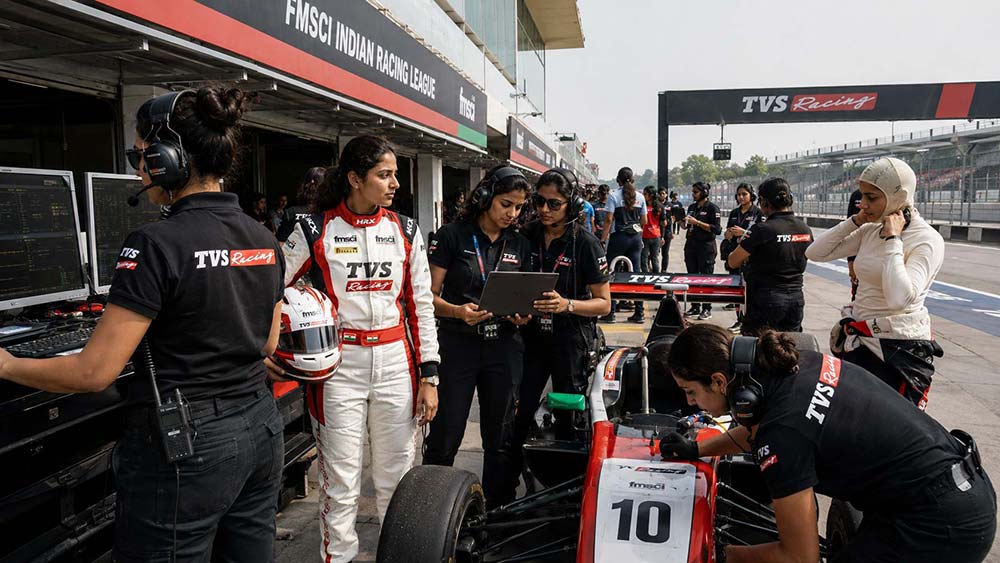
Data, Operations, and the Roles Nobody Films
The Indian Formula 4 Championship runs on telemetry. Since 2024 Sharayu Puranik has been one of the engineers reading it. Her line cuts through the noise — “analytics don’t ask whether you are male or female.” The numbers speak first.
Modern motorsport performance is no longer determined by driving skill alone. Engineers, data analysts, mechanics, and race strategists all contribute to the athlete’s competitive outcome.
Shaanvi Kokra works a different terrain. Pit operations, sponsor coordination, and trackside media for IRL teams sit on her desk simultaneously. Two roles that did not formally exist for women in Indian motorsport a decade ago are now occupied by named professionals with measurable scope.
What are the biggest barriers for women in motorsport in India?
The biggest barriers are cost, geography, and limited seat time. A national-level season can cost ₹8–80 lakhs. Infrastructure is concentrated in South India. Female drivers average 1–5 years of career support compared to 12+ years for male drivers.
The garage is no longer a closed door. It opened slowly — and only because women pushed from both sides, with tools in their hands and data on their screens.
The Institutions Building the Pipeline for Indian Women in Motorsport
Individual excellence does not survive without institutional architecture. The women competing today did not appear from nowhere. They came through programmes designed — sometimes imperfectly — to give them a structured starting line.
JK Tyre, TVS Racing, and the Talent Hunt Model
Two parallel pipelines now define how Indian women enter motorsport professionally. One runs on four wheels, the other on two — and together they have moved the sport from accidental discovery to institutional sourcing of female talent.
- JK Tyre Women in Motorsport: Selected Diana Pundole from over 200 applicants. Now backs a ₹2.5 crore scholarship targeting international platforms for the next generation of female racing drivers2.
- TVS Racing factory programme: Training over 500 women riders since 2016. Produced and sustained Aishwarya Pissay through world-level competition with full factory backing.
- Alisha Abdullah Racing Academy: India’s first female national champion now trains 85 to 150 girls annually — turning championship experience into structured coaching.
- Mira Erda Racing Academy, Vadodara: First Indian woman in Euro JK now coaches over 100 children each year. When champions become coaches, the pipeline sustains itself.
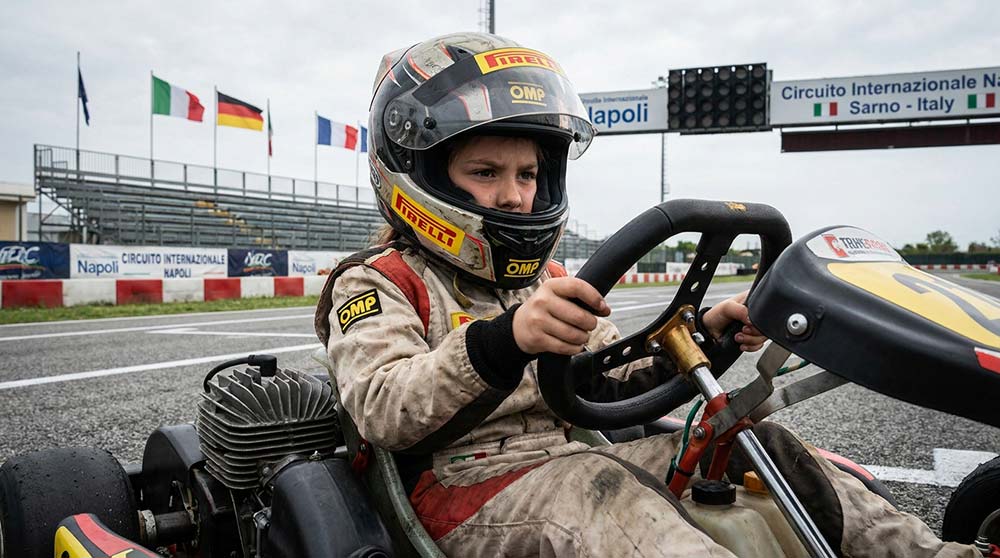
Atiqa Mir and the Global Junior Pipeline
Atiqa Mir is eleven, from Srinagar, and already competing where most Indian female racers never reach. Selected as the only Asian in the F1 Academy’s Discover Your Drive programme and among eleven girls globally chosen for the Iron Dames Young Talent Programme. A podium at Champions of the Future Academy Valencia and highest-ranked female at WSK Super Masters signal what structured early access produces.
Talent opens the throttle, but opportunity determines who reaches the starting grid. Great athletes emerge when systems recognise potential before results— Anuj Mahajan
Policy without pipeline is optics. Pipeline without policy is luck. India is beginning to understand — and act on — the difference.
The Barriers That Remain and the Road Ahead for Women in Motorsport
None of this progress erases the structural weight these women carry. The barriers in Indian women’s motorsport are not dramatic. They are quiet, cumulative, and expensive — and they are still very much present.
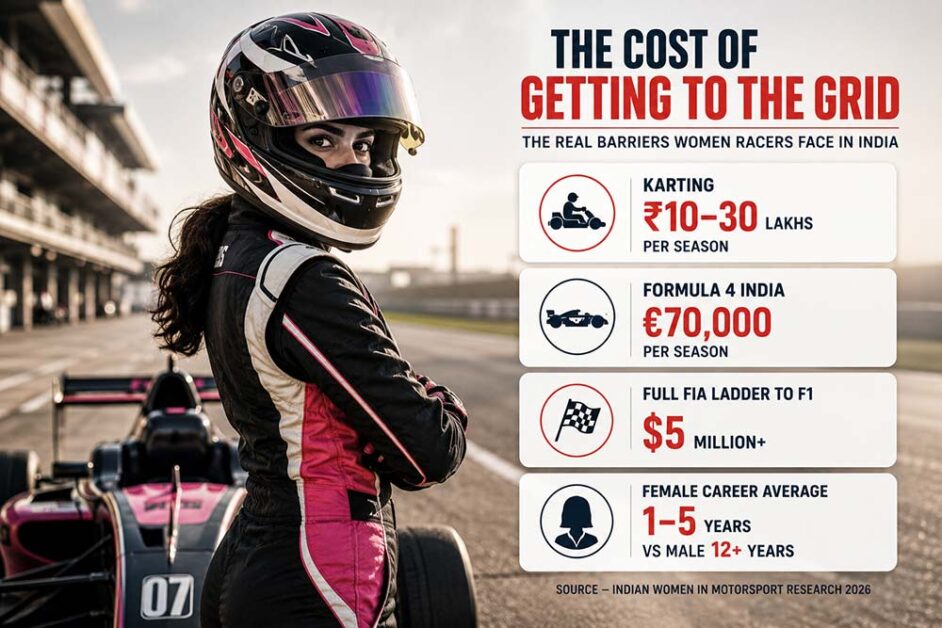
Cost, Geography, and the Seat Time Gap
A single season in the Formula 4 Indian Championship costs approximately €70,000. A full progression through the FIA ladder to Formula One exceeds $5 million. Female racing drivers in India average one to five years of active career support. Male drivers average over twelve. When seat time is purchased and budgets run dry, performance plateaus. When performance plateaus, sponsors withdraw. The cycle is self-reinforcing.
Geography compounds the problem. Racing infrastructure remains concentrated in South India. For women from the north or rural regions, additional travel, training, and logistical costs create barriers that many aspiring racers must overcome before they even reach the starting grid.
What are the biggest barriers for women in motorsport in India?
The biggest barriers are cost, geography, and limited seat time. A national-level season costs ₹8–80 lakhs. Infrastructure is concentrated in South India. Female F1 drivers have a average 1–5 years of career support compared to 12+ years for male drivers.
The Indian Woman in Motorsports story is no longer built on isolated breakthroughs. The IRL mandate continues. Pissay targets Dakar 2027. Pundole races Ferrari internationally through April 2026. The momentum is structural, not sentimental.
The barriers are real. But so is the momentum. What changes next depends entirely on whether institutions sustain the access they have started to build.
Related Stories of Athlete Development
- Sports Mentors in Indian Sports: The People Powering Revolution
- A New Dawn: Sports For Women Empowerment Leading The Way
FAQs: Women in Motorsport
Modern circuits also use safer barrier3 systems designed to absorb crash energy. These safety measures include tyre walls, ARMCO steel guardrails, and concrete structures to protect drivers during crashes. In Indian women’s motorsport, the more consequential safer barriers are structural — cost, geography, and limited access to competitive seat time.
Aishwarya Pissay is the first Indian athlete, male or female, to win a world motorsport title. She claimed the FIM Bajas World Cup women’s category in 2019, backed by TVS Racing, and has since added multiple international medals to her record.
Women can enter Indian motorsport through the JK Tyre national talent hunt, TVS Racing’s grassroots women’s programme, and FMSCI-licensed karting competitions. Karting remains the most accessible entry point, with scholarships available for drivers who progress through structured national championships.
The Indian Racing League is the only premier racing series in the world mandating one female driver per team. The F1 Academy and Formula 4 Indian Championship also offer scholarship-backed seats specifically designed to support female racing drivers entering competitive motorsport.
Conclusion
The story of women in motorsport in India has moved past the era of isolated firsts. Champions, engineers, data analysts, pit crew members, and team owners are now part of the same ecosystem — and that ecosystem is producing results at both national and international levels.
The work that remains is structural. Funding gaps persist. Geography still limits access for women outside South India. Seat time — the currency of competitive development — remains unequally distributed. Progress is real, but it is not yet self-sustaining.
As someone who has spent three decades telling women’s stories, I know that the most important chapters are written not in moments of celebration but in moments of commitment.
Follow TrendVisionZ for more stories on Indian women redefining sport, culture, and leadership — one barrier at a time.
Additional Resources:
- Parihar, Dr & Singh, Dr. (2026). Women in Professional Sport in India: Struggles for Equality and Recognition. International Journal of Scientific Research in Science and Technology. 13. 126-135. 10.32628/IJSRST2613122. ↩︎
- Lick, Elisabeth & Bakirov, Rashid & Ramjaun, Tauheed. (2024). Female motorsport fan engagement on social media-based brand communities. Journal of Digital & Social Media Marketing. 12. 10.69554/LXAX7906. ↩︎
- Pflugfelder, Ehren. (2009). Something Less than a Driver: Toward an Understanding of Gendered Bodies in Motorsport. Journal of Sport & Social Issues – J SPORT SOC ISSUES. 33. 411-426. 10.1177/0193723509350611. ↩︎
Stay Connected with Me
Namita Mahajan is a Lifestyle Influencer, Digital Strategist, and Womenpreneur empowering self-reliance and creativity through storytelling and digital presence.
As Director of Nuteq Entertainment Pvt. Ltd. and Co-Founder of TrendVisionz, she brings together media experience, empathy, and innovation to build purposeful brands.
- Explore our work: Nuteq Entertainment | TrendVisionz | About the Authors
- Read our newsletters: Transforming Lives | BizTech Chronicle | Nuteq Newsline
- Guest writer: BizCatalyst360 | Praja Today
- Join the community: Go Mindfulness: Practices for Professionals Coached
- Connect with me: LinkedIn | Twitter | #StoryforBusiness
- Share your review: Leave your review on Google — your feedback helps us grow.
- Listen on Spotify: Leadership Podcast | Guided NLP | Daily Motivation
Believe. Practice. Perform. Let’s create impact together.
✍️ A Note from the Editor
At TrendVisionz, we craft every article with intention—guided by insight, empathy, and the belief that stories can empower change. Our content remains open and free, because knowledge should be accessible to everyone.
If our work inspires you, we’d be deeply grateful for your support. Even $10/month helps us continue creating stories that inform, uplift, and inspire.
💛 Support our work: Contribute via PayPal or write to us at anujmahajan@trendvisionz.com to set up your monthly support.
Thank you for believing in independent storytelling. — Editor


