
Bhumi, who lives in my society, is 28 and has just had her first baby. The birth was a planned cesarean at a private hospital. Her mother smiles at the scans on Bhumi’s phone. During her own pregnancy, she carried a paper file and saw the doctor once a month. Childbirth in India has quietly changed.
The latest NFHS-6 findings reflect the same shift across India. India’s Total Fertility Rate has fallen to 2.0. More than 90% of births now happen in hospitals. Pregnancy is monitored more closely, and cesarean deliveries continue to rise. Each number reflects a larger shift in how Indian women experience pregnancy, childbirth, and motherhood today.
Over the years, I have worked closely with hospitals, healthcare professionals, and public-facing health communication initiatives that shape how women access care. I am also a mother of two grown children. Both my normal deliveries were guided by the same doctor.
This article explores how childbirth in India has changed across generations, revealing smaller families, hospital-based births, evolving pregnancy care, and the growing role of cesarean delivery.
Also Read:
Editorial Note: Names have been changed to protect privacy.
Childbirth in India Across Three Generations
Three generations of women. Three very different experiences of pregnancy and birth. Few areas of family life reveal India’s social and healthcare transformation as clearly as childbirth.
When I think about my mother-in-law’s generation, my own experience as a mother, and the world Bhumi inhabits today, the contrast is striking. I realise that childbirth did not change overnight. The change was gradual, unfolding one generation at a time.
From Home Births to Institutional Deliveries
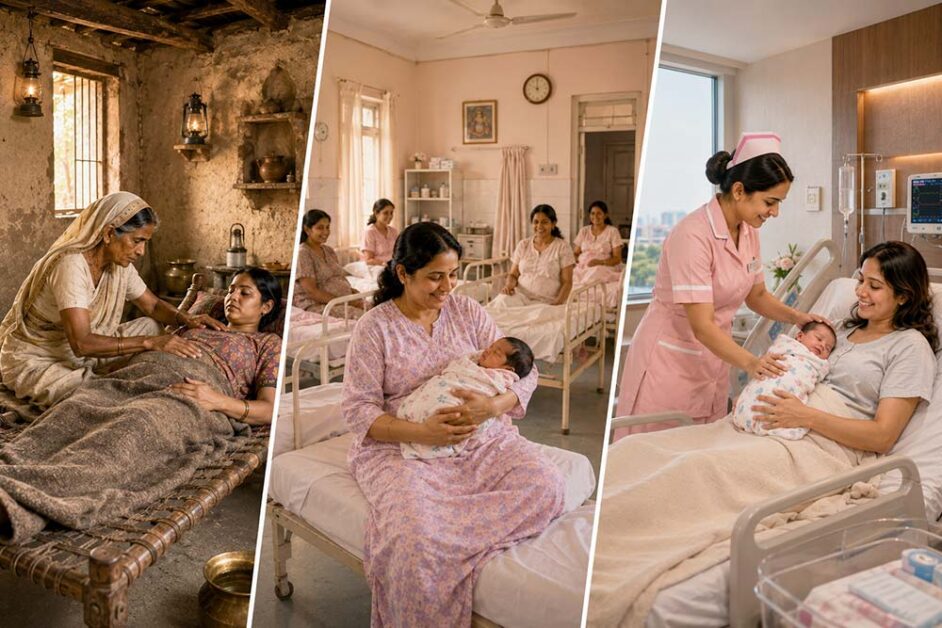
My mother-in-law gave birth at home, like many women of her generation. Access to hospitals was limited, especially outside major cities. Today, childbirth in India looks very different. NFHS-6 shows that institutional births have risen from 88.6% to 90.6%, making hospital deliveries the norm rather than the exception.
This shift reflects stronger maternal healthcare systems, better transport, wider awareness, and greater access to skilled birth attendants. It also shows how the urban-rural divide has narrowed, bringing safer delivery options to more families.
From Personal Care to Modern Maternity Systems
A generation ago, maternity care often revolved around a single doctor who managed the pregnancy from first visit to delivery. Today, care is delivered through a network of specialists, diagnostic centres, nurses, and hospital teams.
Digital records, routine screening, specialised consultations, and standardised protocols are now common parts of pregnancy care. The result is greater monitoring and support, but also a shift from relationship-based care to system-based care.
As a woman and a mother, I never imagined that something as personal as childbirth could change so much within a single generation. The journeys of the women we meet next reveal how family size, pregnancy care, hospital births, and motherhood itself are being redefined across India.
Fewer Children, Different Choices: India’s Falling Fertility Rate
India’s Total Fertility Rate has fallen, placing the country just below replacement level fertility. Behind that statistic are millions of individual decisions about when to marry, when to become parents, and how many children to have.
Ananya is 26, married, and works as a software professional in Bengaluru. Financially independent and focused on building her career, she is in no hurry to become a mother. Her decision is personal, yet multiplied across millions of women like her, it reflects a broader change in how young Indians think about family and parenthood.

What India’s Total Fertility Rate Really Means
The Total Fertility Rate may sound technical, but it answers a simple question: how many children the average woman is likely to have.
- India’s Total Fertility Rate stands at 2.0. This is just below the replacement level fertility benchmark of 2.1.
- Replacement level fertility: means each generation is large enough to replace itself. Falling below that level signals a long-term shift in family size and population growth.
Why Indian Families Are Choosing Fewer Children
Family size is changing1 because life itself is changing. Economic pressures, shifting aspirations, and greater access to family planning are influencing how young Indians think about parenthood.
- People are marrying and becoming parents later. Career and financial stability often come first.
- Raising children costs more than before. This is especially true in urban India.
- Women have more educational and professional opportunities. Family decisions increasingly reflect those choices.
- Family planning access continues to improve. Contraceptive use has risen from 66.7% to 69.1%.
Being socially active, I often notice that conversations around parenthood2 have changed. Earlier generations asked how many children a family would have. Today, many young couples are still deciding whether, when, or even if they want children at all.
How Pregnancy Care Changed in One Generation
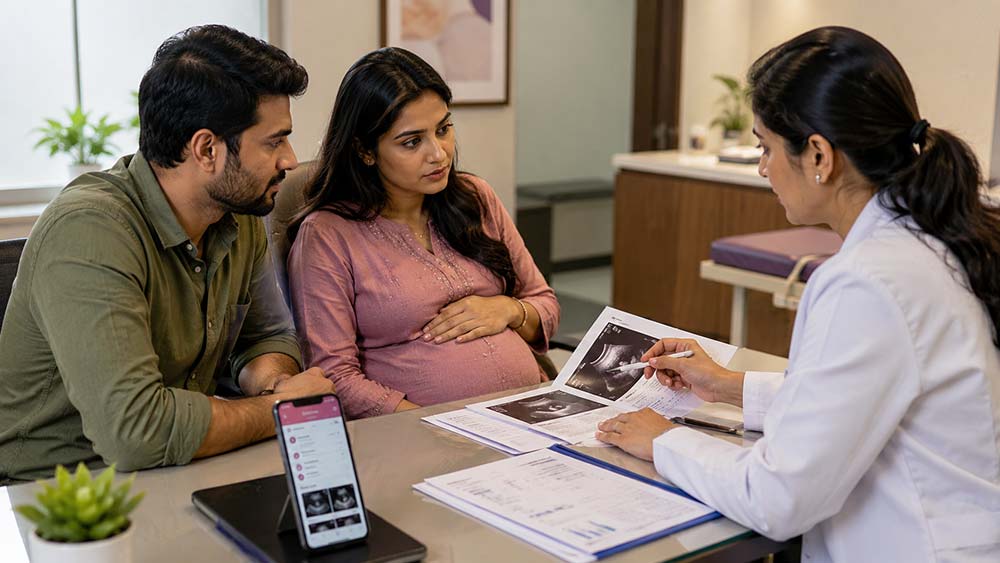
During a visit to a leading obstetrician and gynaecologist in Delhi, I met Meera, an expectant mother from the outskirts of Pune. She had travelled to Delhi for a consultation regarding her high-risk pregnancy.
As we spoke, she scrolled through scans, test reports, and appointment reminders on her phone. Her concerns were not about where the baby would be born. They were about test results, timelines, and making sure everything remained normal.
From Waiting for Birth to Monitoring Pregnancy
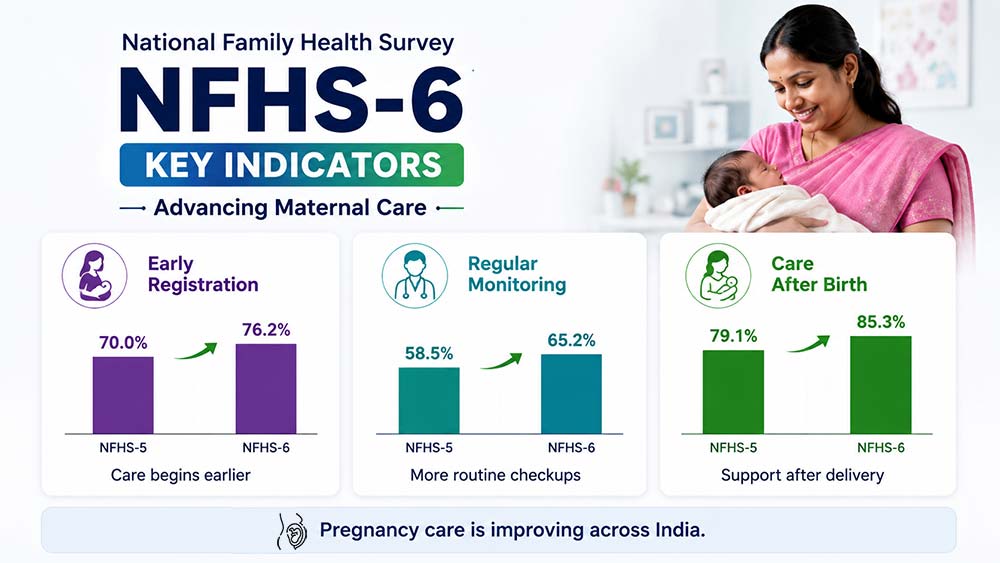
Pregnancy care today begins earlier, lasts longer, and involves far closer monitoring than it did a generation ago. Antenatal care is now a continuous process rather than a series of occasional visits.
According to the obstetrician, the biggest change has been timing. Women are entering the healthcare system earlier, allowing doctors to identify risks sooner and monitor pregnancy more closely. What was once a monthly visit has evolved into a structured journey of screening, follow-up, and prevention.
How Is Pregnancy Care Different Today Than a Generation Ago?
Pregnancy care now begins earlier and involves more regular monitoring through scans, tests, and consultations. Maternal healthcare focuses on prevention and early detection, while postnatal care increasingly extends support beyond childbirth.
Being connected to healthcare communication for years, I have seen how pregnancy care has become far more structured than it once was. The support is stronger, but the experience is also far more managed.
Hospital Deliveries in India: The New Normal
Perhaps the most significant transformation in childbirth in India has been where women give birth. A generation ago, home births were common across large parts of the country. Today, hospital deliveries have become the expected path for most families.
While filming a documentary for the Ministry of Women and Child Development, I spoke with women from very different backgrounds. One theme surfaced repeatedly: home birth, once considered normal, now felt increasingly distant.
Sunita travelled nearly an hour from her village to a government community health centre. Her mother delivered at home. For Sunita, a hospital birth was not a luxury. It was the only option she considered.
From Home Births to Institutional Deliveries
For much of the previous generation, childbirth often took place at home because healthcare facilities were distant and difficult to access. Sunita grew up in a different India. Better roads, maternal health programmes, community outreach workers, and wider access to skilled birth attendants have transformed expectations around childbirth. Hospital care is now viewed as the safer and more practical choice.
Safer Childbirth Through Hospital Deliveries
The impact is visible across the country. More than 90% of births now take place in healthcare facilities, making institutional births one of India’s most significant public-health achievements. For many families, access to maternal healthcare is no longer limited by geography in the way it once was.
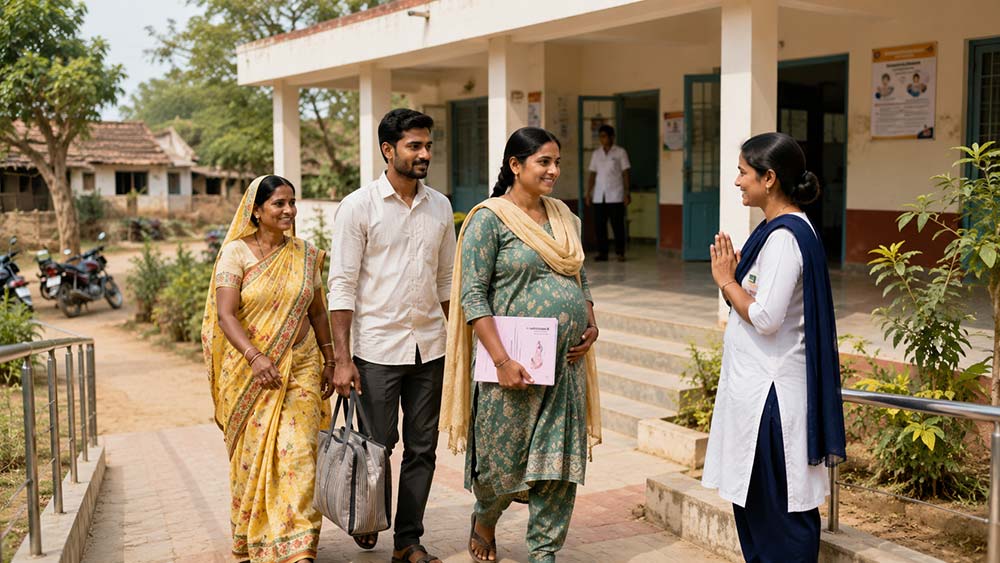
Looking at women like Sunita, I see how dramatically childbirth has changed within a single generation. The bigger question now is not where women give birth, but how childbirth itself is evolving inside the hospital system.
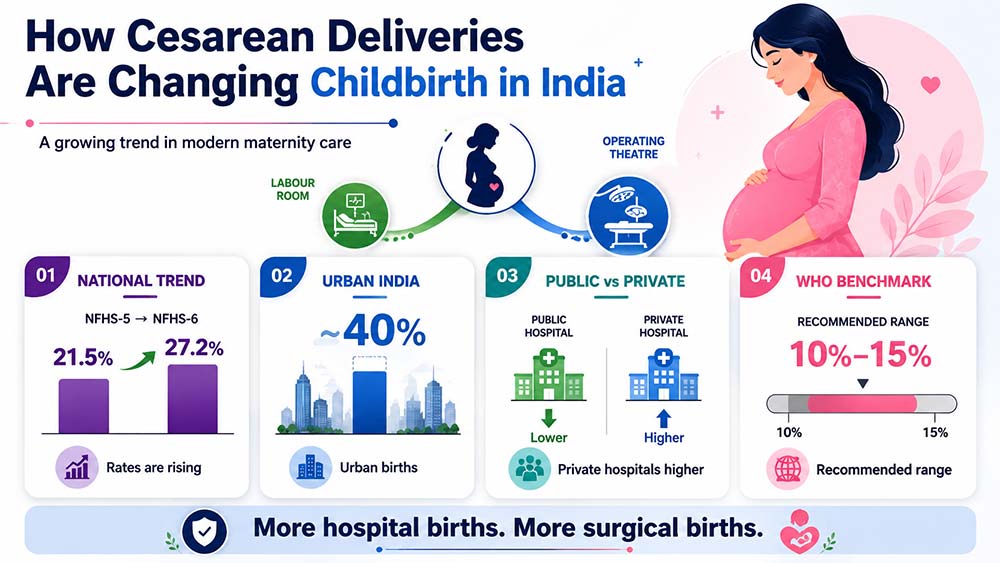
The Caesarean Delivery Surge in India
Priya’s delivery was scheduled weeks in advance. The hospital theatre was booked. Client deadlines were planned around the birth. For many urban professionals, childbirth now unfolds within the same culture of scheduling that shapes work and daily life.
When Childbirth Becomes a Planned Procedure
Priya is 34, financially independent, and runs a successful content business from Mumbai. Like many women in India’s urban professional class, she approached pregnancy with careful planning and access to some of the country’s best healthcare facilities. Her delivery was smooth, organised, and predictable. Yet it also reflected a broader shift in how childbirth is increasingly experienced in urban India.
Priya laughed as she told me that she had even consulted ChatGPT to identify the most astrologically favourable dates for her baby’s birth. She then discussed those dates with her gynaecologist while planning her delivery. The story may sound unusual, but it reflects a broader shift. The rise in caesarean delivery is not driven by a single factor. It is increasingly shaped by medical technology, convenience, scheduling, risk management, and personal preferences, particularly in urban private healthcare settings.
A Necessary Procedure, But An Emerging Question
Cesarean delivery is one of modern medicine’s most important interventions and saves lives when medically necessary. The emerging question is whether childbirth, having moved successfully from home to hospital, is now shifting from the labour room to the operating theatre faster than many people realise.
Caesarean sections are absolutely critical to save lives in situations where vaginal deliveries would pose risks. But not all the caesarean sections carried out at the moment are needed for medical reasons. — Dr Ian Askew, Former Director, WHO Department of Sexual and Reproductive Health and Research
Priya’s birth went smoothly. What stayed with me was not the surgery itself, but how naturally an operating theatre had become part of a routine urban birth story.
What NFHS-6 Reveals About the Future of Motherhood in India
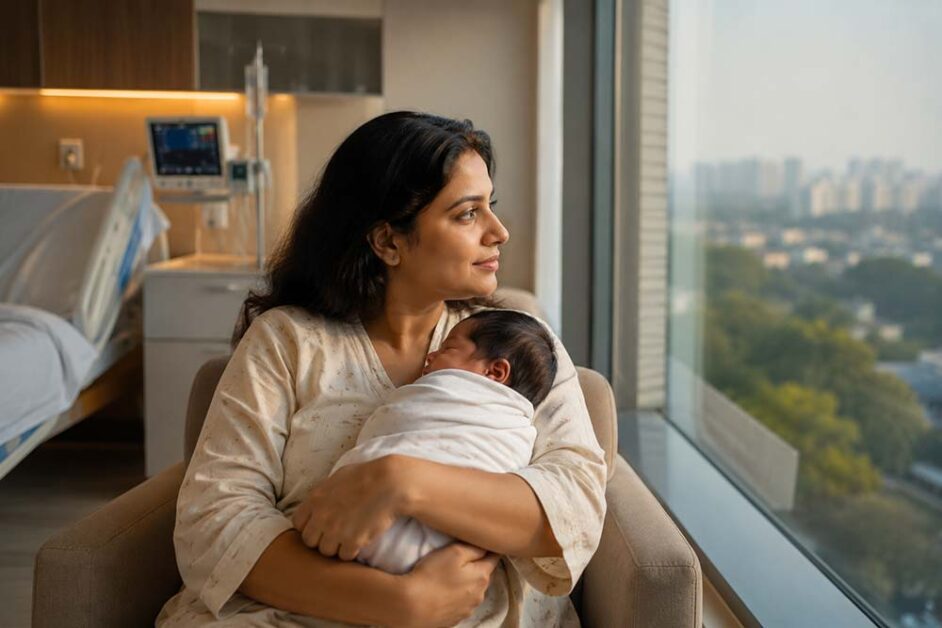
The stories of these women are different, yet they point in the same direction. Together, they reveal how childbirth in India is becoming safer, smaller, more monitored, and increasingly shaped by medical and personal choices.
Key Takeaways
- Motherhood is becoming more intentional. Smaller families, delayed parenthood, and changing aspirations suggest that having children is increasingly a conscious decision3 rather than an expected life stage.
- Healthcare is reaching women earlier. Pregnancy is now supported by earlier registration, closer monitoring, and stronger maternal healthcare systems than previous generations experienced.
- Hospital birth has become the national standard. Institutional deliveries are no longer concentrated in major cities and now represent the normal childbirth experience for most Indian families.
- Technology is changing the experience of pregnancy. Digital records, scans, screening, and continuous monitoring are reshaping how women navigate pregnancy and childbirth.
- The role of medical intervention is growing. Rising cesarean delivery rates suggest that childbirth is becoming more medicalised, creating new questions alongside undeniable gains in safety.
- India’s motherhood story is still evolving. Progress is visible across fertility, pregnancy care, and childbirth outcomes. But the next generation will shape what modern motherhood ultimately becomes.
For one generation, progress meant reaching a hospital. For the next, it may mean ensuring that safer childbirth remains personal, informed, and genuinely centred on women. Looking across these stories, what stands out is not how much motherhood has changed. How quickly that change has arrived.
Also Read:
- Obesity Treatment: From GLP-1 Therapy to Gene Therapy Breakthroughs
- The Complete Guide to Abortion Care: Safety, Science, and Global Context
FAQs: Childbirth in India
Childbirth in India is becoming safer, more medicalised, and increasingly hospital-based. Families are having fewer children, pregnancy care begins earlier, and more women receive institutional care, reflecting major changes in maternal health, healthcare access, and childbirth practices.
Cesarean deliveries are rising because of greater surgical access, changing medical practices, risk management, and higher use of private hospitals. While many procedures are medically necessary, rising rates have prompted discussion about how childbirth is increasingly managed in urban healthcare settings.
Improved maternal healthcare, better transport, government health programmes, and wider access to skilled birth attendants have made hospital deliveries the preferred choice for most Indian families. It is a fact that more than 90% of births in India, now take place in healthcare facilities.
Conclusion
Childbirth in India looks very different from the one I experienced when I became a mother. Both my children were delivered normally, guided by the same doctor from the first appointment to the day they were born. Looking back, that continuity of care now feels like a glimpse into another era.
Today, women like Bhumi navigate pregnancy through scans, digital records, specialist consultations, and carefully planned hospital deliveries. What once felt exceptional has become ordinary. The experience of motherhood is increasingly shaped by healthcare systems, technology, and informed decision-making.
The generation that follows will inherit a childbirth landscape that is safer, more medical, and filled with more choices than ever before. Smaller families, stronger maternal health systems, and closer monitoring are no longer emerging trends. They are becoming the new normal across India.
The progress is undeniable. Yet rising cesarean delivery rates, changing expectations around birth, and evolving models of care remind us that every gain brings new questions. Understanding those shifts with clarity will help shape the future of childbirth in India.
At TrendVisionz, we explore the social shifts hidden inside national conversations, helping readers understand not just what is changing, but why it matters.
Stay Connected with Me
Namita Mahajan is a Lifestyle Influencer, Digital Strategist, and Womenpreneur empowering self-reliance and creativity through storytelling and digital presence.
As Director of Nuteq Entertainment Pvt. Ltd. and Co-Founder of TrendVisionz, she brings together media experience, empathy, and innovation to build purposeful brands.
- Explore our work: Nuteq Entertainment | TrendVisionz | About the Authors
- Read our newsletters: Transforming Lives | BizTech Chronicle | Nuteq Newsline
- Guest writer: BizCatalyst360 | Praja Today
- Join the community: Go Mindfulness: Practices for Professionals Coached
- Connect with me: LinkedIn | Twitter | #StoryforBusiness
- Share your review: Leave your review on Google — your feedback helps us grow.
- Listen on Spotify: Leadership Podcast | Guided NLP | Daily Motivation
Believe. Practice. Perform. Let’s create impact together.
✍️ A Note from the Editor
At TrendVisionz, we craft every article with intention—guided by insight, empathy, and the belief that stories can empower change. Our content remains open and free, because knowledge should be accessible to everyone.
If our work inspires you, we’d be deeply grateful for your support. Even $10/month helps us continue creating stories that inform, uplift, and inspire.
💛 Support our work: Contribute via PayPal or write to us at anujmahajan@trendvisionz.com to set up your monthly support.
Thank you for believing in independent storytelling. — Editor
Additional Resources:
- Nayak, Debendra. (2014). Changing Household Size in India. Transactions of the Institute of Indian Geographers. 36. 1-18. ↩︎
- Bodin M, Holmström C, Plantin L, Schmidt L, Ziebe S, Elmerstig E. Preconditions to parenthood: changes over time and generations. Reprod Biomed Soc Online. 2021 May 14;13:14-23. doi: 10.1016/j.rbms.2021.03.003. PMID: 34136667; PMCID: PMC8178081. ↩︎
- Sumathi, Hinduja & Eljo, Jeryda Gnanajane. (2025). Redefining Motherhood in India: A Feminist and Intersectional Perspective on Maternal Identities and Social Change. International Journal of Research Publication and Reviews. Volume 6. 2863-2878. 10.5281/zenodo.15743580. ↩︎


