
“That is normal at your age” is something many teenage girls hear about periods, acne, mood shifts, or changing energy. Sometimes it is reassuring and accurate. But adolescent health also means understanding where normal variation ends.
Adolescence spans ages 10 to 19, bringing rapid physical, hormonal, and emotional change. In India, government reporting based on NFHS-5 found anaemia in 59.1% of adolescent girls.

Over the years, as a media professional, I’ve worked closely with senior healthcare professionals and followed women’s health conversations across different life stages. One gap repeatedly stands out: teenage girls are often taught how to manage a period, but not always which changes in their bodies.
In this edition, I explain what usually changes during puberty, how teenage periods and hormonal changes can vary, and which signs should prompt medical advice. For teenage girls, this is about understanding the body with greater confidence and making teenage girls’ health easier to discuss without embarrassment or dismissal. And for parents, it is about listening without dismissing what a girl is experiencing.
Also Read:
- Healthy Diet for Women: Essential Nutrition for Every Life Stage
- Medical Aesthetic Clinics: A Modern Approach to Dental, Skin, and Hair Care
Puberty in Girls Follows a Recognisable Developmental Pattern
Puberty in girls usually follows a recognisable biological sequence, although the timing varies between individuals. Knowing the usual pattern helps distinguish normal development from changes.
Puberty in girls commonly begins with breast development, followed by pubic or underarm hair and a growth spurt. The first period, or menarche, usually arrives about two to three years after breast development begins.
Image : puberty-in-girls-development-sequence.jpg
Alt : Puberty in girls sequence showing development, growth spurt, and menarche
Caption: The usual sequence of puberty in girls
Normal Puberty Follows a Predictable Sequence
Breast development usually begins between ages 8 and 13, followed by body hair and rapid growth. The first period, or menarche, commonly begins around ages 12 to 13, usually about two to three years after breast development starts. In India, the average age at menarche is about 12.77 years, although individual timing varies. Girls of the same age can still be at different stages and develop normally.
The sequence matters more than comparing exact ages, but there are clear limits. No breast development by age 13, no first period by age 15, or no period more than three years after breast development begins are reasonable points for medical assessment. Persistent growth delays in children or delayed pubertal milestones also require proper review. Breast development beginning before age 8 should also be discussed with a doctor, as this falls outside the usual pubertal range.
Teenage Hormonal Changes Affect More Than Periods
Teenage hormonal changes can affect skin, sleep, appetite, mood, energy and body composition while the reproductive system continues to mature.
Oilier skin and acne may become more noticeable. Sleep patterns can shift, appetite may change, and emotional responses can feel stronger. Height, weight and body composition also change during puberty, which is why BMI by age and height needs age-specific interpretation rather than adult comparisons.
Puberty allows wide individual variation, but not every delay should be dismissed. Understanding the normal sequence gives girls a useful baseline before menstrual patterns become the next important health signal.
Menstrual Health: What Normal Teenage Periods Look Like
Early teenage periods are often irregular because menstrual cycles take time to mature. That variation can be normal, but “irregular is normal” has limits. The pattern matters most when viewed against the number of years since the first period.
Cycle Patterns Change With Years Since the First Period
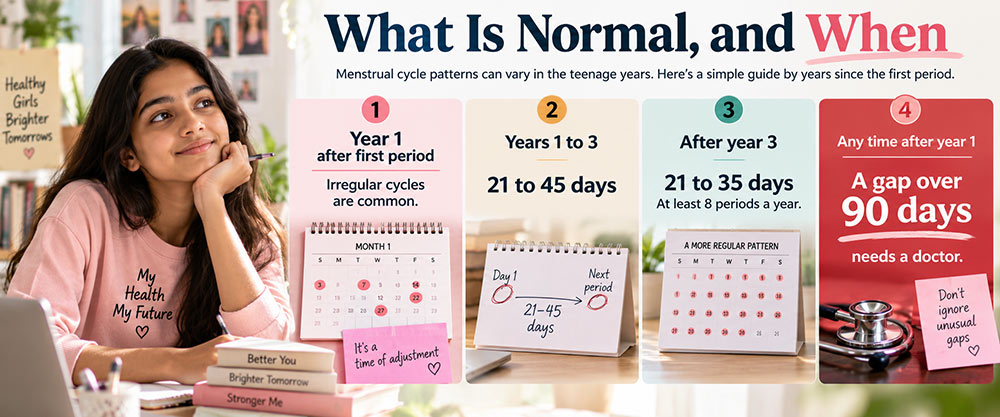
Doctors often judge teenage periods by gynaecologic age, which simply means how long it has been since the first period, rather than by a girl’s birthday alone.
- First year: Irregular cycles are common while the menstrual pattern is still developing and can be part of normal early menstrual maturation.
- One to three years: Cycles that remain shorter than 21 days or longer than 45 days require medical discussion if the pattern continues.
- After three years: Cycles usually become more adult-like, commonly around 21 to 35 days, with at least eight periods in a year.
By the third year after menarche, about 60–80% of girls have cycle lengths within the adult-like 21–34-day range. A gap of more than 90 days after the first year falls outside the usual pattern and should be discussed with a doctor.
Period Tracking Helps Girls Recognise Their Own Pattern
Tracking does not need an app or complicated chart. A calendar, diary, or private phone note can help make menstrual health easier to understand.
- Dates: Record the first day of each period and the gap before the next one.
- Flow: Note how many days bleeding lasts, unusually heavy days, and any flooding or leakage.
- Effect: Record significant pain, dizziness, weakness, or days missed from school or normal activities.
A typical teenage period usually lasts up to seven days, although flow can vary. Tracking these changes creates a personal baseline and makes it easier to explain concerns clearly if medical advice is ever needed.
From what I have seen in women’s health conversations, girls gain confidence when they understand their own pattern. That awareness makes it easier to speak up when something feels different.
Teenage Health Problems: Periods That Need a Doctor
It was just last Friday when I was speaking with a senior gynaecologist, and she exclaimed, “Too many girls still think severe pain or heavy bleeding is something they simply have to live with.”
That stayed with me. Most teenage period problems are manageable, but heavy bleeding, disabling pain, long gaps, fainting, or breathlessness call for immediate attention.
Teenage Period Problems That Should Not Be Normalised
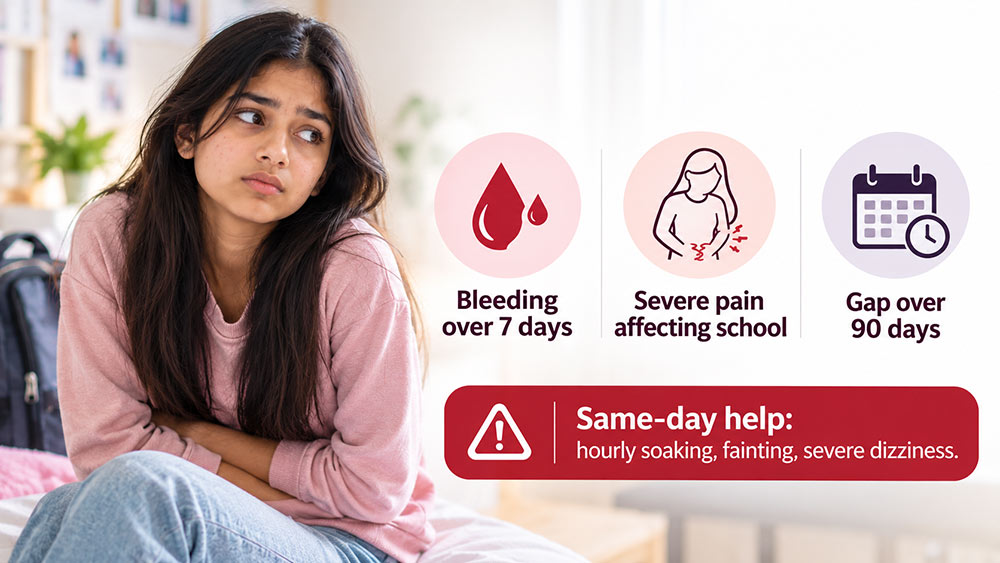
Bleeding that lasts more than seven days, requires changing a pad or tampon more often than every two hours, repeatedly soaks through protection, or needs double protection can signal heavy menstrual bleeding. Fainting, marked dizziness, breathlessness, or unusual weakness during a heavy period raise the urgency and should not be ignored.
Severe cramps that repeatedly keep a girl away from school or normal activities need to be looked into. So does a cycle gap of more than 90 days after the first year following menarche. Frequent unexplained nosebleeds, easy bruising, prolonged bleeding after dental work, or a family history of abnormal bleeding can also point towards an underlying bleeding disorder1.
A teenage girl should not have to miss school, feel faint, or plan her life around heavy or painful periods. When symptoms begin disrupting daily life, they need proper medical attention — Dr Madhu Goel, Senior Obstetrician & Gynaecologist
When should a teenage girl see a doctor about her periods?
A teenage girl should see a doctor for heavy bleeding lasting more than seven days, severe period pain2, fainting, severe dizziness, or cycle gaps longer than 90 days. Soaking a pad or tampon every hour for several hours needs same-day medical attention.
My takeaway: if periods are repeatedly disrupting school, daily activity, or causing faintness and unusual weakness, they need attention. Girls should know these signs early, not normalise them.
Adolescent Health Concerns: Hormones, PCOS and Anaemia
Two adolescent health concerns are often misunderstood: PCOS and anaemia. One is sometimes diagnosed too quickly from irregular periods or acne; the other can be missed even when tiredness, dizziness, or poor concentration are affecting daily life.
PCOS in Teenagers Needs More Than Irregular Periods
PCOS in teenagers needs careful assessment because puberty itself can bring irregular periods, acne, and changing hormone patterns. Those changes can look worrying without necessarily meaning PCOS.
I remember a teenage girl in my neighbourhood whose symptoms quickly led people around her to assume PCOS. That stayed with me because those signs alone do not confirm the condition.
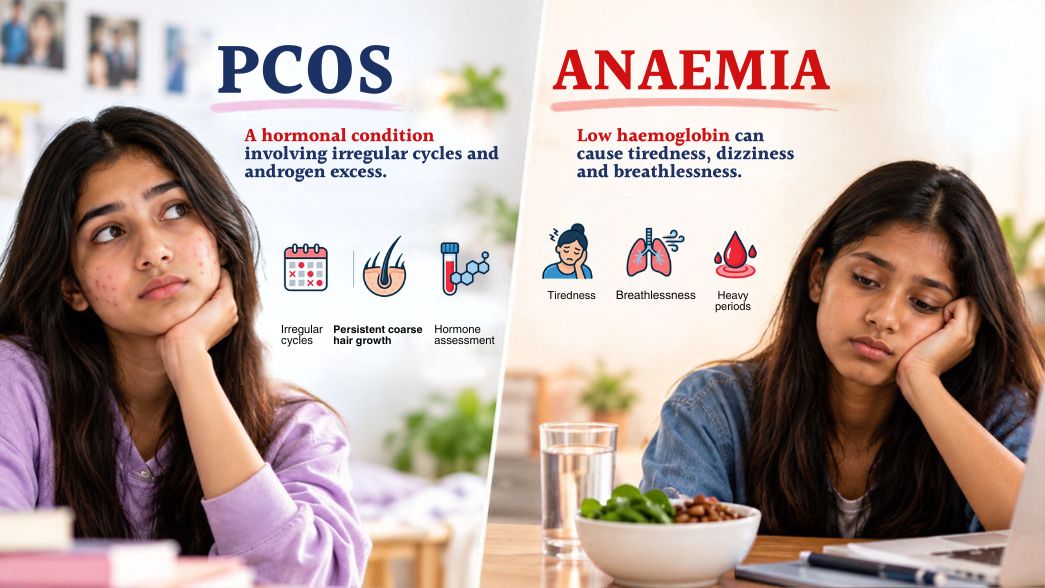
Diagnosis should consider persistent menstrual dysfunction together with signs of androgen excess, after other causes are excluded. Current guidance also advises against using ovarian ultrasound or AMH alone to diagnose PCOS in adolescents3.
Anaemia Is a Common Teenage Health Problem in India
Anaemia can develop quietly during adolescence4 and is easy to mistake for ordinary tiredness. In teenage girls, heavy periods, rapid growth and nutritional gaps can all contribute to symptoms which need to be looked at.
- The response: India’s Anaemia Mukt Bharat (AMB) programme uses a 6×6×6 strategy combining six interventions, six beneficiary groups, and six institutional mechanisms.
- The signs: Persistent tiredness, weakness, dizziness, breathlessness, or poor concentration, particularly when they occur alongside heavy or prolonged periods.
- The food base: A balanced diet should provide enough iron, protein, calcium and vitamin D during rapid growth. Restrictive “period diets” are unnecessary; consistent nutrition matters more. This is where healthy diet choices and nutrients such as magnesium can support overall wellbeing.
Summarising it: when several symptoms persist together, do not self-diagnose from a search result. A proper assessment can separate normal adolescent change from something that genuinely needs treatment.
Adolescent Reproductive Health: Prevention Starts Early
Adolescent reproductive health becomes useful when girls know exactly what preventive steps apply at this age. That includes menstrual tracking, hygiene, vaccination, nutrition, and knowing when routine questions need medical discussion.

- Track your cycle from the first period. Record the first day, cycle gap, bleeding duration, heavy-flow days, pain, dizziness, and any school or activity missed. A gap beyond 90 days after the first year needs medical review.
- Know what normal bleeding looks like. A teenage period usually lasts up to seven days. Repeatedly changing protection more often than every two hours, flooding, or leakage can indicate heavy menstrual bleeding.
- Know the HPV vaccination window. India’s national programme gives a single dose of Gardasil-4 to 14-year-old girls, voluntarily and free at designated government health facilities. The nationwide campaign began on 28 February 2026.
- Understand menstrual hygiene beyond products. NFHS-6 reports hygienic menstrual-method use among 79.2% of young women aged 15–24. Product access matters, but recognising abnormal bleeding, pain, and cycle changes matters too.
- Ask about symptoms before they become routine. Persistent heavy bleeding, disabling pain, unusual cycle gaps, dizziness, breathlessness, or ongoing fatigue are reasons to raise the issue during a consultation.
I have a strong belief, shaped by experience, that girls should learn early that reproductive health is not something to discuss only when something goes wrong. Knowing your body, speaking up, and understanding future cervical cancer screening are all part of prevention too.

Also Read:
- The New Face of Childbirth in India: What NFHS-6 Is Really Telling Us
- AI in Dentistry: Transforming Modern Dental Care
FAQs: Adolescent Health
A teenage period usually lasts up to seven days. Bleeding that regularly lasts longer, repeatedly soaks through protection, or requires changing pads or tampons unusually often should be discussed with a doctor.
Irregular periods are common during the first year after menarche. After that, persistent irregularity, especially when cycle gaps exceed 90 days or remain outside the expected range for years since menarche.
PCOS in teenagers is not diagnosed from acne, irregular periods, or ultrasound findings alone. Assessment looks for persistent menstrual dysfunction together with signs of androgen excess, while ruling out other possible causes.
Conclusion
Adolescent health becomes easier to understand when girls know the usual sequence of puberty and recognise their own menstrual pattern. That awareness turns uncertainty into something more manageable.
Tracking cycle dates, bleeding days, heavy flow, pain and unusual symptoms creates a useful personal record. It also makes conversations with parents or doctors clearer when something changes.
Heavy bleeding, disabling pain, long gaps or persistent fatigue require attention. Good nutrition, HPV vaccination and the confidence to ask questions all belong to preventive health during adolescence, not later.
Explore more TrendVisionz Health insights on Women, Pregnancy & Family Health, and discover more from Namita Mahajan on women’s health across every life stage.
Stay Connected with Me
Namita Mahajan is a Lifestyle Influencer, Digital Strategist, and Womenpreneur empowering self-reliance and creativity through storytelling and digital presence.
As Director of Nuteq Entertainment Pvt. Ltd. and Co-Founder of TrendVisionz, she brings together media experience, empathy, and innovation to build purposeful brands.
- Explore our work: Nuteq Entertainment | TrendVisionz | About the Authors
- Read our newsletters: Transforming Lives | BizTech Chronicle | Nuteq Newsline
- Guest writer: BizCatalyst360 | Praja Today
- Join the community: Go Mindfulness: Practices for Professionals Coached
- Connect with me: LinkedIn | Twitter | #StoryforBusiness
- Share your review: Leave your review on Google — your feedback helps us grow.
- Listen on Spotify: Leadership Podcast | Guided NLP | Daily Motivation
Believe. Practice. Perform. Let’s create impact together.
✍️ A Note from the Editor
At TrendVisionz, we craft every article with intention—guided by insight, empathy, and the belief that stories can empower change. Our content remains open and free, because knowledge should be accessible to everyone.
If our work inspires you, we’d be deeply grateful for your support. Even $10/month helps us continue creating stories that inform, uplift, and inspire.
💛 Support our work: Contribute via PayPal or write to us at anujmahajan@trendvisionz.com to set up your monthly support.
Thank you for believing in independent storytelling. — Editor
Additional Resources:
- Screening and Management of Bleeding Disorders in Adolescents With Heavy Menstrual Bleeding: ACOG COMMITTEE OPINION SUMMARY, Number 785. Obstet Gynecol. 2019 Sep;134(3):658-659. doi: 10.1097/AOG.0000000000003412. PMID: 31441820. ↩︎
- ACOG Committee Opinion No. 760: Dysmenorrhea and Endometriosis in the Adolescent. Obstet Gynecol. 2018 Dec;132(6):e249-e258. doi: 10.1097/AOG.0000000000002978. PMID: 30461694. ↩︎
- Peña AS, Witchel SF, Boivin J, Burgert TS, Ee C, Hoeger KM, Lujan ME, Mousa A, Oberfield S, Tay CT, Teede H. International evidence-based recommendations for polycystic ovary syndrome in adolescents. BMC Med. 2025 Mar 11;23(1):151. doi: 10.1186/s12916-025-03901-w. PMID: 40069730; PMCID: PMC11899933. ↩︎
- Scott, S., Lahiri, A., Sethi, V., Wagt, A., Menon, P., Yadav, K., Varghese, M., Joe, W., Vir, S. C., & Nguyen, P. H. (2022). Anaemia in Indians aged 10–19 years: Prevalence, burden and associated factors at national and regional levels. Maternal & Child Nutrition, 18, e13391. ↩︎


