

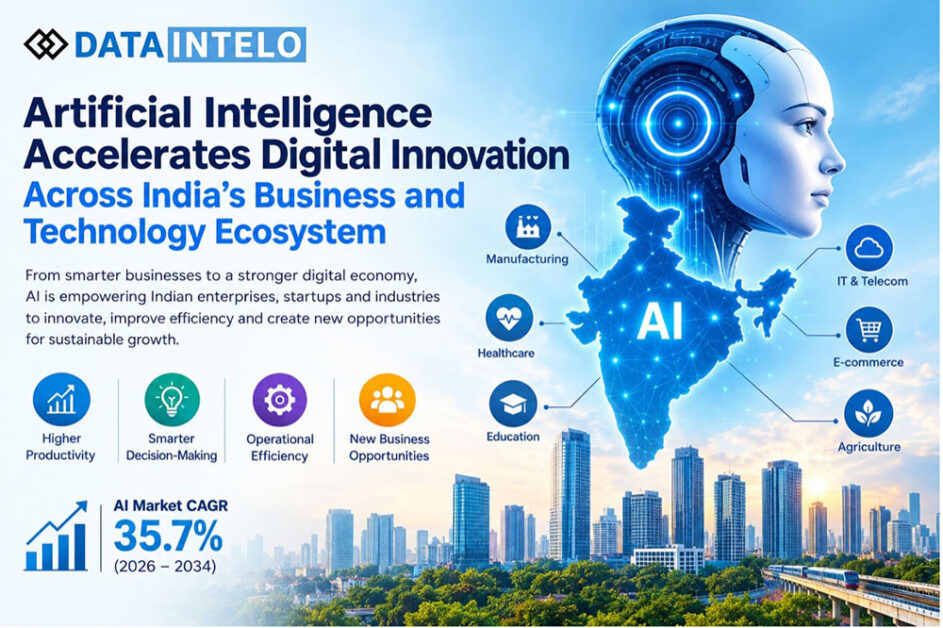
Artificial Intelligence is emerging as an important and pivotal factor in digital transformation that is impacting several processes in business activities organizations, such as data processing, automation, software development, and decision-making. This trend is especially obvious in India, where businesses are adopting AI technologies across such sectors as information technology, finance, medicine, automobile industry, retailing, production, and others.
Government data illustrates the scale of this transition. A February 2026 Press Information Bureau backgrounder reported that 87% of Indian enterprises were actively using AI solutions, while India’s AI Adoption Index stood at 2.45 out of 4. The same source reported that India’s relative penetration of AI skills was 2.5 times the global average across comparable occupations.
Also Read:
- The Future of Business Management: AI’s Role in Driving Innovation and Growth
- Types Of Cloud Services In Everyday Life: Driving Business Growth
AI Is Becoming a Major Technology Market
The expansion of adoption in the business sector is supported by the rapid growth of investments by companies. The global market of AI was valued at around USD 214.6 billion according to a report by DataIntelo in 2025, and was anticipated to hit USD 3,680.5 billion in the year 2034. From 2026 onwards, the monthly growth rate in the industry was expected to increase by close to 35.7%, stated the software sector had around 42.3% industry share, and North America region was responsible for 38.5% revenue.
The numbers suggest that AI is shifting from being limited to individual applications to a broader technology ecosystem that includes software, cloud platforms, data infrastructure, computing hardware, cybersecurity, business software, and specific applications.
This means that for businesses, the possibility of using AI spreads beyond the usage of generative AI assistants; companies are lately more concerned with how they can implement AI into operational processes and achieve measurable outcomes in terms of productivity, customer experience, risk management, and product development.
Enterprise Adoption Is Moving Into Operations
Adopting AI is turning practical as most companies are advancing from mere experimentation to real implementation of AI technologies. Machine learning is now being used to help in the process of demand prediction, anomaly discovery, fraud detection, predictive maintenance, market segmentation, quality assurance. Generative AI adds capabilities to AI solution processes such as document creation, software support, summarizing, knowledge navigating and communication.
Government data indicates that adoption is already broad across Indian enterprises. Another 2026 PIB backgrounder reported that leading AI-adopting sectors include industrial and automotive, consumer goods and retail, banking, financial services and insurance, and healthcare, which together account for approximately 60% of AI’s total value in India. It also reported that around 26% of Indian companies had achieved AI maturity at scale.
It is essential to differentiate between adoption and maturity. Implementing an AI tool may not guarantee any business value. Mature firms are those who integrate AI within their operations and are equipped to measure performance, manage access to data, and ensure a regular evaluation of the model’s results.
Data Infrastructure Is Becoming Strategic
AI systems need much more than just algorithms. In their effectiveness, data quality, as well as computing power, storage, networking, APIs, monitoring, cybersecurity, and governance are all important. The more complicated the AI applications, the more the infrastructure determines how organization can affordably and successfully use them.
India’s government has made AI infrastructure a central component of its national strategy. The IndiaAI Mission includes a plan to establish AI computing infrastructure with more than 10,000 GPUs through public-private partnerships. Its architecture also includes a datasets platform, innovation centre, application-development initiative, Future Skills, startup financing, and Safe & Trusted AI components.
The datasets component is particularly important because AI models require representative, high-quality information. The IndiaAI Dataset Platform is intended to provide access to high-quality, anonymised, non-personal datasets, helping researchers and startups develop applications while reducing barriers to experimentation.
India’s AI Startup Ecosystem Is Expanding
The technology shift is also visible in entrepreneurship. Government information released in 2026 reported that India has approximately 180,000 startups, with nearly 89% of new startups launched in the previous year using AI in their products or services. The same government source reported more than 1,800 Global Capability Centres, including over 500 focused specifically on AI.
The data suggests that AI is having an impact not just on existing companies, but it is also helping to create new technology companies and specialized innovation organizations.
For startups, the availability of cloud-based AI solutions and the growing number of development tools makes it easier to establish the infrastructure needed for intelligent applications. Nonetheless, differentiation depends more on proprietary data, expertise in the field, model performance, security, and ability to solve specific problems in the business process.
AI Is Reshaping the Professional Skills Market
While the advances in technology may have created the need for trained professionals in AI. The government’s research released in March 2026 claimed that India had around 600,000-650,000 AI professionals in 2024, but it would require over 1.25 million professionals in the field in 2027.
This need is more than just requiring data scientists and machine-learning engineers. Organizations are now in need of AI product managers, data engineers, cybersecurity specialists, professionals in AI governance, cloud architects, automation experts, and domain specialists working with smart systems.
The equation for skills cannot be completed without taking into consideration the employees who are already working in the organizations. Finance, marketing, manufacturing, healthcare, logistics, and customer service professionals should be also trained for understanding AI systems.
Generative AI Is Changing Software and Knowledge Work
Generative AI represents another important layer of digital innovation. It can generate text, software code, images, summaries, documentation, and structured information. In software engineering these capabilities can help in reducing the time spent on repetitive coding and documentation and allow developers to concentrate more on architecture, security, testing, and system design.
Nonetheless, the term efficiency refers to the quality of implementation. Output from AI models ought to be validated since they can produce wrong or dangerous information, code, or suggestions that may not be suitable for given situations. Thus, companies need testing systems, human supervision, data constraints, and clear accountability.
The optimal solution will probably be a combination of AI capabilities with the enterprise’s experience rather than the use of the generic models only.
AI Agents Could Connect Enterprise Systems
The next stage of enterprise AI is moving from isolated assistants toward agentic workflows. AI agents are capable of understanding objectives, collecting data, using software applications, and performing a series of tasks under restrictions.
For instance, a customer service agent can get a request, pull up account information, consult an approved database, draft a reply, update a ticket, and escalate difficult cases, thus eliminating coordination chores in many systems.
However, increased autonomy necessitates more controls. In order to authorize the agents to perform sensitive actions, organizations need to have a number of controls in place, including identity management software, authorizations, audit trails, monitoring, human judgment, and evaluation system.
Responsible AI Becomes an Engineering Requirement
Given that artificial intelligence is becoming a part of various business operations, proper usage of AI technologies is critical. Improperly used techniques can lead to the leakage of confidential information, reproduction of biases, provision of erroneous results, or inappropriate automated decisions.
India’s AI Mission specifically includes a Safe & Trusted AI component intended to support responsible development and deployment through governance structures, tools, and frameworks. The government has also established AI Centres of Excellence in areas including healthcare, agriculture, and sustainable cities, while a new AI Centre of Excellence for education was announced with an outlay of ₹500 crore.
This approach recognizes that AI innovation and governance must develop together.
Measuring AI’s Business Impact
Organizations’ top concern is not whether they can introduce AI, but whether this introduction will yield identifiable result. Companies should monitor things like processing time, cost of operations, error rate, time taken for problem solving, downtime, employee productivity, conversion percentage, and revenue generated. In establishing a successful AI initiative, it is essential to start with a clear business objective and define its benchmark.
Organizations can then test an appropriate model, evaluate accuracy, calculate infrastructure and inference costs, establish security controls, and scale the solution only when measurable benefits exceed implementation costs.
Also Read:
- The Power of Custom Software Development in Digital Landscape
- How Metaverse Development is Transforming Retail: Key Strategies for Brands
The Road Ahead
The AI landscape in India is moving into a stage where more businesses are adopting AI technology, developing infrastructure for AI, developing start-ups in AI, and developing the skills that support AI technology. With 87% of firms using AI, more than 1,80,000 start-ups, over 1,800 Global Capability Centres, and a mission of the nation to establish more than 10,000 GPUs, India is creating skills and abilities in various sectors of AI.
At the global level, the commercial opportunities are not less. DataIntelo estimates that the market for artificial intelligence will go up from $214.6 billion in 2025 to $3680.5 billion in 2034, indicating huge investments in various aspects of AI such as software, infrastructure, services, and applications.
Connecting AI with reliable data, infrastructure that can be scaled, skilled personnel, cybersecurity, and measurable business goals will give organizations their next competitive advantage. Those who consider AI as part of technology that is integrated into any process in the organization will be better able to keep up with fast technological development and transform this into digital innovations.
Explore more digital shifts, emerging technologies, and AI-led developments in our Trending category and AI Innovation cluster.
✍️ Guest Write with Us
At TrendVisionz, the digital venture of Nuteq Entertainment Pvt Ltd, we welcome contributors who share our passion for storytelling, digital marketing, and innovation. Whether it’s an article, case study, or industry insight that educates, inspires, or entertains — we’d love to feature your perspective.
- Explore our work: Nuteq Entertainment | TrendVisionz | Author Profile
- Read our newsletters: Transforming Lives | BizTech Chronicle | Nuteq Newsline | Growth Catalyst
- Guest Contributions: BizCatalyst360 | Praja Today
- Books: Go Mindfulness: Practices for Professionals Coached
- Join the community: LinkedIn Group – Digital Marketing & Content Creation World
- Connect with me: LinkedIn | Twitter | #StoryforBusiness
- Share your review: Leave your review on Google — your feedback helps us grow.
Follow me on Twitter or LinkedIn. Check out our website.
How to Contribute:
Send your pitch or draft to Editor: anujmahajan@trendvisionz.com