
For devotees, the consecration of Ram Lalla at Ram Mandir Ayodhya on 22 January 2024 fulfilled a hope carried for nearly 500 years. During our recent family visit, I had Ram Lalla darshan twice. Ayodhya darshan also took us beyond the temple, into a city where faith, history and culture meet.
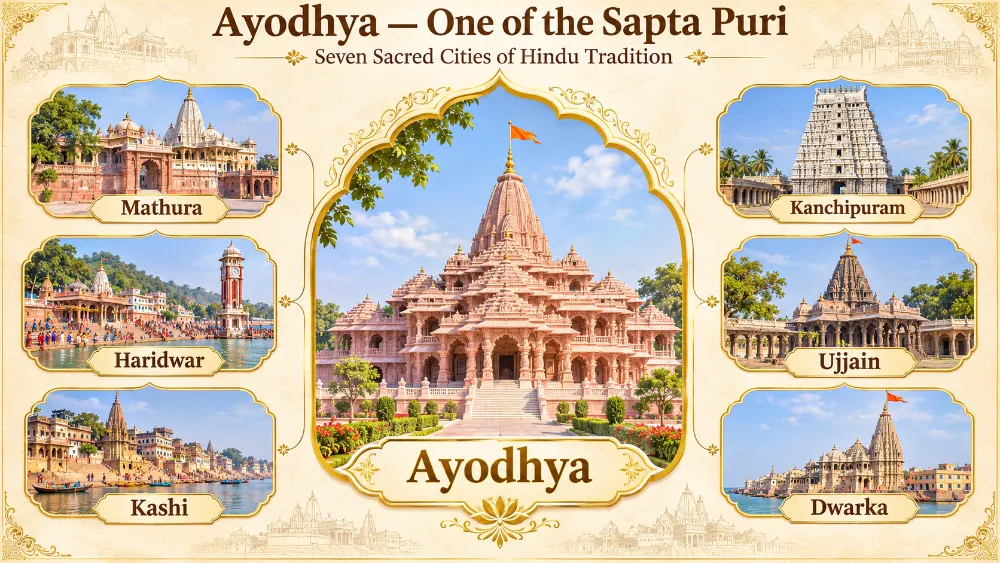
Ayodhya is revered as Shri Ram’s birthplace. It belongs to the Sapta Puri, seven sacred cities1 associated with moksha, or freedom from rebirth. Palace traditions recall his life, while the Saryu River recalls his departure in Hindu belief.
My media work has taken me across much of India. Exploring Ayodhya with my family brought stories I had known for years closer. At Hanumangarhi, the palace temples and Guptar Ghat, we took time to understand the traditions behind each place of worship.
In this edition, we explore Ayodhya’s temples and the sacred traditions along the Saryu River. Discover their significance and what to look for during darshan. For readers planning a pilgrimage, these connections bring greater meaning to the visit.
Also Read:
- Kashi Varanasi: Sacred Ghats and Living Traditions
- Panch Prayag: The Five Sacred Confluences Along the Char Dham Yatra
Ram Mandir Ayodhya Marks Shri Ram’s Sacred Birthplace
Ram Mandir Ayodhya stands at the site revered as Shri Ram’s birthplace. For devotees, worship here connects the city’s sacred past with the prayers and offerings that continue each day.
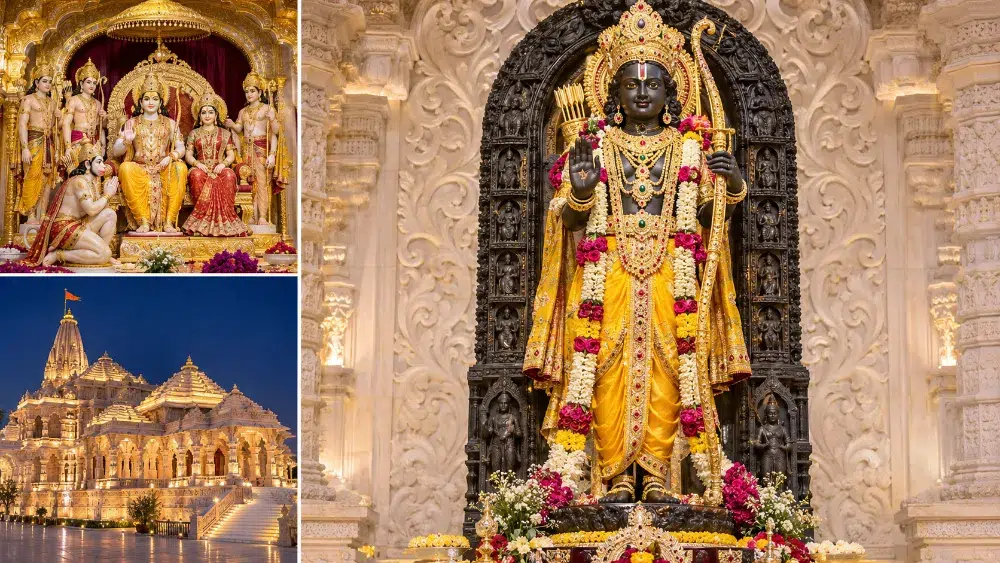
Shri Ram Janmabhoomi Mandir in Ayodhya houses Ram Lalla, depicting Shri Ram as a five-year-old child, in its main sanctum. Ram Darbar on the first floor presents Shri Ram with Sita, his brothers and Hanuman, reflecting his role as king.
Ram Janmabhoomi Connects the Birthplace With Shri Ram’s Legacy
In the Valmiki Ramayana, Ayodhya is the capital of Kosala, ruled by kings of the Ikshvaku dynasty. Shri Ram belongs to this royal lineage, but devotees approach his birthplace through a more personal relationship. Here, the prince whose story they know through recitation and family traditions is worshipped as Ram Lalla. Ram Janmabhoomi, meaning Ram’s birthplace2, gives that devotion a physical setting.
The present temple followed centuries of struggle, prolonged legal battles and archaeological investigations. The 2003 ASI excavation formed part of the evidence examined during court proceedings. Today, worship at Ram Janmabhoomi carries that long history into a continuing relationship with Shri Ram.
Ram Lalla and Ram Darbar Reveal Childhood and Kingship
In the main sanctum, devotees worship Ram Lalla as a five-year-old child. Sculptor Arun Yogiraj carved the standing, 51-inch murti from dark stone. This child form invites the affection devotees express towards Balak Ram through prayers and worship. Ram Lalla’s Ramanandi tilak is adorned with diamonds and rubies. On Ram Navami, sunlight directed through mirrors and lenses illuminates his forehead, creating the Surya Tilak, also called Surya Abhishek.
On the first floor, Ram Darbar depicts Shri Ram as king, accompanied by Sita, his brothers and Hanuman. Here, worship recalls his life within a family and his responsibilities as a ruler. These two depictions bring different chapters of Shri Ram’s story into the temple.
Traditionally, devotees begin Ayodhya darshan at Hanumangarhi, seeking Hanuman ji’s blessings before visiting Ram Mandir. Revered as Ayodhya’s king and guardian, he holds a special place in the city’s worship.
Devotion and Living Traditions Shape Ayodhya
Ayodhya darshan extends beyond the moment before a deity. At Hanumangarhi and across the city’s temples, prayers, chanting and shared rituals show how devotion to Shri Ram continues through daily worship.
Hanumangarhi Preserves Hanuman’s Role as Ayodhya’s Guardian
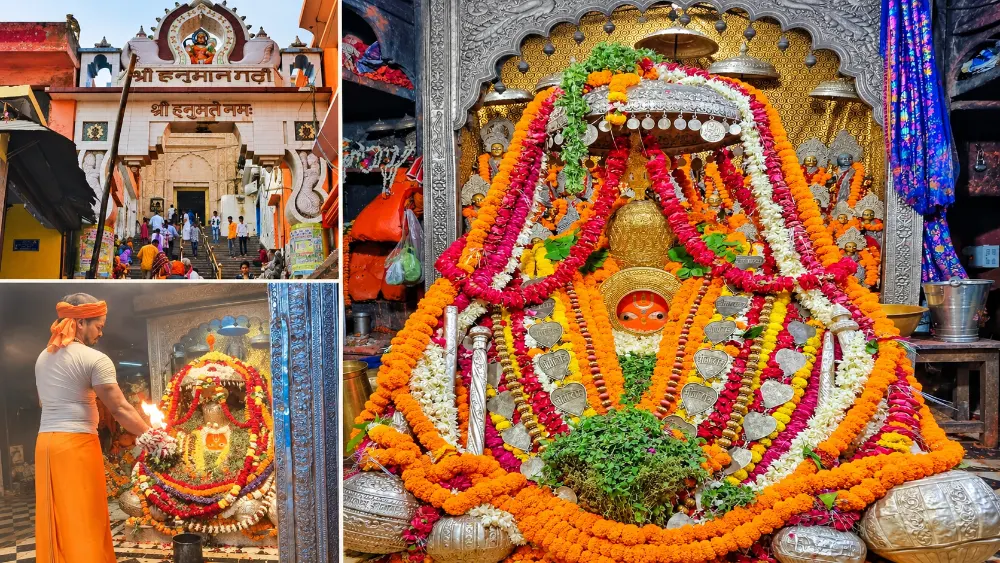
Hanumangarhi introduces Hanuman’s guardianship through its sacred setting, distinctive murti and the tradition of seeking blessings before Ram Lalla darshan.
- Guardian of Ramkot: Ramkot is the sacred area associated with Shri Ram, traditionally protected by Hanuman. His guardianship3 reflects the service and loyalty central to his relationship with Shri Ram.
- Maa Anjani and Bal Hanuman: The main shrine depicts young Hanuman seated in his mother Maa Anjani’s lap. Recognising this mother-and-child form helps visitors understand what they see during darshan.
- The Shrine and Its Worship: A climb of 76 steps leads to the temple. Its elevated, fortlike setting reflects the guardianship associated with Hanuman, while prayers and offerings express devotees’ reverence.
Ram Naam and Ram Dhun Make Remembrance Part of Worship
In Ayodhya, devotion includes speaking and singing Shri Ram’s name, giving visitors a way to participate beyond the temple sanctum.
- Ram Naam as Remembrance: Ram Naam means Shri Ram’s name. Repeating it, aloud or silently, makes remembrance an act of worship that devotees can continue beyond their time in Ayodhya.
- Ram Dhun as Shared Devotion: Ram Dhun sets that remembrance to melody and rhythm. Refrains such as “Shri Ram Jai Ram Jai Jai Ram” allow people to sing together without needing to know a longer hymn.
- Ram Bhakti Across Generations: Singers such as Jubin Nautiyal, Swasti Mehul and Sachet–Parampara bring Ram bhakti to contemporary audiences. Bhajan clubbing gives Gen Z another way to gather, sing and connect with devotional music.
During my Ayodhya darshan, the ringing of temple bells and chanting of Ram Dhun drew my attention beyond the sanctum. These sounds revealed how devotion shapes the city’s daily life.
Family and Duty Shape Shri Ram’s Legacy
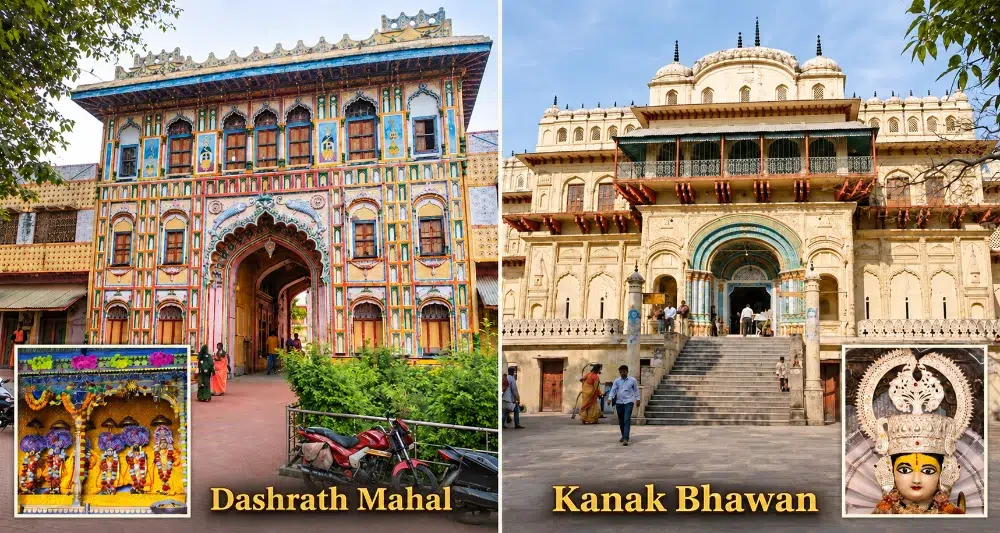
The holy city of Ayodhya remembers Shri Ram as a son, husband and king. Dashrath Mahal recalls his childhood and family duties, while Kanak Bhawan celebrates his marriage to Sita through worship of the divine couple.
Childhood and Duty Shape Shri Ram’s Role as a Son
Dashrath Mahal, also known as Bada Sthan, is traditionally associated with King Dashrath’s royal residence. Its temple houses Shri Ram, Sita and his brothers. Recently watching Ramayana: Part 1 brought the epic’s royal household into focus for all Indians.
The palace tradition recalls a turning point in Shri Ram’s life. In Kop Bhawan, Kaikeyi demanded Bharat’s coronation and fourteen years of exile for Shri Ram. He honoured his father’s promise, accepting a departure that would take him far beyond royal life. Revered as Vishnu’s seventh avatar in human form, Shri Ram embodies “Pran jaye par vachan na jaye”—honouring one’s word even at the cost of life. His acceptance of exile reveals the personal sacrifice that keeping a promise can demand.
Marriage Gives Partnership a Sacred Place
Kanak Bhawan centres worship on Sita and Shri Ram together, recalling their marriage and shared place within Ayodhya’s royal household.
- A Wedding Gift for Sita: Temple tradition holds that Kaikeyi gifted Kanak Bhawan to Sita after her marriage. The account remembers her welcome into the family through a home of her own.
- Worship of the Divine Couple: Devotees encounter crowned images of Sita and Shri Ram together. Here, attention turns towards the couple and their shared life, complementing worship of Ram Lalla’s childhood form.
- Sacred Memory in the Present Temple: The current temple was established under Maharani Vrishbhan Kunwari and consecrated in 1891. Its later history remains distinct from the wedding-gift tradition preserved through worship.
Together, these palace temples show how sacred stories endure through worship and later rebuilding. Their significance lies in both the traditions they preserve and the devotion that sustains them today.
The Saryu River Holds a Sacred Place in Ayodhya Darshan
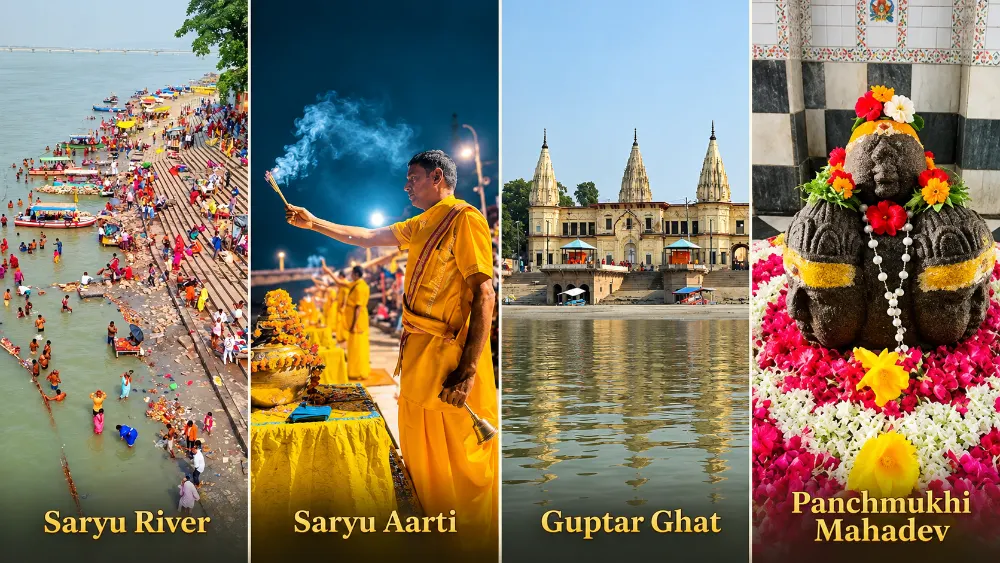
The Saryu River flows beside Ayodhya, where devotees bathe, pray and gather for aarti with lamps and chants. At Guptar Ghat, Shri Ram’s departure tradition connects the riverside with worship at Panchmukhi Mahadev.
Riverside Worship Brings Together Traditions of Shri Ram and Shiva
Guptar Ghat is traditionally revered as the place where Shri Ram took jal samadhi in the Saryu, returning to Vaikuntha. The Uttara Kanda recounts his entry into the river, while pilgrimage tradition identifies this riverside with Goprataraka.
Shri Anadi Panchmukhi Mahadev Mandir houses a five-faced Shivling representing Shiva’s forms associated with earth, water, fire, air and space. Local tradition holds that Shri Ram worshipped here before his departure, connecting the shrine’s Shiva worship with the sacred narrative remembered at Guptar Ghat.
Why is the Saryu River sacred to devotees of Shri Ram?
In Hindu belief, the Saryu is sacred through its association with Ayodhya and Shri Ram. Devotees honour it through bathing, prayer and offerings. Guptar Ghat is traditionally revered as the place of his jal samadhi and return to Vaikuntha.
At the river, Ayodhya’s sacred geography extends beyond temple walls. Understanding these connections helps you approach the pilgrimage as a whole, with each place contributing its own meaning.
Five Ways Ayodhya Darshan Deepens Your Pilgrimage
Ayodhya’s temples and river ghats give familiar stories a setting you can visit. Together, they offer five ways to understand the relationships between sacred places, devotional practices and Shri Ram’s life.
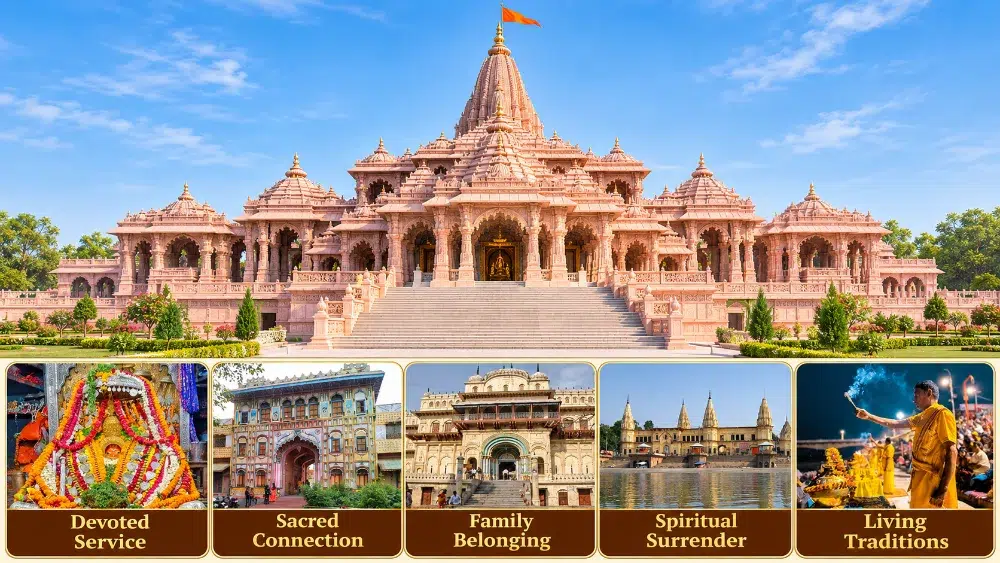
- Devotion through service: Hanuman’s guardianship places service at the heart of worship. Seeking his blessings before approaching Shri Ram reminds devotees of the reverence expressed through loyalty and care.
- Connection through place: Ram Janmabhoomi gives the birthplace tradition a physical centre. The palace temples and Saryu extend that connection, allowing visitors to follow different chapters of Shri Ram’s story.
- Belonging through relationships: Dashrath Mahal and Kanak Bhawan remember Shri Ram within a household. Childhood, marriage and family responsibilities bring human relationships into the experience of pilgrimage.
- Surrender beside the Saryu: Guptar Ghat’s departure tradition offers space to reflect on completion and letting go. Its meaning remains open to personal belief, rather than prescribing how every visitor should feel.
- Continuity through worship: Ram Naam, aarti and daily offerings keep sacred memory active. Visitors encounter traditions sustained through participation, with each generation learning prayers and practices from those before them.
During your Ayodhya darshan, take time to understand what you encounter. A shrine’s story can change what you notice and the questions you carry home.
Also Read:
- Patal Bhuvaneshwar Cave: Where Myth, Mindfulness, and Shiva Converge
- How to Plan a Mahakaleshwar and Omkareshwar Pilgrimage in Madhya Pradesh
Carrying Ayodhya’s Stories Home
Having Ram Lalla darshan twice was central to our family visit. Exploring the city beyond the temple helped me understand how much of Shri Ram’s story Ayodhya continues to preserve.
For your Ayodhya darshan, leave room for curiosity alongside prayer. Ask what a shrine remembers, how its worship developed, and which traditions connect it with the places you have visited.
Back home, those connections can give familiar prayers and Ramayana passages a different resonance. A name once heard in a story now belongs to somewhere you have stood and worshipped.
Explore TrendVisionz’s Mindfulness section and Sacred Geography & Spiritual Heritage collection. Discover how pilgrimage, sacred rivers and temple traditions shape India’s spiritual heritage.
About Anuj Mahajan
Anuj Mahajan is a media entrepreneur, author, filmmaker, and COO of Nuteq Entertainment. With more than 32 years of experience across media, communication, leadership, and business growth, he writes about communication architecture, human behaviour, leadership, mindfulness, business transformation, and decision-making.
He is the Co-Founder of TrendVisionZ, author of three books, creator of the StoryforBusiness podcast, and publisher of the Transforming Lives newsletter.
Explore the Ecosystem
- Explore my work: Nuteq Entertainment | TrendVisionz | Author Profile
- Read my newsletters: Transforming Lives | BizTech Chronicle | Nuteq Newsline
- Guest writer: BizCatalyst360 | Praja Today
- Books: Go Mindfulness: Practices for Professionals Coached
- Join the community: LinkedIn Group – Digital Marketing & Content Creation World
- Connect with me: LinkedIn | Twitter | #StoryforBusiness
- Share your review: Leave your review on Google — your feedback helps us grow.
- Listen on Spotify: Leadership Podcast | Guided NLP (7 Episodes) | Daily Motivation – 21 Episodes
Believe. Practice. Perform.
Additional Resource:
- Bakker, H. The rise of Ayodhyā as a place of pilgrimage. Indo-Iran J 24, 103–126 (1982). ↩︎
- Bhatt K, Ashutosh K, Johar V, Dogra P, Gangotia A, Singh M, Chander H (2026;), “Reclaiming collective memory: the consecration of Shree Ram Temple in Ayodhya and the Hindu cultural identity”. Global Knowledge, Memory and Communication, Vol. ahead-of-print No. ahead-of-print. ↩︎
- Lutgendorf, P. (1997). Monkey in the Middle: The Status of Hanuman in Popular Hinduism. Religion, 27(4), 311–332. ↩︎
FAQs: Ayodhya darshan
Are Saket and Ayodhya the same place?
Saket is a historical name associated with Ayodhya. In devotional usage, Saket Dham can also mean Shri Ram’s eternal divine abode. The meaning depends on whether the reference concerns the earthly city or religious belief.
What is the difference between Valmiki Ramayana and Ramcharitmanas?
The Valmiki Ramayana is a Sanskrit epic attributed to Valmiki. Ramcharitmanas is Tulsidas’s Awadhi retelling of Shri Ram’s story, composed in the sixteenth century with a strong devotional emphasis.
Which seven sacred cities make up the Sapta Puri?
The Sapta Puri are Ayodhya, Mathura, Haridwar, Kashi, Kanchipuram, Ujjain and Dwarka. Hindu tradition associates these cities with moksha, or liberation from rebirth. Each has its own sacred stories and pilgrimage traditions.


5 comments
[…] Posts Ayodhya Darshan: Shri Ram’s Birthplace to the Holy Saryu How Fast Can an Emergency Department Fill an Urgent Staffing Need? Teenage Periods and Your […]
[…] Posts Ayodhya Darshan: Shri Ram’s Birthplace to the Holy Saryu How Fast Can an Emergency Department Fill an Urgent Staffing Need? Teenage Periods and Your […]
[…] Posts Ayodhya Darshan: Shri Ram’s Birthplace to the Holy Saryu How Fast Can an Emergency Department Fill an Urgent Staffing Need? Teenage Periods and Your […]
[…] Posts Ayodhya Darshan: Shri Ram’s Birthplace to the Holy Saryu How Fast Can an Emergency Department Fill an Urgent Staffing Need? Teenage Periods and Your […]
[…] Posts Ayodhya Darshan: Shri Ram’s Birthplace to the Holy Saryu How Fast Can an Emergency Department Fill an Urgent Staffing Need? Teenage Periods and Your […]