
Potty training can feel like a big milestone, but it doesn’t have to turn into a battle. There’s no single “right” age when every child should be toilet trained. What matters more is whether your toddler is showing the physical, cognitive, and emotional signs that they’re ready to start. A gentle, stress-free transition from diapers to the toilet relies on watching for readiness signs, establishing a calm routine, and using positive reinforcement rather than pressure.
Once those signs show up, a calm routine, a bit of encouragement, and a good stock of patience usually get you there. Every child moves at their own pace, and there’s no fixed timeline that applies to all of them.
Also Read:
Signs of Readiness
Your child doesn’t need to tick off every one of these before you begin, but a few of them showing up together is a good sign it’s time:
- Staying dry longer: Going two hours or so without wetting their nappy, which points to developing bladder control.
- Body awareness: Squatting, pausing mid-play, hiding, or pulling a certain face when they need to go, or telling you their nappy is wet.
- Basic words: Understanding or using words like “pee,” “poop,” or “potty.”
- Physical readiness: Walking to the bathroom, sitting on a potty or toilet seat, and pulling their trousers up and down with a bit of help.
- Curiosity: Wanting to watch you or a sibling use the toilet, or asking about underwear.
Readiness isn’t only about your child, either. It helps to start during a stretch when your household is fairly settled, without a lot of travel or big changes going on, so you can actually respond when they signal they need to go. Understanding growth delays in children can help parents distinguish individual developmental differences from concerns requiring attention.”
Starting the Transition:
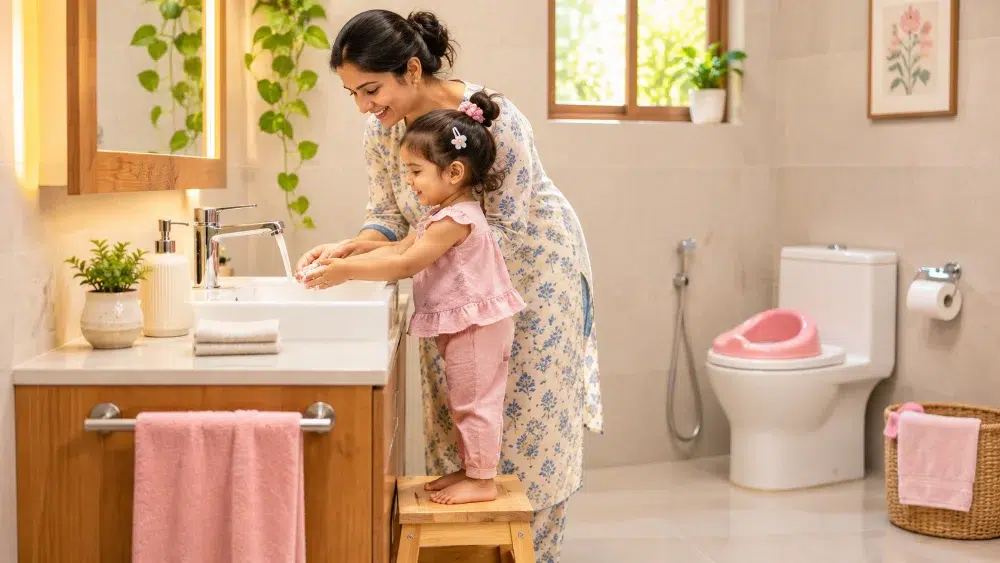
- Set up the basics. You can use either a separate potty chair or a secure toilet seat designed for toddlers. If you’re using the main toilet, add a step stool so their feet rest firmly instead of dangling. Let them sit on it fully clothed a few times first, just to get used to it, before you expect anything to happen.
- Build it into the day. Offer potty time after waking up, after meals, and before bath or bed. Keep it short, a couple of minutes at most, and don’t push it if they don’t want to sit. Slotting this into a broader daily routine makes it easier for a toddler to know what’s coming next.
- Name what’s happening. Simple lines like “your tummy is telling you it needs to poop” help your child connect the physical feeling to the action, without turning it into a big production.
- Praise the try, not just the result. A toddler who sat down and tried is worth just as much encouragement as one who actually went. Skip the shaming over accidents; it tends to backfire.
- Give them a few small choices. Picking their own underwear or a potty book gives them some ownership over the process, without handing them the whole decision.
- Move gradually from diapers to underwear. There’s no need to switch overnight. Once your child recognises the urge and is comfortable using the potty, introduce training pants or regular underwear for a few hours at home. Keep diapers for naps and outings as needed. The transition can happen gradually over days or weeks, and taking a short pause if accidents increase is completely fine.
Alongside toilet habits, managing screen time for kids supports balanced daily routines during early childhood.”
Handling Accidents
Accidents are part of learning, not a sign anything’s gone wrong. Even once a child is using the potty well, they can keep happening on and off for weeks. When one does:
- Stay calm. Skip the sighing, the disappointed look, all of it.
- Keep it matter-of-fact. Help them clean up and just repeat that pee or poop goes in the potty.
- Never punish or shame. It tends to make kids more anxious, not less, and can slow the whole process down.
- Notice the pattern. Tired, distracted, deep in play, away from home- whatever it is, it’s useful to know.
If accidents show no sign of easing off, or your child starts holding urine or stool in, it’s worth pausing for a bit and mentioning it to your paediatrician.
Daytime Versus Nighttime Readiness
Daytime and nighttime dryness usually don’t happen on the same schedule, and that’s expected rather than unusual. Nighttime bladder control develops through a different physical process and tends to arrive later, sometimes well over a year after a child is reliably dry during the day. It’s common for a child to be fully daytime trained while still wearing a nappy or pull-up to bed, and that’s not a step backward. A reasonable sign that a child may be ready to try nights without a nappy is waking up dry on most mornings over a couple of weeks, rather than any particular age.
Potty Training and Preschool
If you’re still choosing or evaluating a centre, it’s worth asking directly how they handle potty training day to day. Preschools that actively build it into the daily routine, with staff who reinforce the same calm approach you’re using at home, tend to make the transition considerably smoother than ones that simply expect children to arrive already trained.
Keeping the approach consistent between home and preschool tends to make the whole process smoother, since children pick up the habit faster when the routine and the words used for it don’t change depending on where they are. A few things that help:
- Share the words and cues you use at home with your child’s teachers, so they can mirror them during the day.
- Send a couple of spare sets of clothes, since accidents at centres are just as normal as they are at home.
- Ask what the centre’s own daily approach looks like; many early-years settings build regular, unhurried potty breaks into the schedule as a matter of course, which usually works well alongside whatever you’re doing at home.
As children develop independence, digital parenting becomes another important responsibility for families navigating early childhood
What If Your Child Refuses to Use the Potty?
Resistance is common. A toddler may understand what the potty is for but still refuse to use it because they want control over the process or feel uncomfortable with the change.
If this happens:
- Don’t force your child to sit.
- Keep talking about the potty in a neutral, positive way.
- Let them watch you or an older sibling use the toilet if they are comfortable doing so.
- Allow them to sit on the potty without expecting them to pee or poop.
- Try again after a short break if the resistance becomes intense.
Sometimes stepping back for a while and trying again later is more productive than turning potty training into a daily struggle.
When to Talk to a Paediatrician
Most hiccups sort themselves out with time and practice. But it’s worth a call if your child has pain when urinating or passing stool, ongoing constipation, keeps holding urine or stool in, accidents that aren’t gradually improving, or a sudden return of frequent accidents after they’d been consistently dry. A paediatrician can rule out constipation or a urinary issue that might be making things harder than they need to be. This article is meant as general guidance, not medical advice, so any specific concern about your child is best discussed directly with their doctor.
Also Read:
The Bottom Line
Potty training is a process, not a race. Some children get there in a couple of weeks, others need months of practice and a fair few accidents along the way, and neither pace says much about anything beyond that particular skill. Watch for readiness, keep the routine predictable, and let your child practise without pressure. The goal isn’t to get out of nappies as fast as possible; it’s to help your child feel comfortable recognizing their body’s signals and doing something about it on their own.
FAQs: potty training
Is there an ideal age to start potty training?
Not really. Readiness varies widely between children, and it has more to do with physical and communication development than age in months. Some children show signs before two, others closer to three, and both can be entirely normal.
How long does potty training usually take?
It varies. Some children get the hang of it within a few weeks; others take a few months of gradual practice with plenty of accidents along the way. Slower progress isn't a sign that anything's wrong.
Should I wake my child at night to use the toilet?
Generally, no. Nighttime dryness tends to develop on its own once a child's body is ready, and waking them up doesn't usually speed that up. It's more useful to wait for signs like consistently dry mornings.