
Have you ever handed your child a phone, switched on parental controls, and felt the difficult part was handled? That confidence is understandable. Yet Digital Parenting 1begins where those settings stop. A recent survey found 61% reporting increased impatience, 58% aggression and 50% hyperactivity among children, alongside concerns around heavy digital exposure.
A settings menu can limit time, purchases and selected content. It cannot interpret every message, contact or misleading video a child encounters. India now recognises cyberbullying, harmful content and digital dependency as child online safety concerns.
I have seen media consumption change dramatically inside Indian homes. The screen once sat in the living room, shared and visible. Today, it often sits privately in a child’s hand. Technology evolved quickly; the way we supervise children did not always evolve with it.
This edition explores how families can balance boundaries, communication, monitoring, media literacy and growing independence online. It is for parents and caregivers who want practical guidance without turning digital safety into constant surveillance or fear.
Also Read:
- Understanding Growth Delays in Children: When Is It More Than “Just a Phase”?
- Family with Pets: Exploring the Wonderful World of Pet Ownership
Digital Parenting Goes Beyond Screen Limits
Most households treat Digital Parenting as a settings exercise. Install the app, set the limit, move on. The definition is considerably wider, and that gap explains why controls keep failing in homes that configured them carefully.
Digital parenting means guiding children to use technology safely, responsibly, and confidently. As children mature, parents gradually shift from direct supervision toward helping them develop independent judgement, recognise online risks, and make safer choices even when adults are not watching
Professor Sonia Livingstone argues in her British Academy 10-Minute Talk that digital parenting should move beyond screen-time policing. Open discussion, shared values and guided choices can build digital literacy, confidence and resilience.
The Four Parts That Work Together
Four elements carry the work. Boundaries set the technology boundaries a household agrees to hold. Parental modelling shows children what balanced use looks like in practice. Open communication keeps problems reportable. Age-appropriate independence releases control as judgement develops. Each one weakens noticeably when it operates alone.
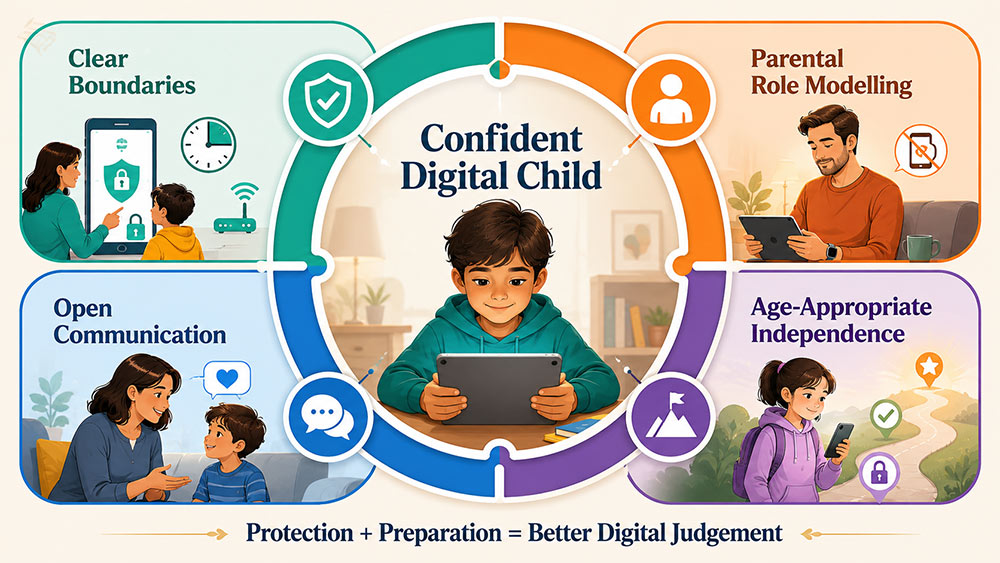
When digital rules are poorly handled, parents can often notice the effect in everyday behaviour. Rules issued without conversation tend to encourage concealment, because a child who expects confiscation stops disclosing. Conversation without boundaries allows habits to drift, because good intent rarely survives an autoplay feed. UNICEF treats these elements as one combined approach rather than separate options.
Restriction Dominates Both Research and Practice
The research mirrors the home. A systematic review of digital parenting measures2 recorded 268 survey items using the word “internet” and 129 using “online.” The emphasis across those instruments falls heavily on restrictive practice, meaning rules about time, place, content and access. Measurement follows what parents already do.
Positive guidance received less attention. So did digital competence, digital wellbeing and constructive technology use, which are harder to score than hours logged. Influence also runs in both directions. A child’s maturity, behaviour and digital skill shape how a parent responds, as much as the reverse.
From what I have seen, restriction can manage exposure, but judgement grows through conversation, trust and practice. Children need to learn safer choices before parents are no longer beside them.
Digital Platforms Shape Screen Time and Online Behaviour
Platforms children use are built to sustain attention through recommendations, autoplay and monetisation. Parents are therefore managing more than screen behaviour. They are helping children navigate systems designed to encourage continued viewing, interaction and spending.
Autoplay and Algorithms Extend Children’s Screen Time
How long does the audience stay? Working in media has taught me that attention is rarely accidental. Every additional minute can shape what people notice, remember and act upon. For children, screen time is influenced not only by self-control, but by design choices working quietly in the background.
- Autoplay: Removes the natural pause where a child might otherwise choose to stop. Parents can recreate that pause by agreeing when a video, episode or gaming session ends.
- Algorithmic recommendations: Repeatedly serves content shaped by previous viewing and engagement. Ask children why they think certain videos keep appearing; it begins teaching them how feeds influence choice.
- In-game purchases: Introduces spending expectations through microtransactions and digital rewards. Discuss purchases, rewards and real money before payment access is enabled.
A film ends, but a feed keeps going. That difference matters because prolonged engagement can expose children to increasingly varied content.
Exposure Reaches Past Age-Appropriate Content
Risk can arrive through unsuitable content, contact with other people, and increasingly through material that was never real. Children therefore need more than filters; they need to recognise when something deserves a conversation.
- Inappropriate content: Violent imagery, self-harm material, online hate, sexual content, toxic influencers and unrealistic beauty standards. Children should know they can report disturbing content without expecting immediate blame.
- Cyberbullying and contact risk: Teach warning signs such as secrecy, pressure, threats, requests for personal information or attempts to move conversations into private spaces.
- AI generated content: Manipulated images and synthetic identities make verification part of media literacy. Children should learn that an image, profile or message is not automatically authentic.
Online predator awareness belongs in this conversation early and calmly. A child who understands grooming behaviour can recognise warning signs that a filter may never detect. Repeated exposure can also shape how children understand relationships, consent, appearance, identity and acceptable behaviour. Social media influence can also reshape how children interpret age-appropriate choices.
Parents cannot inspect everything children encounter. They can help them recognise when something feels manipulative, unsafe or too difficult to handle alone.
Online Privacy and Parental Monitoring Should Grow With Age
When our children were younger, knowing what they were watching or whom they were speaking to felt like responsible parenting. But children grow, and so must the way we supervise them. At some point, checking everything can begin competing with something more valuable: their willingness to tell us things themselves.
Transparent Digital Monitoring Builds Trust
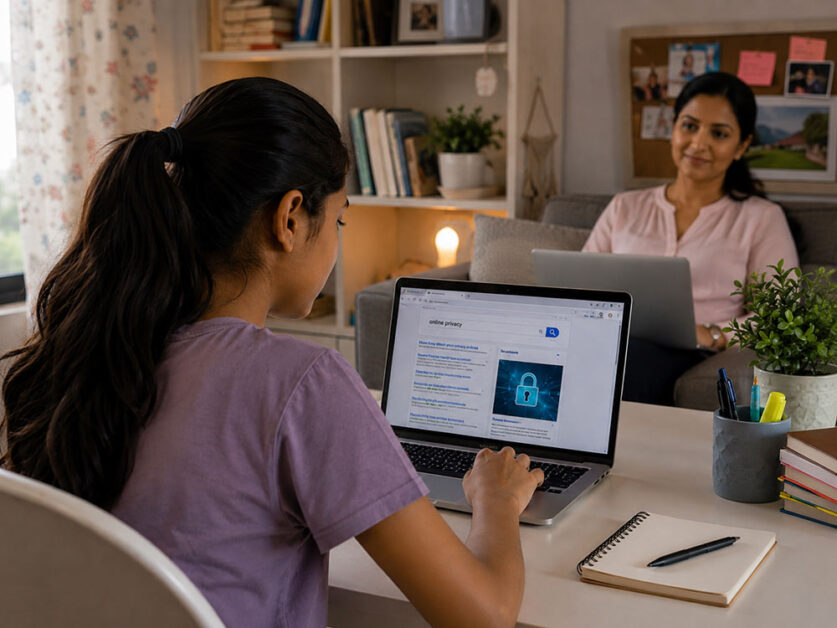
UNICEF recommends that children know when parents are monitoring their digital activity. I find that distinction important. There is a difference between saying, “I need to know where you are online because you are still learning,”and quietly checking everything without their knowledge.
The same applies to online privacy. Children need to understand why sharing a location, photograph, personal detail or careless comment can matter later. A digital footprint is difficult to retrieve once it travels. Our job is not simply to watch what children post. It is to help them develop the pause that makes them ask, “Should I share this at all?”
How much online privacy should a teenager have?
Teenagers should earn increasing online privacy3 as their judgement develops. Parents can keep essential safeguards visible and discussed, while gradually stepping back. The goal is not knowing everything they do online. It is raising someone who knows what to do when you are not watching.
What I have learned as a parent is that stepping back does not mean becoming absent. It means staying close enough for children to ask for help, while giving them enough space to practise judgement for themselves.
Parental Role Modelling Shapes Children’s Digital Habits
Children learn how to use technology by watching us, long before they follow anything we tell them. What we do with our own phones becomes the working rule in the house. Everyday behaviour teaches more than any policy we announce at the dinner table.

Household Habits Teach More Than Household Rules
I have said “no phones at dinner” and then answered a message at dinner. Children notice that immediately, and they are right to. A rule we repeatedly break quickly loses credibility. Children notice the gap between what we ask of them and what we practise ourselves. That gap is exactly why expert paediatric guidance on role modelling matters so much in everyday digital parenting.
Kids learn as much from watching us as they do from our well-intended lectures — Jenny Radesky, MD, FAAP, Board-Certified Developmental Behavioral Pediatrician
Warmth and clear expectations together work better than either alone, which is what authoritative parenting describes. Some parents protect three short device-free windows each day, the 7-7-7 idea, simply to stay in contact. Watching a video together, or playing a game your child chose, does something similar. You learn their online world, and later conversations become easier to start.
A Family Tech Agreement Makes Rules Collaborative
Agreements set before the first device work better than corrections issued after the first problem. Sit down before a phone arrives or a new platform opens, not after something goes wrong.
- Device free bedroom rules: Screens leave the bedroom at a fixed hour, and that includes us.
- Access agreed in advance: Ask before downloading an app or joining a platform, and expect a real conversation, not a refusal.
- A calm first response: Blame and confiscation teach a child to handle the next problem alone.
Rules a child helped write are rules a child will defend. Rules we impose last only until nobody is watching.
Digital Parenting Builds Safer and More Independent Online Habits
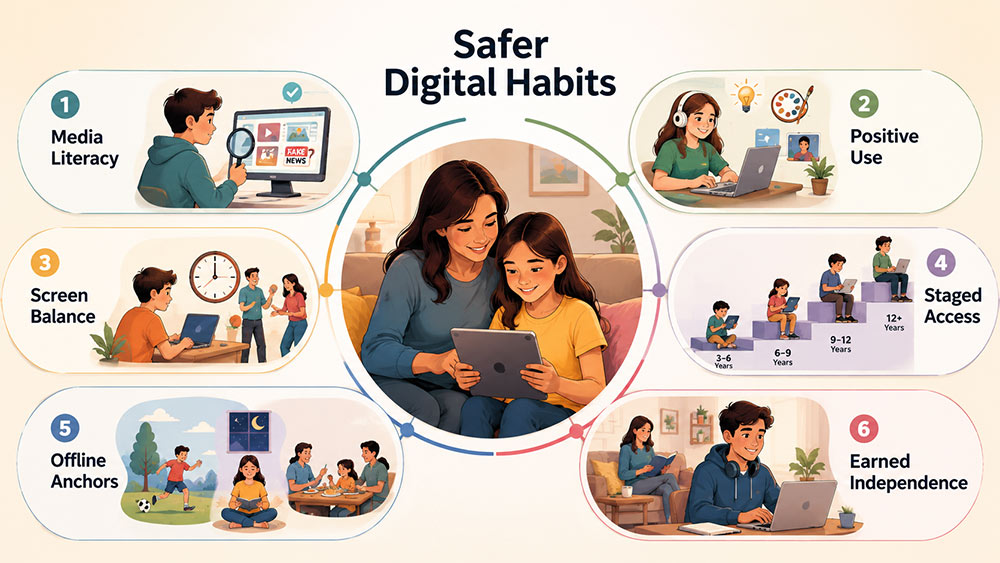
The real test of Digital Parenting comes when children are online without us. Safe internet use for children grows through judgement, media literacy and responsible habits. Child online safety improves as supervision gradually gives way to confident, independent choices.
- Media literacy before access: Teach children why certain posts appear, how platforms earn attention, how misinformation spreads and why images, profiles or videos may be manipulated.
- Positive digital use: Technology should also support learning, creativity, research, communication and skill-building. Psychologist Jacqueline Nesi, PhD, notes that there can also be benefits for many teens. Internet safety for kids should not make the online world sound entirely dangerous.
- Age appropriate screen time: There is no single daily limit that suits every school-age child or teenager. The AAP’s 5 Cs 4looks at the child, content, calm, communication and what screen time for kid is crowding out, especially sleep, activity, learning and family time.
- Staged digital access: Tisseron’s 3-6-9-12 framework can help parents think about when to introduce screens, gaming, independent internet access and social media. It is a pacing framework, not medical guidance.
- Protect offline anchors: Sleep, outdoor activity, hobbies, family time and real-world friendships still need protected space.
- Independence follows judgement: As children demonstrate responsibility, supervision can gradually reduce. Age matters, but behaviour and maturity matter too.
As a parent, that is the outcome I would value most: not a child who follows every digital rule, but one who can pause, question and make a safer decision when nobody is watching.

FAQs- Digital Parenting
There is no single right age. Readiness should depend on maturity, responsibility and family needs. Parents can introduce access gradually, agree rules in advance, and increase independence only when the child shows sound judgement.
Stay calm, listen first and avoid immediate blame or punishment. Ask what happened, how the child felt and whether anyone contacted them. Then review privacy settings, block or report harmful content, and reinforce safe online behaviour.
Start with built-in device and platform settings for content filters, purchases, screen limits and privacy. Explain the controls to your child, review them regularly, and adjust restrictions as maturity and digital judgement improve.
Also Read:
- Craft Spirits: How Women Founders Are Reshaping India’s Premium Alcobev Industry
- Best Breathable Activewear Fabrics for Indian Summers
Conclusion
Digital Parenting is not about watching every click or removing every risk. It is about preparing children to understand what they see, question what feels wrong, and make safer choices with growing confidence.
The journey moves from exposure to boundaries, from boundaries to connection, and from connection to guidance. Over time, supervision should create space for independence rather than permanent control.
As parents, our role is to remain present, informed, consistent and connected. Technology will keep changing; the need for trust, judgement and open conversation will not.
At Trendvisionz, I believe better digital habits begin with informed families. Our Lifestyle insights examine the everyday choices shaping how families live and adapt. Within Home, Relationships & Modern Life, we explore the changing dynamics of parenting, technology and family connection. I hope the perspectives shared through my work help parents make more informed, practical choices in a changing digital world.
Reviewed for child development and digital wellbeing accuracy by Dr Vivek Jain, Paediatrician.
About Anuj Mahajan
Anuj Mahajan is a media entrepreneur, author, filmmaker, and COO of Nuteq Entertainment. With more than 32 years of experience across media, communication, leadership, and business growth, he writes about communication architecture, human behaviour, leadership, mindfulness, business transformation, and decision-making.
He is the Co-Founder of TrendVisionZ, author of three books, creator of the StoryforBusiness podcast, and publisher of the Transforming Lives newsletter.
Explore the Ecosystem
- Explore my work: Nuteq Entertainment | TrendVisionz | Author Profile
- Read my newsletters: Transforming Lives | BizTech Chronicle | Nuteq Newsline
- Guest writer: BizCatalyst360 | Praja Today
- Books: Go Mindfulness: Practices for Professionals Coached
- Join the community: LinkedIn Group – Digital Marketing & Content Creation World
- Connect with me: LinkedIn | Twitter | #StoryforBusiness
- Share your review: Leave your review on Google — your feedback helps us grow.
- Listen on Spotify: Leadership Podcast | Guided NLP (7 Episodes) | Daily Motivation – 21 Episodes
Believe. Practice. Perform.
Additional Resource:
- Haddon, L. (2015). Children’s critical evaluation of parental mediation. Cyberpsychology: Journal of Psychosocial Research on Cyberspace, 9(1), Article 2. https://doi.org/10.5817/CP2015-1-2 ↩︎
- Modecki KL, Goldberg RE, Wisniewski P, Orben A. What Is Digital Parenting? A Systematic Review of Past Measurement and Blueprint for the Future. Perspect Psychol Sci. 2022 Nov;17(6):1673-1691. doi: 10.1177/17456916211072458. Epub 2022 Jul 11. PMID: 35816673; PMCID: PMC9634335. ↩︎
- UNICEF. (n.d.). Online privacy checklist for parents. UNICEF Parenting.
https://www.unicef.org/parenting/child-care/online-privacy↩︎ - American Academy of Pediatrics. (2026). Kids & screen time: How to use the 5 C’s of media guidance. HealthyChildren.org. ↩︎


